| CISR presentation | |
| Professional development | |
| Keynote lecture | |
| External presentation | |
| No presentation |
| Date | Presenter | Presentation/topic |
| Monday 21st May | Husaini Aza Mohd Adam | Haptic Visualisation and Rendering of 2D images
Abstract
This research project investigates the ability for human participants to feel the visual information contained within 2D visual art. Haptic interaction is utilised as the basis for the development of mapping algorithms allowing participants to feel the visual information contained within 2D images. The human user will grasp a haptic interface with one or both hands and then 'feel' forces and vibrations representing colour, intensity and other visual elements of 2D images. The ability of visually impaired and able sighted users to perceive the visual information using the mapping algorithms and haptic interfacing will be evaluated.
|
| Monday 14th May | A/Prof. Hamidreza Saligheh Rad | Biography
Hamidreza Saligheh Rad, PhD from Queen's University, ECE (communications; 2001-2005); visiting research scholar at Harvard Medical School (cardiac MRI; 2006-08); research faculty at UPenn Medical Center (pulse sequence and RF pulse design in MRI; 2008-2011); assistant professor at Tehran University of Medical Sciences (MR physics and signal processing, quantitative MRI/MRS; 2011-present).
Abstract Bone contains a significant fraction of water that is not detectable with ordinary Cartesian magnetic resonance imaging (MRI) sequences. The advent of ultra-short echo-time (UTE) methods allows recovery of this sub-millisecond T2* water. In this work, we have developed a new 3D hybrid-radial ultra-short echo time (3D HRUTE) imaging technique based on slab-selection by means of half-sinc pulses, variable-TE slice-encoding, and algorithms for quantification. The protocol consists of collecting two datasets differing in TR, from which T1 is extracted, which is needed for quantification. No soft-tissue suppression was used to preserve SNR of the short-T2 bone water (BW) protons. Critical for quantification is correction for spatial variations in reception field and selection of the endosteal boundary for inclusion of pixels in the BW calculation. Reproducibility, evaluated in 10 subjects, covering the age range from 30 to 80 years, yielded an average coefficient of variation of 4.2% and intra-class correlation coefficient of 0.95. Lastly, experiments in specimens by means of graded deuterium exchange showed that approximately 90% of the detected signal arises from water protons, whose relaxation rates (1/T1 and 1/T2*) scale linearly with the isotopic volume fraction of light water after stepwise exchange with heavy water. |
| Monday 7th May | Lei Wei | Recent advances of integrating haptics and Kinect into DI-Guy
Abstract
Much of the state-of-the-art commercial simulation software focuses on providing realistic animations and convincing artificial intelligence to avatars within a scenario. Research on enhancing the interactivity and immersion of such simulation is not generally as highly refined. Based on the research of our user-study, we identify that it is desirable for simulation software to have improved interaction between users and the scenario. The more intuitive interactions that the system has, the better the immersive experience will be. Based on this idea, we propose a pipeline to effectively integrate haptics as well as Kinect into the DI-Guy simulation environment, with the goal of improving user interactivity with the avatars in the scenario. By implementing such a pipeline, simulation packages will be capable of not only enhancing control over certain actions of avatars, but also providing realistic force feedback to the user.
|
| Monday 30th April | Vera Roshchina | Biography
2000-2005: Undergraduate degree in Mathematics and System Programming from Saint-Petersburg State University (Russia) Abstract
We show that it is possible to construct solid piecewise smooth bodies invisible in one and two directions (in the sense of billiards/geometrical optics) and demonstrate a fractal body invisible in three directions. Several open problems in Newtonian Aerodynamics (related to minimal/maximal resistance of bodies in rarefied media) will be presented as well.
|
| Monday 23rd April | Asim Bhatti | Unified spike sorting framework using multi scale-space principle component analysis
Abstract In vitro multichannel recordings from neurons have been used as important evidence in neuroscientific studies to understand the fundamentals of neural network mechanisms in the brain. Consequently, accurate detection and sorting of neural activity waveforms becomes a key requirement for creating meaningful machine brain interfaces and to understand the working principles of neural networks. Number of spikes detection and sorting algorithms are proposed based on the variance maximisation of the sum of distances between the waveform clusters. Wavelet coefficients are also employed to exploit the time-frequency localisation and scale-space representation of the waveforms [1, 2] however in a very simple way. To exploit the maximum potential of wavelet transform and available statistical technique, we propose a unified framework for unsupervised neural spike clustering. Proposed framework exploits the features of wavelets scale-space representation and time-frequency localisation through the use of wavelet transform modulus maxima (WTMM). WTMM are translation invariant high profile multiscale wavelet coefficients that remain unaltered by the shifted versions of the same action potential spike. Multiscale principle component analysis minimises the dimensionality of the raw data at different scales prior to clustering. Principle component analysis provides variance-distribution of the waveforms at different scales and spaces, generated by wavelets transform, and help in estimating the optimised number of clusters. |
| Monday 16th April | Prof. Ray Ogden | Biography University Education Appointments Awards and Distinctions Editorial Research Interests Publications Visiting Appointments Abstract Photos
|
| Monday 16th April | Prof. David Y Gao | Biography Professor Gao received his B.A. in Manufacturing/Material Science, M.A. in Aerospace Engineering. His PhD was obtained from Tsinghua University in Engineering Mechanics and Applied Math. Since then, he has held research and teaching positions in different institutes including MIT (Math), Yale (Engineering), Harvard (Math), the University of Michigan, and Virginia Tech. Currently, he is the Alexander Rubinov Chair Professor at the University of Ballarat, Australia. Professor Gao's research interests range over nonconvex/nonsmooth analysis and mechanics, operations research, scientific computation, modeling, simulation, optimization and control of complex systems. He has published one research monograph (454 pp), one handbook, seven books, and about 130 scientific and philosophic papers. His main research contributions include a canonical duality-triality theory, several mathematical models in engineering mechanics and material science, a series of complete solutions to a class of nonconvex/nonsmooth problems in nonlinear analysis and mechanics, and some deterministic methods/algorithms for solving certain NP-hard problems in global optimization and computational science. The main part of the canonical duality theory, i.e., the complementary-dual variational principle he proposed in 1997 is playing an important role in large deformation solid mechanics. Professor Gao is an editor-in-chief for Springer Encyclopedia of Duality, Springer book series of Advances in Mechanics and Mathematics, and Taylor & Francis book series of Optimization and Control of Complex Systems. He serves as an associate editor for several journals of applied math, optimization, solid mechanics, dynamical systems, and industrial and management engineering. Currently he is the Secretary-General and Vice President of International Society of Global Optimization http://isogop.org/ Abstract Complex systems theory is a multidisciplinary scientific field which studies the common properties of systems that are considered fundamentally complex. The fundamental difficulty in complex systems theory is mainly due to nonsmooth and nonconvexity. In static systems, the nonconvexity usually leads to multi-solutions in the related governing equations. Each of these solutions represents certain possible state of the system. How to identify the global and local stability and extremality of these critical solutions is a challenge task. It turns out that many nonconvex problems in global optimization and computational science are considered to be NP-hard. In nonlinear dynamics, the so-called chaotic behavior is due to nonconvexity of the objective functions. In complex systems, even some qualitative questions such as regularity and stability are considered as the outstanding open problems. In this talk, the speaker will first present some fundamental principles for modeling complex systems. Based on the definitions of objectivity and isotropy in continuum physics, a potentially powerful canonical duality theory is naturally developed. Based on the traditional oriental philosophy and some basic rules in systems theory, he will show a unified framework in complex systems and a fundamental reason that leads to challenging problems in different fields, including chaotic dynamics, NP-hard problems in global optimization, and the paradox of Buridan's donkey in decision sciences. By using the canonical duality theory, a unified analytical solution form can be obtained for a large class of problems in nonconvex systems and global optimization, both global and local optimality conditions can be identified by a triality theory. For many nonconvex variational problems, the global optimal solutions are usually nonsmooth, and cannot be captured by any traditional Newton-type direct approaches. Applications will be illustrated by certain well-known challenging problems in analysis (such as phase transitions and control of chaotic systems) and NP-hard problems in global optimization and computational science (such as integer programming, network optimization, and TSP etc). Finally, some open problems and very recent solutions regarding the triality and unified theory will be addressed. The speaker hopes this talk will bring some new insights into complex systems theory and decision science. Photos
|
| Monday 2nd April | Zhenying Guan | 3-D Locomotion Biomimetic Robot Fish with Haptic Feedback
Abstract
Underwater exploration is becoming the focus of many scientific research projects. The superior swimming ability of fish, and the great tactile ability of human beings, gave scientists the idea of developing haptic robot fish systems. These would help expand human competence to discover the mystery of the underwater world. The primary goal of this thesis is to develop a biomimetic robot fish and to build a novel haptic robot fish system based on the kinematic modeling and CFD hydrodynamic analysis of the robot fish. Four contributions of the thesis are:
|
| Monday 26th March | Fuleah Abdul Razzaq | Rapid MRI using Compressive Sensing
Abstract Medical imagery is crucial for diagnosis and treatment. Many imaging techniques are currently being implemented in hospitals. Magnetic Resonance Imaging (MRI) is used to capture images of internal systems of the human body. It has an edge over other techniques; it differentiates clearly between all kinds of tissues, which make it extremely useful for brain and cancer. However, process is time-consuming and can take several minutes to acquire one image. The primary focus of this research is to reduce the time taken during MR imaging process using the compressing sensing theory. This theory is based on the idea that in every image the actual amount of information is far lesser than what we traditionally measure. So, most of it can be discarded with negligible compromise on image quality. This research will explore how the compressive sensing can be utilized effectively in Rapid MRI imaging. |
| Monday 19th March | May Thandar | Modelling and Analysis of future distributed automotive manufacturing systems
Abstract Australian designed lightweight modular vehicle (AutoCRC) project will utilize distributed automotive manufacturing processes by different supply chain members. Diverse and distributed supply chains introduce risks to performance of assembly lines and optimal assembly line designs (ALD). Even material requirement planning (MRP) and enterprise resource planning (ERP) systems with their incompleteness of data become an additional source of risk. Modern manufacturing practices such as implementing Just-In-Time (JIT) principles fail to manage risks which can lead to supply chain disruptions. Robust and flexible ALDs, resilient from risks attributed to variations in supply, demand, process and parts, will be needed for AutoCRC. This research will investigate better decision making technique for automotive supply chain risk management under imprecise data and variability using model-based decision support methodologies. Therefore, this research aims to construct models to make better or equivalent predictions with inadequate supply chain information, using nonparametric, multivariate probability density estimations by kernel method and discrete event simulation. Finally, the model will analyse efficiency, profitability, sensitivity to materials availability and manage risk of the overall system to reduce supply chain vulnerability. |
| Monday 12th March | Daniel Lowe | Augmented Reality Training Environment for Microrobotic Cell Injection
Abstract Microrobotic cell injection is an area of growing research interest. Operators typically rely on limited visual feedback to perceive the microscale environment, and despite lengthy training times procedure success rates often remain low. Our work aims to enhance operator performance by developing a simulated training environment that provides users with improved visual and haptic feedback. It is suggested that operators can use this environment to engage in cost-effective, offline training and later transfer their skills to a physical system. This presentation explores our progress towards creating an augmented reality environment to facilitate offline operator training. |
| Monday 5th March | Ben Horan | Robotics as a Tool to Teach Electronics in a Common First Year Engineering Course
Abstract Undertaking a broad range of fundamental introductory courses is often an essential part of Undergraduate Engineering education. These courses are also often part of a first year common to students of different Engineering disciplines. This research investigates the use of robotics as a tool to augment the practical component of a first year introductory Electronics course. The robots were utilised to provide physical demonstration of the purpose of simple electronic circuits. The approach was implemented to a class comprising students from a diverse range of disciplines. The approach aimed to simultaneously increase student engagement and to improve the learning experience for students studying Electronics-related disciplines as well as those majoring in Mechanical and Civil Engineering. An evaluation study was performed to determine the effectiveness of the approach. A two part data collection instrument was implemented to gain data from students. One part of the data collection instrument asked students quantitative and qualitative questions, and their self-perceptions demonstrated that the robot practicals had a highly positive effect on students' interest and learning. It is suggested that is partly due to most students' excitement with the notion of robotics. The other part of the data collection instrument used the Felder-Silverman model to determine preferred learning styles and possible relations between characteristics of the robot practicals and positive effects on students' interest and learning. |
| Monday 27th February | Luke Nyhof | EEG & BCI Systems
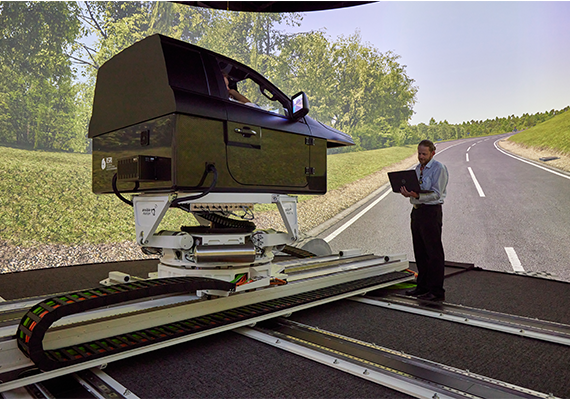
Abstract The performance of electroencephalograph (EEG)-based brain-computer interface (BCI) systems is susceptible to external influences, typically due to movement of the subject. Static flight simulators are the norm for this type of measurement in reduced risk flight training; however modern day simulators require a new level of realism. Next-generation flight simulators, such as the Deakin University Haptically Enabled Universal Motion Simulator, expose the pilot to external 'G' forces by physical moving the entire cockpit and pilot, motions which increase the likelihood of unwanted EEG artefacts. The filtering techniques are based on a custom designed approach to overcome the dynamic nature of the flight simulator; the techniques are based on Extended Kalman Filters to accommodate for the non-linearity of the EEG acquired signals. |
| Monday 20th February | Michael Fielding | The OzBot finds it's haptics
Abstract Mick will be talking about some of the work CISR has undertaken in the area of haptics and robotics within the Defence sector, with a particular focus on the OzTouch system. This talk is the second in a two part series on what happens behind the black doors downstairs in the 'Defence Lab', following on from James Mullins' presentation titled "The OzBot mobile platform - 7 years of development". |
| Monday 13th February | James Mullins | The OzBot mobile platform - 7 years of development
Abstract James will be talking about the advances and challenges involved with the design, development and marketing of the CISR OzBot platform. He will talk about the development process, the technologies involved, timeframes and future opportunities. The OzBot series of police and military robots have been developed by a team of CISR engineers specifically for Australian conditions and needs. This talk is the first in a two part series on what happens behind the black doors downstairs in the 'Defence Lab'. |
| Monday 6th February | Nong Gu | Blind Signal Processing: Methods and Application
Abstract Blind signal processing (BSP) is an emerging area of research in signal processing with many potential applications. The basic of objective of the BSP is to recover a set of source signals from a set of observations that are mixtures of the sources with no, or very limited knowledge about the mixture structure and source signals. Depending on the model to be studied, the BSP problem could be classified into two groups, which are blind source separation and blind equalization respectively. Some recent progresses in the research of BSP will be covered in this talk. |