
If you have any questions about our media releases or would like to connect with a member of our team, please reach out to us.
Deakin and Ford transform Ranger Super Duty into rapid-response fire unit in 12 weeks
Media release
16 October 2026
Seven minutes and 42 seconds. That is the benchmark response for an urban structure fire. Project Fire Response Unit set out to make it five.
When a fire takes hold or a serious road collision occurs, every minute matters.
But as communities grow and development pushes further into bushland, getting the right capability to the scene is becoming harder. Full-sized fire appliances remain essential, but narrow streets, heavy traffic and difficult terrain can slow their arrival.
Ford Australia and Deakin University asked a simple question: could the Ranger Super Duty help trained responders and critical equipment reach an incident sooner?
Twelve weeks later, the answer became “Project Fire Response Unit” – a collaboration to create a Fire Response Unit custom build1, designed to carry two trained responders, 800 litres of water and critical equipment, ready to act while larger appliances are still on the way.
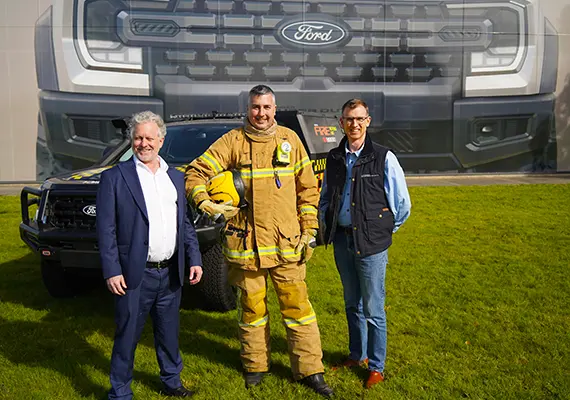
Project Fire Response Unit: Innovation in action
‘Project Fire Response Unit brings frontline insight, Deakin expertise and Ford engineering together to deliver faster, more agile emergency response when every second counts,’ said Dr James Mullins, Director Strategic Partnerships, Deakin University. ‘It shows how strategic partnerships can rapidly turn innovation into real-world protection for firefighters and communities.’
Built on the Ford Ranger Super Duty Super Cab, it combines the agility of a ute with the capability of a compact fire appliance. Its 4,500kg Gross Vehicle Mass (GVM)2, strong payload capacity and off-road durability allow it to carry firefighting, first-aid and communications equipment into places larger trucks may struggle to reach.
An integrated electric power system operates its pumps without a separate generator, reducing auxiliary noise, emissions and complexity.
Designed to complement, not replace, traditional fire trucks, Project Fire Response Unit enables trained responders to assess the scene, establish communications, provide first aid and begin initial fire suppression before larger appliances arrive.
Project Fire Response Unit is a collaborative effort
Project Fire Response Unit demonstrates Deakin’s new Collaborative Innovation Ecosystem model: start with a real-world problem, place end users at the centre and bring together the right industry, academic, government and community strategic partnerships to solve it.
Ford Australia contributed its automotive engineering excellence and the Ranger Super Duty platform. Deakin brought academic rigour, digital engineering capability and advanced simulation and prototyping resources. Zeliox Australia supplied the integrated electric power system, while XL Service Bodies designed and built the customised service body.
‘Ford Ranger Super Duty Fire Response Unit shows what Ford and Deakin can achieve together: a real-world problem solved in just 12 weeks, built on 40 years of partnership and local engineering excellence in Geelong,’ said Fadi Mawal, President and Chief Executive Officer of Ford Australia and Ford New Zealand. ‘This is Ford Australia at its best – and our commitment to Australia's emergency services has never been stronger.’
Most importantly, frontline responders shaped the vehicle’s purpose, equipment and layout, while feedback from the emergency services sector helped validate the concept.
Deakin Institute for Intelligent Systems used advanced computer-aided design and full-scale virtual reality to develop, simulate and test the concept before the physical build, moving rapidly into prototyping, engineering and testing.
‘Working alongside Ford, this project demonstrates how we integrate systems thinking, engineering expertise and human-centred design to better understand complex systems and deliver a solution in a matter of weeks rather than the typical research and development cycle that can take years,’ said Professor Doug Creighton, Director of the Deakin Institute for Intelligent Systems.
Built in Geelong
Project Fire Response Unit was designed, developed and built in Geelong – drawing on the region’s proud manufacturing heritage, engineering excellence and ingenuity.
Ford Australia and Deakin University are proud to be part of Geelong’s story, bringing together local talent, advanced manufacturing innovation and industry expertise to create solutions with national and global impact.
40 years of Ford-Deakin Partnership
Project Fire Response Unit is the latest evolution of a partnership between Ford Australia and Deakin University spanning four decades.
It began in the 1980s, when the organisations pioneered an industry-based engineering program allowing students to work at Ford while completing their university studies. Since then, the partnership has expanded across education, employability, research and innovation, including more than 80 significant projects in advanced materials, intelligent systems, sustainable mobility, electrification and autonomous technologies.
Four decades of collaboration built the trust to move quickly, assemble the right expertise and turn a real-world challenge into a working prototype.
Project Fire Response Unit is Deakin’s translation-at-pace model in action: a real-world problem, the right partners and a tangible solution designed around the people who will use it. It shows how Deakin’s collaborative innovation ecosystem model translates ideas into real-world impact at pace and scale.
Launch:
Project Fire Response Unit was unveiled at the AFAC emergency management conference in Melbourne last week. The concept will help inform further discussion with emergency services and industry about how smaller, agile response vehicles could complement existing firefighting fleets and help trained responders reach incidents sooner.
Disclaimer
1. The Ford Ranger Super Duty Fire Response Unit is a custom build developed for demonstration purposes. It has not been certified by any fire or emergency service authority.
2 Gross Vehicle Mass is the maximum allowable weight of a vehicle including any load transported by the vehicle, including tow ball down weight of a trailer but excluding the weight of a trailer itself. GCM is the maximum allowable weight of the vehicle and its trailer. Subject to state and territory regulations. Stated vehicle weights are approximate and subject to individual variances. Vehicles should be weighed before and after adding any load to ensure the maximum GVM, GCM and Gross Axle Weight Ratings are not exceeded.