
Deakin Professor awarded best Australian research published in 2025
Media release
23 April 2026
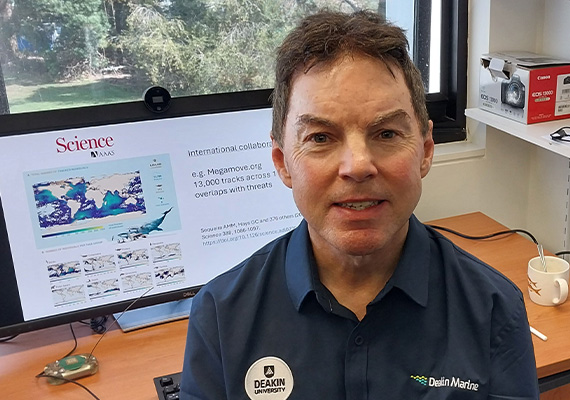
Deakin Distinguished Professor and Chair in Marine Science Graeme Hays has been recognised by the Australian Academy of Science for contributing to the best published research work of 2025, following the selection of a landmark paper published in Science that brings together global solutions to climate change and biodiversity loss.
The research paper, Global tracking of marine megafauna space use reveals how to achieve conservation targets, was authored by an international team of eight scientists as part of the global Megamove program, which uses large‑scale animal tracking to inform conservation action.
Professor Hays is the only Deakin University researcher recognised as part of the award.
Collectively, the work represents one of the most ambitious ecological tracking efforts ever undertaken, drawing on more than a billion dollars’ worth of global animal‑tracking data to better protect species that move across international boundaries.
Tide turning for sea turtles
Professor Hays’ contribution focuses on sea turtles, once on the brink of extinction and now widely recognised as one of the world’s most significant conservation recovery stories.
‘Large marine animals, including sea turtles, fish, mammals and birds, can move huge distances in the global ocean, often in the high seas in areas beyond national jurisdiction, which makes their conservation challenging,’ Professor Hays said.
For more than two decades, Professor Hays has tracked sea turtles across the Mediterranean, Caribbean, Atlantic and Indian oceans, using satellite technology to identify global migration routes and critical feeding areas. When combined with tracking data from other species and researchers, this work has delivered the most comprehensive global synthesis to date of important marine habitats.
‘By combining my datasets with those of other researchers and across many different species, our global collaboration has provided the clearest picture yet of where protection is needed most and is helping drive conservation planning across the globe,’ he said.
One notable example is Professor Hays’ work in the Chagos Archipelago in the Indian Ocean, where tracking data revealed the region to be one of the most important foraging grounds in the world for critically endangered hawksbill turtles. This research informed the reinforcement of one of the world’s largest marine protected areas and underpinned a commitment by the Government of Mauritius to create a protected zone of more than 600,000 square kilometres — twice the size of Victoria — should sovereignty of the region transfer.
‘This ground‑breaking work has highlighted the value of global collaborations to help rebuild marine life,’ Professor Hays said.
By demonstrating how large‑scale animal‑tracking data can directly inform the creation and strengthening of marine protected areas, Professor Hays’ research has helped support one of the greatest conservation successes of modern times — contributing to the global recovery of sea turtles from near extinction to flourishing populations in many regions of the world.
Media contact
If you have any questions about our media releases or would like to connect with a member of our team, please reach out to us.
Tania Palich
0497 833 231
Email Tania