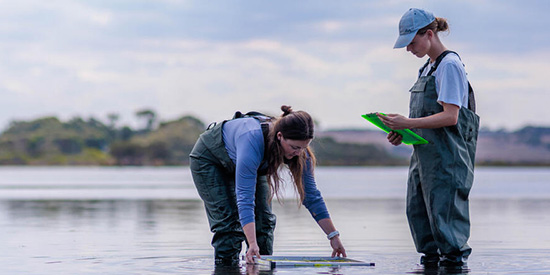
Pearl among the kelp: Why one graduate researcher is fighting for golden kelp
The chilly waters of southern New South Wales are teeming with life. Beneath the steely surface, towering forests of golden kelp sway in the currents, offering shelter to leatherjackets and blue gropers, hawksbills and green turtles and an undergrowth of sponges and algae.
The ancient ecosystem isn’t just paradise for sea life, though – it’s a special place for Pearl Mitchell, a graduate researcher in marine microbiology with Deakin Marine. Driven by a passion for cold-water reefs and sustainability, Mitchell focuses her research on the bacteria of golden kelp and why the species is such a vital foundation for underwater ecosystems.
Australia’s cold-water reefs: our unsung heroes
From her earliest days on the south coast of New South Wales, it seems the cold ocean waters have always call to Mitchell.
‘Growing up in Moruya was just the best because, as a child, I was free range,’ she says. ‘I went snorkelling a lot with my dad around the rocky reef area. Looking at the kelp, I remember thinking, “That is so cool”. It felt like an alien planet. I think from then on, I was pretty locked in to doing marine science.’
Despite the restless exploration of her childhood, Mitchell says that she didn’t fully appreciate her local rocky reefs until she went diving in the tropics. With their technicolour coral and famous fish, Australia’s tropical reefs are natural headline grabbers – but Mitchell hopes her passion for cold-climate reefs inspires similar interest in others.
‘People like to romanticise the Great Barrier Reef and that’s fair enough,’ she says. ‘But I think I would like some more attention on kelp forests in general and more public awareness around cold-water reefs.’
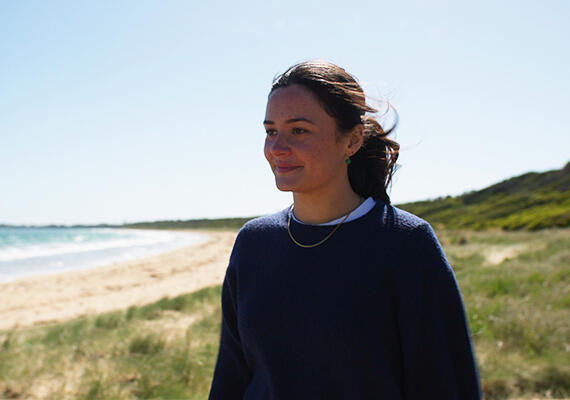
Explore the kelp forests with Pearl
Go beneath the surface with Pearl Mitchell as she reflects on how childhood snorkelling trips with her dad sparked her passion for the ocean and inspired her to champion kelp forests and Australia’s cold-water reefs.
Pearl Mitchell’s research project
While they might not yet be on the public radar, Mitchell is bringing attention to Australia’s cold-water reefs through her Deakin Marine research project .
‘My project is about assessing the bacterial component of golden kelp and its microbiome for the purposes of enhancing restoration,’ she says.
Why is golden kelp so important?
Mitchell calls kelp a ‘foundational species’ – essentially, one of those vital forms of life that form the basis of ecosystems for a range of other species. For instance, a range of high commercial species like rock lobster and abalone rely on kelp forests for habitat. The degradation of kelp habitats threatens the sustainability of these fisheries, with flow-on consequences for regional employment, export income and the wellbeing of coastal communities.
‘It helps the ecosystem services, draws carbon out of the atmosphere like any plant and releases oxygen through that,’ Mitchell says of golden kelp.
Beyond storing carbon, these ecosystems are essential for buffering wave energy, protecting coastlines from storm surges and supporting nutrient cycling processes that help mitigate nutrient pollution and sustain healthy coastal waters.
Where is golden kelp found?
Golden kelp is found all over the world – from the Canary Islands to the Middle East and Subantarctic islands. In Australia, golden kelp spans more than 8000km of our southern coast as part of the Great Southern Reef.
‘It borders a massive coastline like in Australia, and it’s one of the main habitat-forming species on the Great Southern Reef,’ says Mitchell. ‘That means it essentially acts like a forest.’ So, its impact is great.
From Moruya to the world
Beyond the lab and Australian waters, Mitchell’s marine science research is taking her around the globe. Late last year, she had the opportunity to attend the 2025 United Nations Climate Change Conference in Brazil as a part of an external fellowship policy program called Global Voices. As Simon Stiell, Executive Secretary of the UNFCCC told the conference, the global gathering is a vital step in arresting climate change.
‘Climate cooperation is alive and kicking, keeping humanity in the fight for a livable planet with a firm resolve to keep 1.5C within reach,’ Stiell said.
For Mitchell, attending the conference was an exciting extension of her graduate research on golden kelp. It also reinforced one of her most important life lessons – that caring for the environment should be a core principle.
‘My dad, having an Indigenous connection to Malaysia, would always talk about the importance of stewardship and First Nations people caring for the environment and what we can learn from them,’ Mitchell says. ‘Just caring in general, whether that's for the environment or for people, I think that's instilled a strong sense of ethics and ethos into me.
'I choose to work across so many different sectors because meaningful change requires understanding each player, how they operate and how they influence one another,' she says. 'By approaching the ocean through this wider lens, I hope to help shape solutions that are not only ecologically sound but socially and economically resilient.'
I believe the future demands that young people critically engage with the systems they inherit. For me, that means moving beyond a focus on just restoration and instead understanding these environments as part of a broader ecosystem that intersects with the economy, community wellbeing and scientific innovation.
Graduate researcher
How kelp restoration can help the environment
Life below the waves might seem out of reach for most of us – but its importance can’t be understated. And while a species like golden kelp makes up just a tiny slice of the ecosystem, life in our cold-water reefs can’t survive without it. It’s why Mitchell is committing her research to its restoration and rehabilitation.
Beyond her passionate research though, Mitchell is also keen to share the idea that academia is not the exclusive domain of high achievers. She hopes to show others – particularly other women – that post-graduate studies are very much attainable.
‘As long as you're passionate about the area that you want to do and you want to learn, I think that's the most important thing,’ she says.
Want to learn more about how Deakin’s research is shaping the future of our oceans? Discover Deakin Marine.