
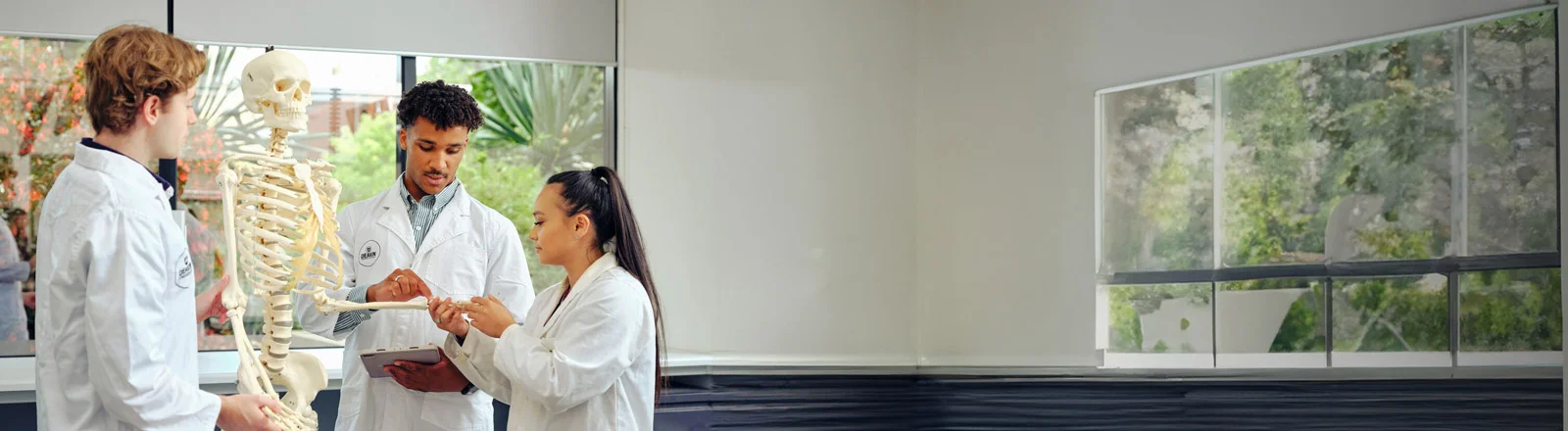

Focus on rural and regional medicine

#1 Victorian university for medicine employment

Inclusive pathways into medicine
Why choose medicine at Deakin
Study medicine in a program designed to improve the health and wellbeing of the communities we serve, by focussing on excellence, innovation and developing work readiness in our graduates. Deakin’s Doctor of Medicine has a distinctive focus on rural and regional medicine, Indigenous health, patient-centred care and service to marginalised communities, preparing you to make a meaningful difference through your future medical career.
From your first year, you will engage with a full-time study load to develop foundational knowledge in medical sciences, clinical practice, public health, ethics and Indigenous health while building the communication, clinical reasoning and professional skills essential for contemporary medical practice. In Years 1 and 2, through problem-based learning, interactive sessions and immersive hands-on laboratory and clinical experiences, you will learn to apply your knowledge on campus and in real healthcare settings and develop confidence working with patients, families and multidisciplinary healthcare teams.
In Years 3 and 4, students experience full-time clinical placements across hospitals, general practices and community health settings that provide opportunities to experience medicine across diverse populations and environments. In your final years, you will undertake full-time clinical training through one of Deakin’s medical school sites across Victoria, gaining hands-on experience that prepares you for professional practice, lifelong learning and a wide range of medical career pathways.
-
Strong regional and community focus
Study medicine and explore rural and regional healthcare, Indigenous health and the social factors that influence health and wellbeing.
-
Graduate ready for professional practice
Immersive clinical learning and strong connections across healthcare settings help prepare graduates for practice.
-
Join a medical school committed to inclusive pathways
Rural Training Stream and Indigenous Entry Stream pathways support students from rural, regional and Indigenous backgrounds pursuing a career in medicine.
-
Develop patient-centred medical practice skills
Strengthen communication, clinical reasoning and professional capabilities through problem-based and experiential learning.

Connected to industry
Deakin’s strong industry connections help shape your learning. Build practical experience in real workplace contexts through work-integrated learning, mentoring and networking opportunities. Industry advisory boards also help shape our degrees, which means what you study is current, relevant and aligned to what your future employers need.
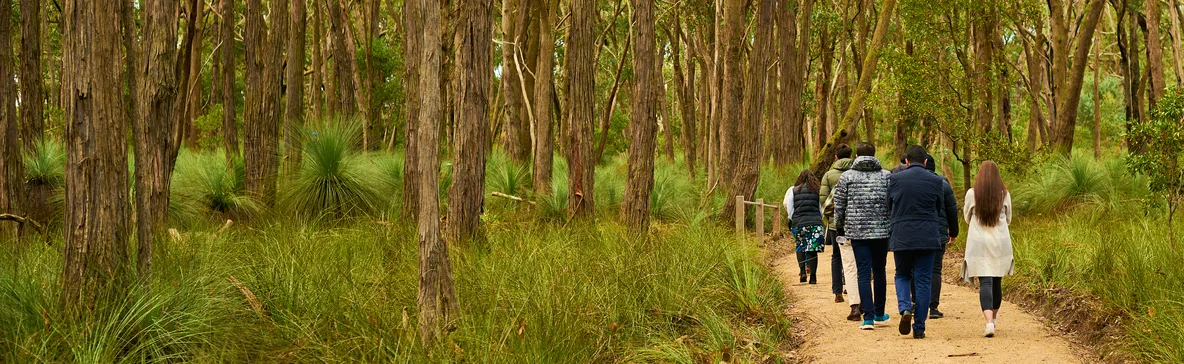
Deakin puts employability first
Career outcomes
Graduate ready to take the next step towards medical practice. Following internship and general registration, you can pursue further training across a broad range of medical careers, with Deakin's strong rural and regional focus preparing you to make an impact where doctors are needed most.
General practitioner
Provide comprehensive care across all stages of life, from prevention and diagnosis to treatment and ongoing health management. Following specialist GP training, you could practise in regional, rural and other communities.
- 33%
Occupation growth in 10 years
- $240k
Typical annual salary


Specialist physician
Diagnose and manage complex medical conditions in an area of specialist practice. After internship, general registration and specialist training, you could pursue fields such as cardiology, oncology, neurology, paediatrics or general medicine.
- 32.8%
Occupation growth in 10 years
- 15.9k
Specialist physicians employed

Other career opportunities
- Rural generalist
- Paediatrician
- Surgeon
- Pathologist
- Psychiatrist
- Emergency medicine specialist

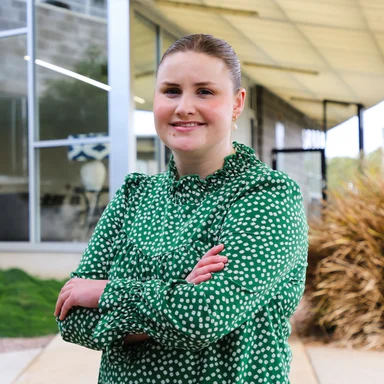

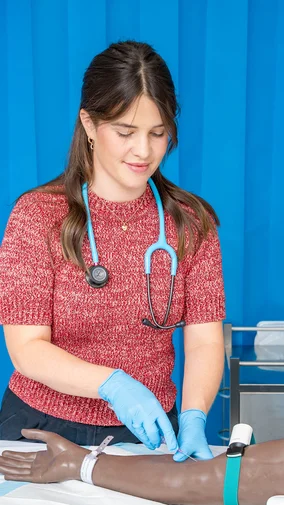
“I have always wanted to work in healthcare and I have seen first-hand the struggles faced by rural communities when it comes to accessing healthcare. My goal is to work in rural parts of Victoria and help to close the gap faced by these communities when it comes to accessing healthcare.”
ImogenDoctor of Medicine
Stories that start here
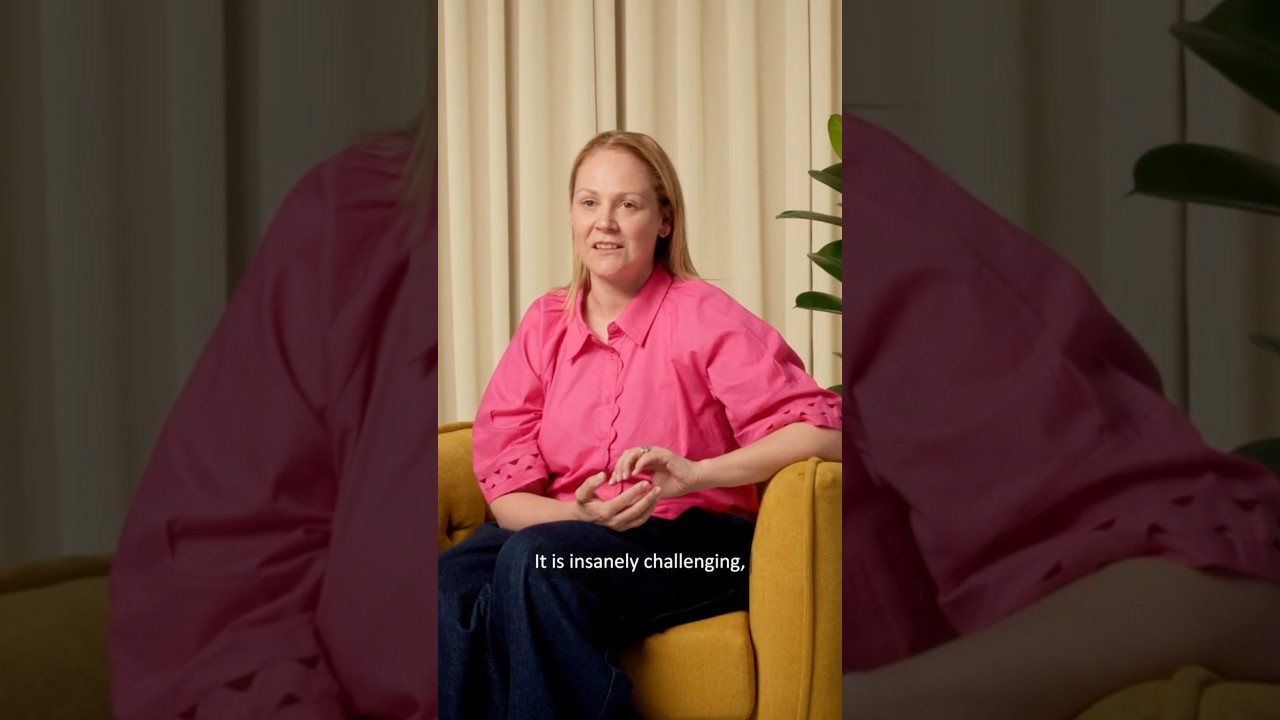

FAQs
No. Deakin does not give preference to applicants with a particular bachelor degree. Students from diverse academic backgrounds can apply for the Doctor of Medicine, provided they meet the current entry and selection requirements.
The GAMSAT is one part of the selection process for eligible Doctor of Medicine applicants. You do not need to complete a particular bachelor degree or study area to prepare for the test. GAMSAT assesses skills including reasoning, critical thinking and written communication. ACER provides official preparation materials and practice tests to help you understand the test format and question types.
If your bachelor degree results are not as strong as you’d hoped, eligible postgraduate coursework may contribute to your GPA calculation for Deakin’s Doctor of Medicine. This can include graduate certificate, graduate diploma and masters by coursework study. Check the current Doctor of Medicine entry requirements and GEMSAS Admissions Guide before choosing further study for this purpose.
The Rural Training Stream is a dedicated pathway for eligible applicants with a rural background who want to complete their medical training in regional and rural Victoria. Students who accept a Rural Training Stream place commit to undertaking all four years of the Doctor of Medicine through Deakin's rural training locations. Check the Rural Training Stream information for current eligibility and application requirements.
Yes. Deakin's Doctor of Medicine is accredited by the Australian Medical Council. Graduates are granted provisional registration as medical practitioners in Australia and New Zealand and are eligible to undertake a paid internship as part of the pathway towards full registration.
*Deakin references data from a range of government, higher education and reputable media sources. Learn more about our achievements on our University rankings page, or explore our sources page for supporting references.
100% of Deakin medicine graduates find full-time employment. Source: Graduates Outcomes Survey 2021-2023, Quality Indicators for Learning and Teaching (QILT), based on full-time employment for domestic medicine postgraduates
What will I study in the Doctor of Medicine?
The Doctor of Medicine (MD) develops the knowledge, clinical capabilities and professional skills required for contemporary medical practice. Through the foundations of medicine and professional practice of medicine phases, you will build confidence in patient-centred care while gaining immersive experience across hospitals, general practice and community healthcare settings.

Build foundations in medicine
Explore foundational medical sciences
Study human biology, infection, defence and repair, and cardiovascular, respiratory, renal and gastrointestinal systems.
Develop clinical reasoning and communication skills
Begin building the professional and patient-centred clinical and communication capabilities required for contemporary medical practice.
Learn through problem-based and experiential learning
Work collaboratively on clinical issues and build confidence in clinical practice, public health, ethics, law and professionalism, Indigenous Health and reflective practice.
Transition to clinical practice
Develop understanding of complex body systems
Explore metabolism and musculoskeletal systems, endocrine and lifecycle health, and brain and behaviour.
Strengthen readiness for clinical environments
Build confidence in clinical reasoning, foundational clinical skills and professional practice through Transition to Clinical Practice learning experiences.
Broaden your understanding of healthcare
Explore public health, ethics, law and Indigenous health while developing a holistic understanding of patient care and wellbeing.
Undertake immersive clinical placements
Complete core clinical rotations
Undertake rotations in medicine, surgery, children’s health, and obstetrics and gynaecology within healthcare services and Deakin Medical School clinical placement sites.
Learn through longitudinal and community-based care
Participate in the Longitudinal Integrated Clerkship and Primary and Community Care Programs to strengthen continuity of care and community healthcare delivery capabilities.
Develop hands-on clinical experience
Work with patients, families and multidisciplinary teams while undertaking authentic clinical tasks across diverse healthcare settings.
Consolidate professional medical practice
Undertake advanced clinical rotations
Build experience across general practice, emergency medicine, anaesthetics and intensive care, aged care, rehabilitation, palliative care and mental health.
Prepare for internship and professional practice
Complete two pre-internship rotations that develop readiness for the day-to-day responsibilities of working as a graduate doctor.
Expand your learning through research and clinical immersion
Participate in the Research Scholar Program while continuing immersive clinical training across a range of healthcare settings.
Course structure
To complete the Doctor of Medicine, you must pass 32 credit points.
As a full-time student you will study four credit points per semester and usually undertake two semesters per year.
Note:
- Students must pass all units including all components of units in the course. Assessments will involve a range of written and performative tasks and are structured to progress across the units of the course
- Students in the Doctor of Medicine may also enrol in an optional Extracurricular Research Program
Are you a current student? For course information that applies to the year you started your degree, visit the handbook.
All students are required to meet the University's academic progress and conduct requirements
Units
Year 1 - Semester 1
Year 1 - Semester 2
Year 2 - Semester 1
Year 2 - Semester 2
Year 3 - Semester 1
Year 3 - Semester 2
Year 4 - Semester 1
Year 4 - Semester 2
^Corequisite unit: HME911
Professional recognition
The Doctor of Medicine Program is accredited with the Australian Medical Council. Graduates of the Doctor of Medicine are granted provisional registration as a Medical Practitioner in Australia and New Zealand, and are eligible to undertake paid work as an Intern to become eligible for full registration. Domestic graduates are guaranteed an Internship position in Victoria.

What to expect while studying
All students are required to undertake a valid Police Check and Working with Children Check at the commencement of their course. Students who fail to do so prior to the commencement of clinical placement will not be able to undertake clinical placement and this will impede progress in the course.
Students are also required to declare their immunisation status to satisfy the requirements of health organisations where they will be undertaking their placement/ clinical learning experience. A health organisation may refuse to accept a student for placement if the student’s immunisation status is not satisfactory to the health organisation.
The School will provide commencing students with specific information on their compliance requirements.
As a student in the Doctor of Medicine program, you can expect to participate in a range of teaching activities each week. This could include lectures, small group learning activities, interactive sessions and clinical placements. You can refer to the individual unit details in the course structure for more information. You will also need to study and complete assessment tasks in your own time.
All four years of the Doctor of Medicine require a full-time study commitment, including located learning activities and personal study time. The School endeavours to provide timetables in advance of each semester to enable students to coordinate any work, caring, health or other requirements around course commitments.
The first two years of the Doctor of Medicine include face-to-face learning activities at Waurn Ponds (Geelong). In years one and two, students learn in simulated clinical environments and dedicated medical sciences teaching spaces, along with small group learning sessions. Teaching activities will be conducted both online and face-to-face. Students will also be exposed to clinical experiences from early in the course, through placements with healthcare providers.
During years three and four students will undergo intensive clinical training within health services attached to one of the following Deakin Medical School sites: Eastern Health, Geelong – Barwon, the Rural Communities, Warrnambool – South West, or Ballarat – Grampians. Students will conduct their learning in the clinical environment, guided by experienced staff associated with the clinical schools. See individual unit descriptions for full details.
Students who accept a position in the Doctor of Medicine through the Rural Training Stream make a commitment to undertake the first two years of their course at either our Warrnambool Campus or the East Grampians Health Service in Ararat. Years three and four of their course will then be conducted through one of our 3 rural Deakin Medical School Sites.
The School of Medicine encourages potential applicants who have a disability or ongoing health condition to reach out for a confidential and constructive discussion regarding the requirements of the course and the potential for any reasonable accommodations. Please contact the School of Medicine
Students in the Doctor of Medicine may also enrol in an optional Extracurricular Research Program.
At Deakin, we're committed to ensuring an inclusive environment that supports all students to belong, thrive and succeed. We work closely with students, where needed, to identify potential barriers to participation and where possible, provide tailored support so students can engage with learning and assessment activities.
If you are neurodivergent, have a disability, health condition or mental health condition that may impact your study or participation in university life, and want to know how Deakin could support you, contact our Domestic students (opens in a new window) or International students (opens in a new window) or Disability Resource Centre (opens email client) teams for a collaborative and confidential discussion. This discussion is to support you to make plans for your studies and future career and will not have any bearing on your application to the course.
When can I start?
The first two years will be undertaken at the Geelong Waurn Ponds Campus for General Entry Stream students, or either Ararat or Warrnambool for Rural Training Stream students. Years 3 & 4 for all students will be undertaken at one of our Deakin Medical School sites. For students in the Rural Training Stream, years 3 & 4 must be undertaken at a rural site.
Your course learning outcomes describe the knowledge, skills and capabilities you’ll develop and be able to demonstrate by the time you graduate. Built into your course through your units and assessments, they provide a clear picture of what you’ll be equipped to know, understand and do – preparing you to apply your learning with confidence beyond university.
| Course Learning Outcomes |
|---|
| Diagnose and manage clinical conditions, and carry out practical procedures to provide safe patient care. |
| Select appropriate communication modes to share complex knowledge and concepts with patients, carers, colleagues and communities. |
| Use digital technology responsibly to enhance medical practice. |
| Critically appraise and apply knowledge to problem solve and make sound professional and patient care decisions. |
| Formulate healthcare solutions using research skills to evaluate, interpret and implement evidence-based practice. |
| Demonstrate professional obligation and responsibility to patients, the profession and self as work ready doctors; and show a life-long commitment to reflective learning through practice, research and teaching. |
| Demonstrate collaborative practice within a health care team to provide safe, high quality medical care. |
| Prioritise prevention and implement holistic approaches to enhance the health and well-being of individuals, communities and populations; advocate for public health and demonstrate a commitment to advancing the health and well-being of rural, remote, Indigenous and marginalised individuals and communities. |
- Award granted
- Doctor of Medicine
- Year
2027 course information
- Deakin code
- H911
- Level
- Higher Degree Coursework (Masters and Doctorates)
- Australian Qualifications Framework (AQF) recognition
The award conferred upon completion is recognised in the Australian Qualifications Framework at Level 9
Fees
Estimated tuition fee
$14,046
for 1 yr full-time - Commonwealth Supported Place (CSP)
The estimated tuition (student contribution) fee above is based on a typical first-year full-time enrolment of 8 credit points and is provided as a guide only. Your student contribution is determined by the units you enrol in and will vary depending on the units you choose, your study load, the course duration, and any approved recognition of prior learning. You may also be eligible for a HECS-HELP loan to defer payment of all or part of your student contribution.
Important notice: The Australian Government caps Commonwealth Supported Places (CSP) for the Doctor of Medicine. If you are an international student enrolled in this course past your first study period, and transfer from an international student visa or other temporary visa to a permanent visa, you are unlikely to receive a CSP place. You would still be eligible for a domestic full fee-paying place; however, any scholarship or bursary held as an international student will not be transferred if you change from an international to a domestic student.

Scholarships
A Deakin scholarship can open the door to new opportunities. Whether you have something unique to offer or simply need a bit of extra support to reach your goals, we’re here to help. Scholarships can assist with course fees, living costs and study materials – so you can focus on achieving your best.
Damion Drapac Scholarship for Vocational Doctors
This $15,000 per year scholarship is for students commencing the Doctor of Medicine who are from medically underserved populations and can demonstrate a genuine passion for community medicine. If you are experiencing financial limitations due to personal barriers, then this scholarship is for you.
Apply now

Apply through GEMSAS
Most domestic applications to the Doctor of Medicine, including Rural Training Stream applications, are made through the Graduate Entry Medical School Admissions System (GEMSAS).

Apply through the Indigenous Entry Stream
Aboriginal and/or Torres Strait Islander applicants can apply directly to Deakin through the Indigenous Entry Stream. Check your eligibility, application requirements and how to apply.
Recognition of prior learning
Due to the prescribed structure and specific learning requirements of this course, recognition of prior learning (RPL) is not available.