
The text of this article is licensed under the Creative Commons Attribution (CC BY) 4.0 International license. We'd love for you to share it, so feel free. Images, videos, graphics and logos are not covered by the CC BY license and may not be used without permission from Deakin or the respective copyright holder. For more information on how to share or reuse this content, please contact researchcomms@deakin.edu.au.
Between Us: Dr Akari Nakai Kidd and Dr David Giles
Research news
3 November 2025
An architectural academic and an anthropologist. At first glance, you might think it odd that they have anything in common, but in reality, Dr Akari Nakai Kidd and Dr David Giles are two different sides of the same coin – dedicated to researching homelessness and bringing their unique perspective to the table.
Where David brings a burst of colourful, excited energy, Akari brings a calm and considered response. These differences are their strengths, each of them providing the balance needed for a harmonious partnership.
David and Akari were both early career researchers when they joined Deakin University in 2016, but their paths wouldn’t cross until a few years later, once they both joined HOME Research Centre,working to solve complex problems around affordable housing, homelessness and social inclusion.
Now, David is a Senior Lecturer in the School of Humanities and Social Sciences, with a focus on anthropology. Akari is a Senior Lecturer in the School of Architecture and Built Environment and the Master of Architecture Program Director.
They recently co-led a research project to evaluate the Geelong-based homelessness service providers and the challenges they are facing. Their report, Home Truths: Local Insights into Homelessness, provides recommendations across five ‘Home Truths’ or priority areas for systemic improvement.
Dr David Giles
As a kid, I was a people-watcher. I moved to the United States at age 10 and to figure out my place, I had to do what I later learned was ethnography (participating and observing in a society). Many people become anthropologists in spirit through early experiences of mobility and displacement.
My first real conversation with Akari was during a HOME workshop. During the pandemic, I interviewed unhoused people in emergency hotel accommodation and was figuring out next research steps. HOME encouraged us to swap notes and build out our ideas in different or unexpected ways.
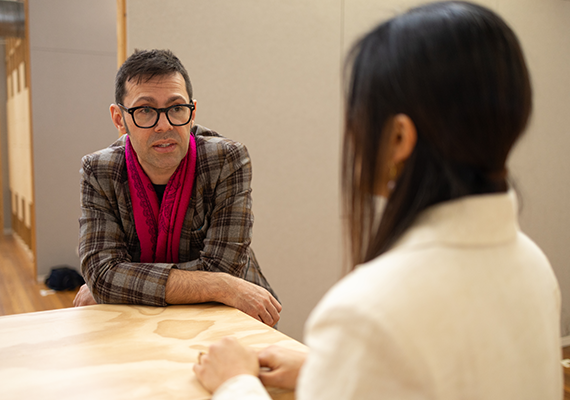
Akari and I discovered our shared interests in affect theory and the cultural dimensions of homemaking, though we approached them from different angles. That conversation made me think, ‘We’ll definitely work on a project together’.
We both bring a kind of Deleuzian openness to our work, thinking fluidly, embracing complexity, and approaching ideas in ‘both/and’ terms rather than ‘either/or’.
What inspires me is seeing Akari embody that same openness in a completely different way. I might approach things with technicolour chaos – a kind of Muppet-like whirlwind – while Akari brings calm, clarity, and precision.
Watching her think and work in her own distinct style is always inspiring. It’s a reminder that there are many ways to be open, creative, and thoughtful.
We’re a great team. We tag-team, building on what the other says. Akari is a really effective team player, which is rare. She’s really good at sitting back, observing, intervening where it’s useful in a genuinely convivial way. Our research team really needs that.
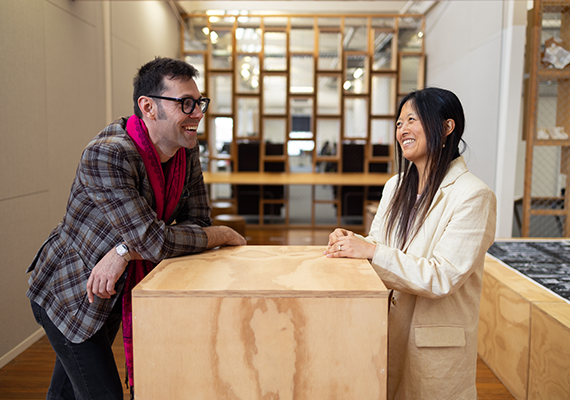
Our research asks, ‘How can the local system of services for people experiencing homelessness be made more accessible?’.
The system was built for a different problem, to catch people who fall through the cracks in a functioning housing market. But now, many are just a few pay cheques away from losing their homes.
I hope this research is one small contribution to the political will to fund and build better systems, that catch people before they ever need to sleep rough.
I think any good project ends in a different place than it started and you’ve got to move with it. The question itself grows over time, and you discover along the way what it’s really about.
If you're doing good interdisciplinary work, you're sort of always creating a Frankenstein's monster of an anthropological approach and an architectural approach. I think we had the right amount of yin and yang to make it work.
I hope this research is one small contribution to the political will to fund and build better systems, that catch people before they ever need to sleep rough.
Dr Akari Nakai Kidd
I remember flipping through newspapers as a child looking at house plans. I was mesmerised, though I didn’t know what architecture was. It was a few years after starting at Deakin that I was exploring homemaking through feminist theory, and a conversation with a colleague sparked my involvement with HOME.
I first met David at a HOME executive meeting. He reminded me of a character from Alice in Wonderland, like the Mad Hatter. He’s full of wisdom and wonderfully eccentric.
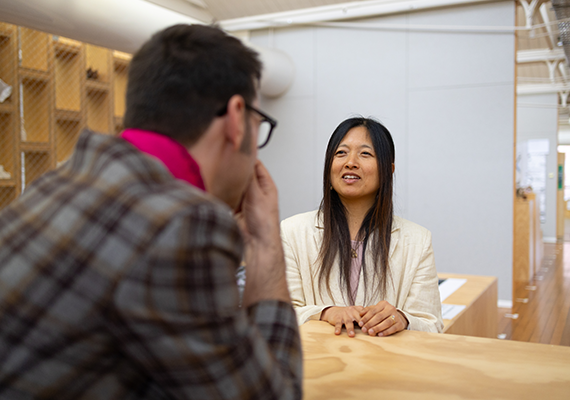
As someone who’s Japanese and quite ordered in my thinking, it was refreshing to meet someone who doesn’t follow that structure. Talking to David opened up new ways of thinking. That impression still holds true.
Co-leading our recent project meant lots of communication and deep thinking. We’ve built a partnership based on trust, respect, and honesty. We’ve shared personal aspects of our lives, and David’s understanding of my busy family life has been appreciated. It feels like a long-term collaboration, not a one-off.
Earlier this year, David’s train was delayed before a radio interview. David asked if I could go on solo, and I thought, ‘Absolutely not’. This project isn’t about solo voices; it’s about facilitating many voices. The delay worked in our favour. The frontline workers were interviewed first, reversing the hierarchy and giving their voices priority.
It reminded me that things often work out, even when they seem chaotic. That’s the magic of working with David, there’s a kind of trust that it’ll all come together.
Our research is already making an impact. During our community knowledge-exchange workshops, the City of Greater Geelong restarted its Homelessness Working Group, using the five Home Truths as a foundation.
One Home Truth was the need for collaboration and information sharing which is already happening through regular meetings. It’s rare to see impact before a report is released, and it’s a privilege to witness that.
I first met David at a HOME executive meeting. He reminded me of a character from Alice in Wonderland, like the Mad Hatter. He’s full of wisdom and wonderfully eccentric.
My hope is to see our research drive practical solutions that build a more coordinated, compassionate, and effective response to homelessness in Geelong.
What inspires me most is how David embodies the idea of being a threshold. In affect theory and Deleuzian thought, the self is a threshold – a point of transition. David is always becoming, always moving toward the next idea, the next conversation, the next project.
Even when something ends, like our report, it feels like it’s opening up more ‘and’s, more beginnings. That sense of perpetual becoming is beautiful. As researchers, colleagues and friends, I hope he continues to challenge me with that openness.
Read more about Akari and David’s Home Truths research project.