
The text of this article is licensed under the Creative Commons Attribution (CC BY) 4.0 International license. We'd love for you to share it, so feel free. Images, videos, graphics and logos are not covered by the CC BY license and may not be used without permission from Deakin or the respective copyright holder. For more information on how to share or reuse this content, please contact researchcomms@deakin.edu.au.
Between Us: Dr Louisa Smith and Dr Dino Hodge
Research news
14 November 2025
How many researchers have you met who say they solidified their working relationship by partying together at Pride celebrations in the Northern Territory? Well, you can now confidently add two to that mental tally.
An unlikely pair in many ways, but really just two peas in a pod, Dr Louisa Smith from Deakin University’s Institute for Health Transformation and external collaborator Dr Dino Hodge tackle hard topics in tandem with a sense of humour and humility.
They work together as part of a broader interdisciplinary team led by Louisa and are currently conducting a Medical Research Future Fund-supported national study called SAGE Dem (standing for ‘minority Sexuality And Gender Experiences Dementia’).
With dementia now being the leading cause of death in Australia, their four-year project is working to develop a world-first model of care for LGBTQ+ people living with dementia.
For Louisa and Dino, this important research is just one part of the bigger puzzle for the communities that they care about so much, and they approach every element of their work with admirable zeal.
Dr Louisa Smith
I originally met Dino through two colleagues who didn’t even know that they both knew him. The first time we met in person was over champagne to celebrate the promotion of one of these colleagues to Associate Professor.
The joy and respect of those festivities set the tone of our connection and future work together and the breadth and depth of Dino’s relationships is something that has impressed me about him ever since.
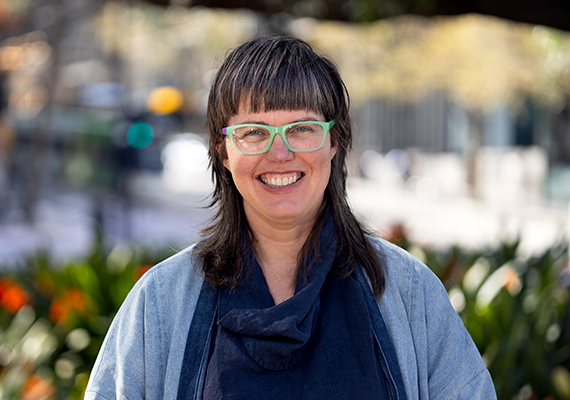
Dino and I are both passionate about LGBTQ+ people being seen and heard, so that our rights can be upheld. We’re also passionate about equality, inclusion and ensuring that the diversity of these communities is represented in the research that we do.
I originally invited Dino to join the team as a Chief Investigator because of his lived experience as a gay man who lives in a retirement village and who cares for two family members living with dementia.
He is also a researcher in his own right, with expertise in qualitative methods. That means he not only comes to meetings and responds to my questions about community, but he’s also able to provide insights about research approaches, samples and methods.
We’re taking an inclusive approach to SAGE Dem and have developed an ethnographic toolkit which allows us to engage people at all stages of dementia. We’re interested in seeing what kinds of care LGBTQ+ people living with dementia need and want, what is and isn’t working, and what they think would make them more comfortable.
Dino is part of the older communities of LGBTQ+ people who have been criminalised and pathologised for most of their lives. They’ve been subjected to violence and discrimination and also know many people who died from HIV/AIDS without receiving adequate care.
It’s not surprising, then, that this community fears dementia as it’s often experienced as a loss of control and choice, particularly in relation to where someone lives and who cares for them.
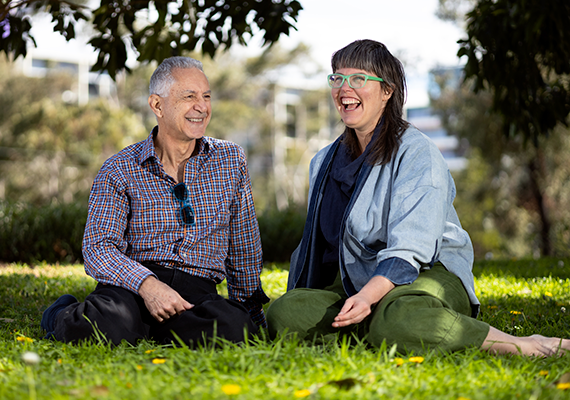
There’s so much to learn from any intergenerational friendship, but a queer one adds another resonance. This age difference is not only humbling and intriguing, but it also helps give me perspective when I’m talking to older participants in the project.
A standout experience of my time with Dino would definitely be attending Darwin Pride with him, a place he lived for nearly two decades. I loved going on his queer history walk where he made empty blocks come to life with rich pasts - I could almost hear the music of the underground drag shows.
For me, a successful collaborative relationship is one where there is mutual respect and trust, where there’s transparency and clarity, and where everyone is aware of their roles and responsibilities. I also think that successful relationships involve joy and celebration. That’s the foundation for sharing expertise that challenges, stretches and ultimately builds innovative and honest research.
Dino has an incredible capacity to bring people together, making them feel heard and seen. Just having him and our other lived experience experts as part of the project drives me to do justice to the stories that I’m being told.
Dr Dino Hodge
Louisa and I first met when she was in Melbourne for one of Deakin’s academic staff events, when one of our mutual friends invited me to meet up over drinks. It’s easy to feel comfortable and to open up to Louisa as she has an incredible skill of getting to the nub of research issues in a very human and embracing manner.
I was flattered to have been invited to contribute to the research project, but wasn’t sure what I could offer. Louisa gently outlined the project focus and showed me how my lived experience and community connections could be useful.
Over the past forty years I have been involved in qualitative research with migrants and refugees, First Nations populations and the LGBTQ+ communities at various times – I guess I can now add the community of seniors to the list!
My sister and I moved into a retirement village a few years ago so that I could continue to care for her as her dementia worsened, though she’s since relocated to residential care. I was initially cautious to reveal too much about myself to the other residents until I knew the lay of the land.
LGBTQ+ communities have historically been regarded by the professions as deviant, mentally ill and members of the criminal class, while religions broadly condemned us. Beginning with the liberation movements of the 1970s, a cultural paradigm shift has been underway, initially addressing decriminalisation and anti-discrimination, with later moves towards full equality and further acceptance.
This shift continues to be a work in progress, and I always say that until everyone equally has to ‘come out’ about their gender or sexuality, we have not yet reached a healthy position.
A very dear gay friend of mine with dementia is insistent that they are ready to die at home rather than face the prospect of moving into aged care.
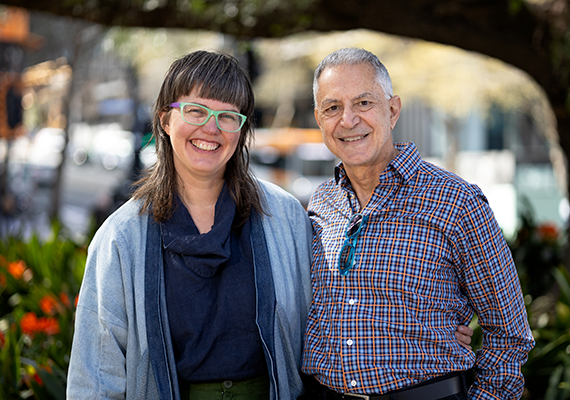
With SAGE Dem, I participate in committee meetings to discuss research design and implementation, review outcomes, and assist in recruitment for the project.
Louisa is highly attuned to the inclusion of First Nations and culturally and linguistically diverse peoples, as well as people from regional and remote geographic areas like the NT.
While the research addresses access and equity, its scope has broadened to include politics and history.
In a way, tracking the history of disenfranchisement of various communities together with the politics of community empowerment is moving beyond a deficit model. An appreciation of social justice, advocacy and celebration is inherent in such work.
Perhaps I’ve always been overly ambitious, but I hope the project means that fewer people need to sacrifice their gender or sexual identity, essentially going back into the closet, when dementia diminishes their capacity for independent living.
To say that active listening is necessary when working with particular communities belies the complex set of attributes this sort of research entails. Empathy, humour, integrity, a gentle touch, honesty, a quickness of mind, respect, courage, intellectual rigour and receptivity are all vital.
I hope that the outcomes of this project assist service providers, and also promotes happiness and comfort for people living with dementia, knowing that they are well-cared for, valued and cherished for who they are.