
The text of this article is licensed under the Creative Commons Attribution (CC BY) 4.0 International license. We'd love for you to share it, so feel free. Images, videos, graphics and logos are not covered by the CC BY license and may not be used without permission from Deakin or the respective copyright holder. For more information on how to share or reuse this content, please contact researchcomms@deakin.edu.au.
Deakin after dark: Nocturnal research helps crack criminal cases
Research news
30 October 2025
After dark research
Late at night, deep in her ‘blowfly bunker’ on Deakin University’s Waurn Ponds campus, Professor Michelle Harvey is surrounded by flies, maggots, blood and beef liver.
It could be a true crime scene but it’s a site of discovery and fascination for Professor Harvey.
'I grew up in the lush green rainforests outside Brisbane catching insects in a net, observing ants and climbing trees to find cicadas and stick insects.
‘So, when I stumbled into an entomology class at university, my childhood obsession with insects evolved naturally into a research passion and then a dream career,’ she says.
Now an entomology expert in Faculty of Science, Engineering and Built Environment (SEBE), Professor Harvey investigates blowflies and their behaviour on human remains.
It’s high-stakes research as the interaction between insects and decomposing flesh can pin-point a person’s time of death and even ‘crack’ challenging criminal cases.
Professor Harvey assists as a consultant to various external agencies including law enforcement where she applies her expertise to forensic scenarios.
And that’s the end game – using science to help unlock crime mysteries and ultimately achieve justice for the deceased person.
How flies and maggots solve crimes
Professor Harvey’s current focus is on the interaction between two types of flies – Lucilia sericata and Chrysomya rufifacies. This is critical as it could hold the key to knowing someone’s time of death.
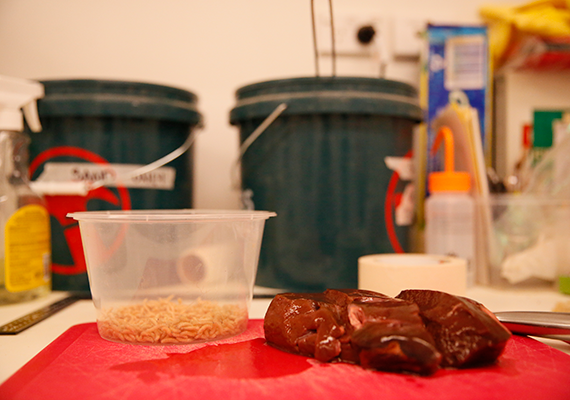
‘Rufifacies produce ravenous hairy maggots that devour the smooth sericata maggots,’ she says.
‘The sericata maggots are the first species on a corpse and the ones used to estimate time since death (PMI).
‘If the hairy maggots eat all the smooth maggots, no sericata maggots will remain on the body to make an accurate post-mortem assessment and this is a significant issue.’
Professor Harvey says that what attracts rufifacies to decaying flesh is not well understood.
‘Knowing whether they are attracted by the meat, the bacteria on it or the motivation to eat all the other maggots is critical in accurately estimating a person’s time of death,’ she says.
‘It comes down to investigating a crime scene as a snapshot in time. I arrive and collect insect evidence and then I interpret what I see and work backwards to determine what happened.
‘Understanding how blowflies behave and what might prompt them to eat each other is crucial to interpreting when the remains may have been deposited and this helps investigators determine a timeframe.’
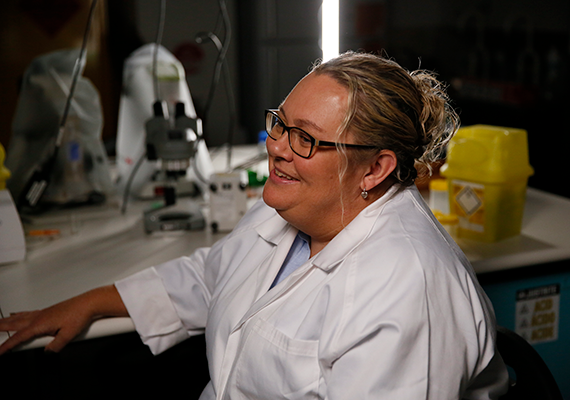
Enter the blowfly bunker
Step inside Professor Harvey's science lab and discover more about her fascinating 'after dark' research
Harvesting blowflies by moonlight
Much of Professor Harvey’s research is conducted after dark, not just in her lab but also in her garden during summer.
Each year, from Christmas to Australia Day, she is in her backyard after sunset with a torch sorting live blowflies out of traps into cages to take to the lab.
‘It's smelly work – my flies are attracted to rotting chicken – but it’s a critical step in my research process and it’s how I spend my annual leave at night each summer.
‘It occurs in the evening as the flies slow down and are easier to handle in the cool of the night.’
Professor Harvey takes her harvested flies back to her controlled lab and checks them at intervals around the clock to ensure ‘they’re happy’.
‘They like a solid 24 degrees, 40% humidity, 12 hours of light and 12 hours of dark, plus access to water, sugar and blood,’ she says.
‘My experiments involve observations and sampling day and night. I’ll be in the lab feeding the flies beef liver, checking meat is plentiful, removing dishes so we can count how they’ve laid, sampling and ensuring we don’t have any escapees.’
All these meticulous steps are aimed at understanding what conditions blowflies prefer and the factors that influence how they lay and feed.
A passion to inspire students
Professor Harvey says that forensic science is a fantastic vehicle to inspire students in science.
‘It’s an area where students can see the tangible nature of science and how it directly impacts lives, safety and society.
‘The Gippsland death-cap mushroom case is a perfect example of how the public are captivated by forensic science – it’s drawn intense media and public attention. Death cases intrigue people and the process of human decomposition and this is a major focus of my research.
‘I’ve been fortunate in my research to watch seven cadavers decompose from ‘day 0’ through to skeletal. Sharing this experience with students is unique and powerful.’
‘I try to keep a human angle to maintain empathy. I have a passion for helping people through science and that is at the centre of my research and teaching.’
Professor Harvey’s dark ‘blowfly bunker’ is not just a space for scientific discovery with real-world impact but a learning lab for Deakin students set to become our next forensic detectives.
She believes that students learn best by active engagement with material, so hands-on practicals and fieldwork are powerful as they can see and experience the things they hear about in lectures.
‘Analysing case studies and building confidence in students to think critically is so important,’ she says.
As Associate Dean Teaching and Learning in SEBE, Professor Harvey leads a faculty with dynamic teaching approaches, work integrated learning and incredible student outcomes.
‘I feel proud of the SEBE teaching and learning community and students, particularly our forensic graduates who use objective science to contribute to justice outcomes.’