
The text of this article is licensed under the Creative Commons Attribution (CC BY) 4.0 International license. We'd love for you to share it, so feel free. Images, videos, graphics and logos are not covered by the CC BY license and may not be used without permission from Deakin or the respective copyright holder. For more information on how to share or reuse this content, please contact researchcomms@deakin.edu.au.
Between Us: Associate Professor Al Fricker and Dr Bryan Fricker
Research news
28 September 2026
For father-and-son researchers and First Nations men Dr Bryan Fricker and Associate Professor Al Fricker, collaboration has always been about much more than co-authoring papers. It’s the culmination of a lifelong conversation spanning generations, communities, and institutions.
Having embarked on their undergraduate degrees within a couple of years of each other and studied in tandem, today both are leaders in their field. Their work at Deakin University’s National Indigenous Knowledges Education Research Innovation (NIKERI) Institute examines Indigenous knowledges, education and history.
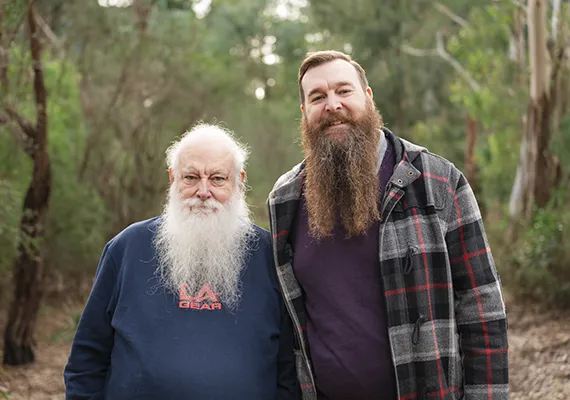
Both share a determination to improve outcomes for Aboriginal and Torres Strait Islander students and communities.
Their research explores how Australians engage with the past, how empathy and authenticity support truth-telling, and how education can become a vehicle for meaningful change.
Associate Professor Al Fricker
I was a fairly precocious student at school. Mum and dad made it very clear to me that when I finished school, if I expected to stay at home, I needed to either be working full time or studying full time.
I got into university then experienced something quite interesting: I was in my first year while dad was in his second year at the same uni.
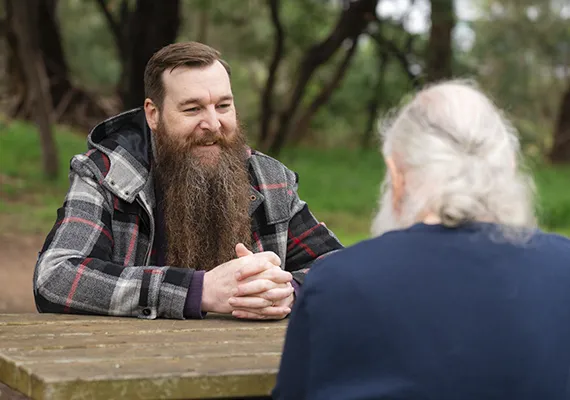
It was so lovely having dad blazing that trail for me, as he’d only just gone through all the bureaucracy and administration that I was now having to deal with.
It was also incredibly inspiring to see him getting so much out of it.
After my Arts degree I took a position in a master’s program to become a school teacher. As a First Nations teacher in a secondary school setting, however, I found myself becoming increasingly jaded.
I didn’t feel like the curriculum was accurate or authentic when it came to covering Aboriginal or Torres Strait content, especially as I had the honour of working with a handful of Mob kids as well.
Eventually I left the classroom and went back to uni to do my honours in Ancient World Studies. I then did my PhD research in a remote Aboriginal community called Papunya which allowed me to really circle back on my experiences as a school teacher.
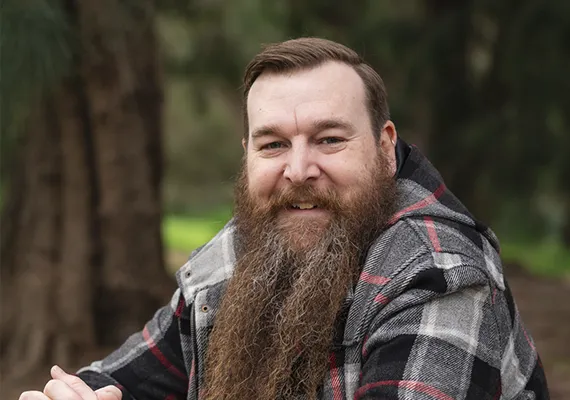
What has largely driven my PhD journey and research since then has been a strong desire to affect change within the schooling system in Victoria and hopefully Australia more broadly. I want to support the outcomes of Aboriginal and Torres Strait Islander students, but also non-Indigenous students, and build the capacity for teachers to engage with First Nations contexts appropriately and effectively.
My dad and I are working on a paper together at the moment, which is very exciting. I still pinch myself at just how fortunate I am to be able to do stuff with the old man. I know how rare that is in the sector and it’s something that I greatly, greatly cherish.
We’re looking to apply Albert Camus’ principle of radical authenticity to Australian history curriculum, and to build in a framework which we’ve called ‘relational historical consciousness’.
It would encourage teachers and students not to try to shape the events and people of the past to meet some kind of contemporary goal or aim, but instead to engage with them in authentic ways. We’re arguing that the recent drive for truth-telling alone may not be enough, because it doesn’t necessarily result in authentic, empathetic responses.
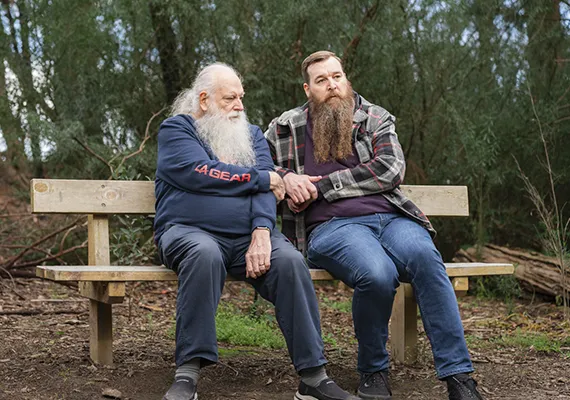
Dad and I have fairly similar working styles; occasionally we can’t help ourselves while catching up on weekends and will end up talking shop.
I think we've had the benefit of many years of really interesting, complex and robust conversations, which I'd like to think is reflected in the papers that we put together and the conversations that we have.
Last year we had the absolute privilege of being able to travel together to Aotearoa New Zealand to attend the World Indigenous Peoples Conference on Education. I always get very nervous presenting, so it was lovely having Dad in the audience while I was talking to a room full of international scholars.
Long term, what I really want to see as a result of our research is that every Aboriginal and Torres Strait Islander child or learner can enter any Australian classroom and have the same learning outcomes as their non-Indigenous peers.
It’s aspirational, but is it achievable? I don't know… but it's certainly something I'd like to contribute to.
Dr Bryan Fricker
As many First Nations people do, I came to university late in life. I was 46 when I started. I’d been in industry for 30 years – which is how long it took me to get over the aversion therapy to education I got at school.
I’d had my own business, sold it, and didn’t think of working again. But I often tended to be the go-to shoulder to cry on so I thought ‘alright, you can pay for the privilege’ and went and got a diploma in professional counselling.
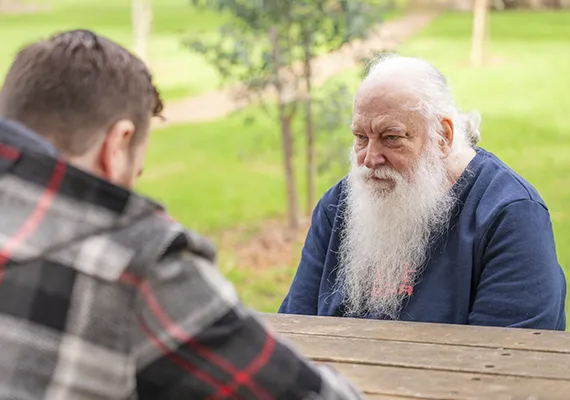
Then Al’s mum, a dreadful credentialist, suggested I get a degree.
I loved it at uni, so much that I stayed there for 12 years and came out at the end with a PhD. Eventually, a casual gig came up at Deakin, followed by a contract lecturing position, and then got tenure. I’ve been here ever since!
Al was working at another university at the time and hating it, and I’d heard that a position had come up at NIKERI so I said ‘Hey, put your hand up’. He did, and now he’s risen to the dizzy heights of Associate Professor while I’m a lowly senior lecturer.
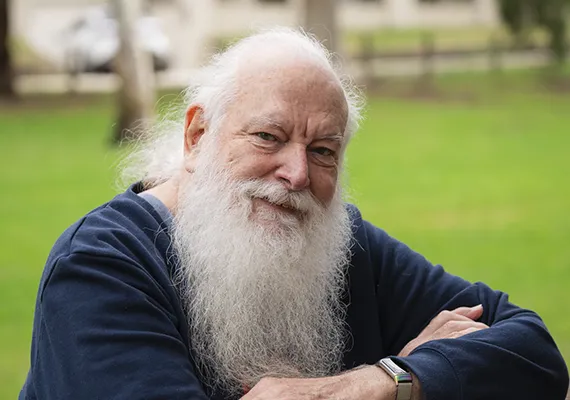
In terms of our research, we believe that history is not static, it’s dynamic. You can’t examine the past without going "Hey, let’s look at the present." Then you can’t avoid interrogating the present, and once you start interrogating the present, that then creates the future – and it just goes on.
You’ve got to go beyond the facts. You’ve got to get to the ‘why’ and then the ‘what now’.
Speaking of the past and present, there are actually more kids, especially in Victoria, being taken out of home now than they were at the height of the Stolen Generation.
This is why I talk about interrogating the past in such a way that will affect the present, because the present’s not always real flash.
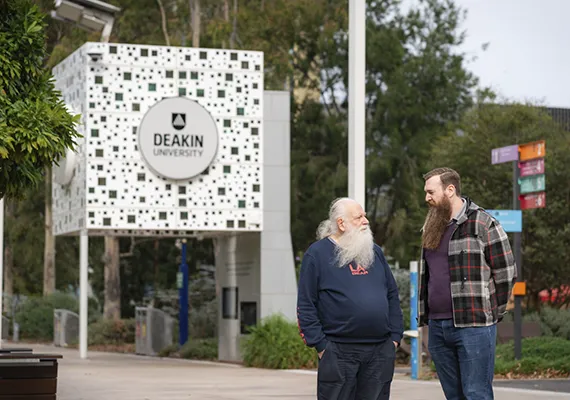
In our research together, Al and I regard each other as equals and that’s why it works so well.
My ambition for our work is one word: equity. That’s my driving thought, equity.
Al uses the word ‘wisdom’ which hits the nail on the head because learning doesn’t equal intelligence, and intelligence doesn’t equal wisdom.
Long term, if we can get to that final stage of wisdom, which is what’s behind the learning, that would be a good outcome.
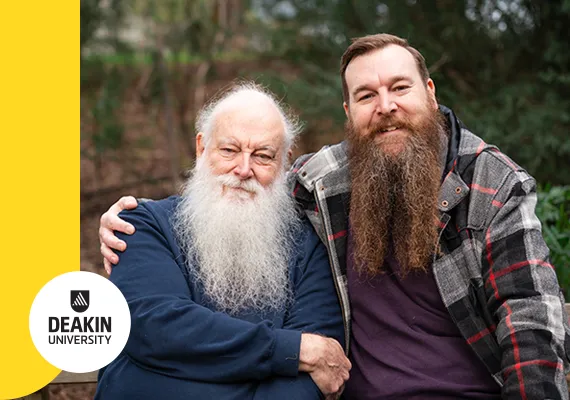
Discover more about Al and Bryan's relationship and research
Hear from Al and Bryan as they talk about their research, teaching styles, and what they've learnt from each other over the decades.