
The text of this article is licensed under the Creative Commons Attribution (CC BY) 4.0 International license. We'd love for you to share it, so feel free. Images, videos, graphics and logos are not covered by the CC BY license and may not be used without permission from Deakin or the respective copyright holder. For more information on how to share or reuse this content, please contact researchcomms@deakin.edu.au.
How bird movements are helping researchers track a global virus
Research news
31 August 2026
While the highly virulent avian influenza strain has only recently been discovered on Australian shores, researchers at Deakin University have been working behind the scenes for years, anticipating what an outbreak might look like.
One of those researchers, Dr Sara Ryding at the Deakin Centre for Marine Science, works predominantly with migratory shorebirds. She focuses on their movements, any changes in movement patterns, and what it might mean for disease risk for those birds and related species.
Over the years, she’s been working on modelling avian influenza outbreaks overseas and making predictions for Australia, with an upcoming research paper co-authored by Dr Tobias Ross and Professor Marcel Klaassen, examining the susceptibility of wild birds to bird flu.
A virus with far-reaching impacts
Bird flu has been present in nature for a long time – though mostly as low pathogenicity avian influenza (LPAI) which can cause mild respiratory and gastrointestinal infections in birds among other impacts.
Over time and under specific species pressures like the industrialisation of poultry, these types of viruses can mutate to become high pathogenicity avian influenza (HPAI) strains, such as the HPAI H5N1 bird flu strain now impacting wildlife across the globe.
As this virulent strain spreads, researchers like Dr Ryding are monitoring the situation closely.
‘In terms of birds, the easier question might be ‘which birds can’t be impacted by HPAI H5N1. That said, there are traits that seem to increase the risk of exposure to the virus,’ says Dr Ryding.
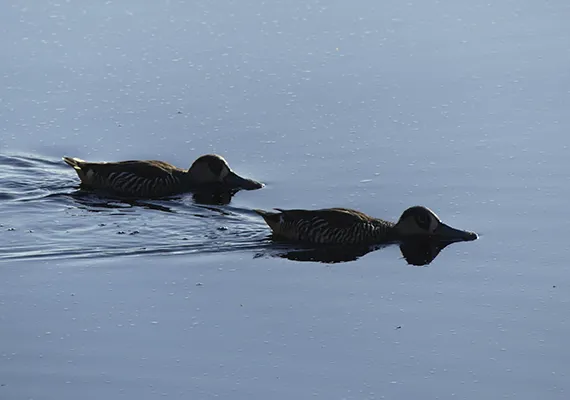
Key at-risk birds include seabirds like the Australasian gannet who nests in colonies, the pink-eared duck whose aquatic foraging brings them into contact with other bird faeces, birds of prey, and ravens and magpies that often scavenge dead or dying birds.
‘We have also seen huge impacts on marine mammals in South America, notably in sea lions.
‘The good thing is that lots of species show some capacity for developing antibodies after exposure, helping them potentially resist the virus much better if they re-encounter it,’ says Dr Ryding.
Flight paths of disease
Understanding how birds move through the environment is key to helping scientists track how the virus spreads.
‘With any strain of bird flu, but perhaps especially HPAI H5N1, it moves through landscapes via the movements of wild birds,’ says Dr Ryding.
Ongoing research uses AviFluMap, a H5 bird flu wild bird model tool for Australia’s wild birds. This is a publicly-available tool developed by Deakin alongside Wildlife Health Australia and Birdlife Australia that integrates multiple layers of information to provide a clear, evidence-based picture of known and emerging H5 bird flu risks.
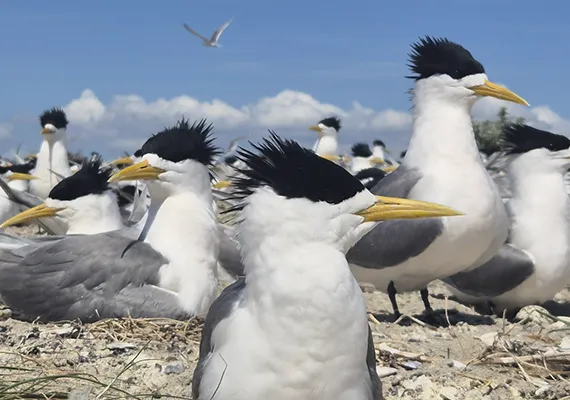
One key turning point of this current outbreak has been the discovery of deaths in greater crested terns. Dr Ryding explains this represented that the virus had moved from the giant petrels, marine birds that rarely visit the Australian mainland, to an Australian bird.
Since then, there have also been deaths in seals and dolphins, marking spread of the virus to Australian marine mammals.
The crucial role of citizen scientists
Australia is a huge country with very long coastlines that make monitoring a challenging task for any single agency to undertake.

‘Citizen scientists can fill crucial gaps in monitoring the virus spread. Indeed, what we know so far about where the virus is presenting is thanks to our citizen scientists,’ says Dr Ryding.
'Without their continued involvement, our understanding of the virus spread and impacts is going to be incredibly limited.’
She notes that while community input is key, it’s also important for people not to touch sick or dead birds and instead call the 24-hour Emergency Animal Disease Hotline (1800 675 888) and let trained specialists with appropriate PPE respond accordingly.
The HPAI H5N1 bird flu situation in Australia is rapidly unfolding, please check the Australian Government’s bird flu webpage for up-to-date information.
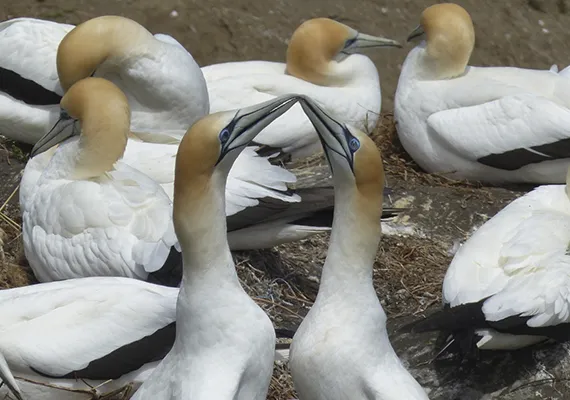
H5 Avian Influenza: What we know now
Dr Sara Ryding explains what we know about H5 avian influenza in Australia, what researchers are monitoring, and why wild bird populations are a key focus.
Bird photography by Dr Tobias Ross, all rights reserved. In order of appearance: Australasian gannet (banner), Pink-eared duck, Greater crested tern, Australasian gannet (video thumbnail).