
The text of this article is licensed under the Creative Commons Attribution (CC BY) 4.0 International license. We'd love for you to share it, so feel free. Images, videos, graphics and logos are not covered by the CC BY license and may not be used without permission from Deakin or the respective copyright holder. For more information on how to share or reuse this content, please contact researchcomms@deakin.edu.au.
Researchers redesigning carbon fibre for multifunctional energy storage
Research news
24 September 2026
Imagine if your car wasn’t powered by a typical battery situated in the engine, but rather powered by energy stored in the walls or even the roof of the vehicle itself?
This is a future that Dr Bhagya Dharmasiri and her colleagues at the Deakin Institute for Frontier Materials have been exploring, bringing load-bearing structures and rechargeable energy storage together to create structural battery composites.
They’re working to embed zinc-based energy storage into carbon fibre structures rather than the typical lithium-ion batteries found in many modern electronics, to make safer, better-performing electric cars, aeroplanes and more.
Rethinking strategic metals
Lithium and zinc are both critical metals for energy storage, but they have key differences in terms of their advantages and risks.
Although lithium-ion batteries can deliver a high volume of energy, they also pose a risk of fire or toxic gas release if incorrectly handled. This volatility can cause unexpected explosions and small fires as seen in recent years with portable chargers and e-bikes.
There are several approaches to mitigating these risks, including safer electrolytes and improved materials and battery design, which are also areas of ongoing research by Dr Dharmasiri and her colleagues.
Lithium remains an important energy-storage technology, and there are many ways we can make these systems safer. Zinc offers another promising approach, particularly where safety and sustainability are priorities.
While zinc stores less energy than lithium, it can use water-based electrolytes, reducing reliance on flammable components. Zinc is also abundant and recyclable, making it an attractive complementary option for safer, more sustainable structural batteries.
Embedding energy storage into carbon fibre
Renowned for its lightweight strength, carbon fibre is an ideal building material for structural battery composites, particularly for use in weight-sensitive sectors like electric vehicles, aerospace and defence.
As Dr Dharmasiri explains, ‘Traditionally, carbon fibre composites are designed to do one main job: carry mechanical loads while keeping structures lightweight. We are asking whether that same material can do more.’
In a recently published research paper, Dr Dharmasiri and her Deakin colleagues Dr James Randall and Professor Luke Henderson presented a scalable approach to redesigning conventional carbon fibre composites into multifunctional zinc structural batteries.
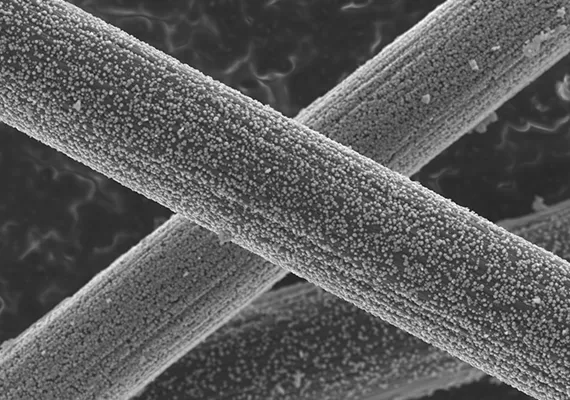
They do this by modifying carbon fibre surfaces to host electrochemically active materials for energy storage (electron microscopy images show the materials grafted onto the surface of carbon fibres).
‘Zinc is particularly interesting for structural batteries because performance is not simply about achieving the highest possible battery energy density,’ says Dr Dharmasiri.
‘A structural battery performs two functions simultaneously, so we need to consider what it contributes to the performance, safety and efficiency of the whole structure.’
At its core, this redesign process involves electrochemical surface modification of the carbon fibre, integrating electroactive zinc and manganese dioxide while maintaining mechanical integrity.
Materials of the future
Going forward, Dr Dharmasiri hopes to move from laboratory-scale zinc structural battery composites to building real engineering components where structural performance, energy storage, safety and multifunctionality are optimised together.
Reducing the number and weight of separate components could create lighter cars, airplanes, and defence crafts with greater range, endurance and functionality.
The same structure could potentially store energy, sense damage and provide electromagnetic protection. Rather than continuously adding separate components for every required task, we could design the material itself to perform several of those functions.
In bringing chemistry and materials engineering together, Dr Dharmasiri and her colleagues’ research aims to rethink what a structure can do.
Learn more about research at the Deakin Institute for Frontier Materials: deakin.edu.au/frontier-materials

How structural battery composites could transform new technology
Step inside the Deakin Institute for Frontier Materials to see how Dr Dharmasiri began her research career, and how this innovation could change the way we design and power future products.