
The text of this article is licensed under the Creative Commons Attribution (CC BY) 4.0 International license. We'd love for you to share it, so feel free. Images, videos, graphics and logos are not covered by the CC BY license and may not be used without permission from Deakin or the respective copyright holder. For more information on how to share or reuse this content, please contact researchcomms@deakin.edu.au.
Spinning seaweed into sweaters
Research news
17 June 2026
You may not realise it, but every time you wear, wash or dry your clothes, they’re shedding fibres which get into the air, your bedroom floor, your washing machine, and out into the world.
While this may not be an issue for items made of natural materials like 100% cotton or wool, many modern clothes are made of polyester blends that shed microplastics made from fossil fuels. These microplastics can cause long-term negative impacts such as health issues, environmental toxicity and harm to animals.
To create another natural alternative, researchers at the Deakin Institute for Frontier Materials are working with Australian startup Uluu to transform farmed seaweed into a new generation of sustainable and biodegradable textile fibres.
Circular economy collaboration
Uluu is a Western Australian company that’s fermenting seaweed and turning it into a natural polymer pellet that can mimic plastic.
They do this by breaking the seaweed down into sugars, feeding them to microbes which produce polyhydroxyalkanoates (PHAs, or biodegradable polyesters) before extracting them to make pellets ready for manufacturing.
The project brings Uluu’s biodegradable pellet technology together with Deakin’s globally-recognised textile research capabilities and facilities.
‘This collaboration with Uluu is a really excellent opportunity for circular economy,’ says Associate Professor Christopher Hurren.
You’ve got a material derived from the sea which can be turned into a fibre that will break down at its end-of-life to go back into the soil where it can once again grow back into a fibre.
Creating natural fibre alternatives
At the heart of this shared endeavour is a process known as melt extrusion. Deakin is the only Australian university that has filament melt extrusion and short staple spinning equipment in the lab.
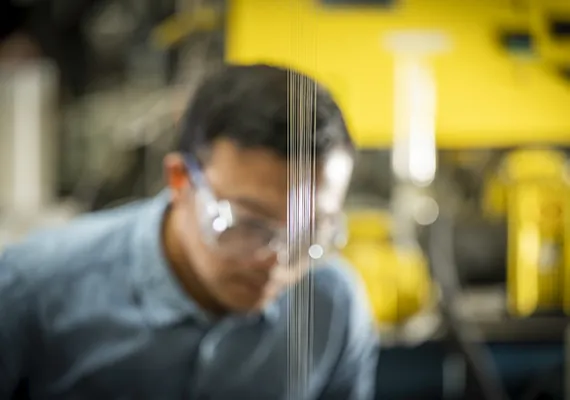
Researchers use heat and pressure to transform the Uluu polymer into a liquid which is then passed through a spinneret or die, like water through a showerhead.
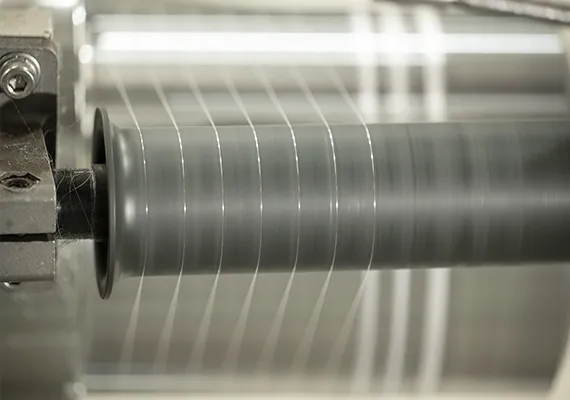
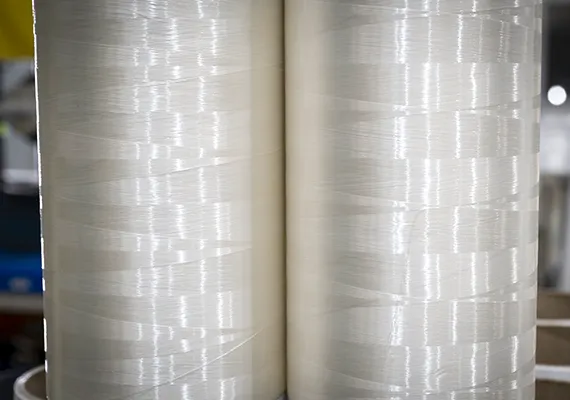
As it cools, this liquid forms fine, continuous filaments that can be turned into yarn for knitted or woven products, which can also be further transformed into shorter staple fibres for different types of textiles.
‘We’re hoping to replace plastic at scale with a material that delivers all the things we love about plastic, but at the end of its life we have the choice to reuse, recycle or compost the material,’ says Uluu co-founder Dr Julia Reisser.
'Most scientists we talked to never thought we’d be able to melt spin our polymers into fibres, but Deakin University came to our side and we’ve made amazing progress with fibres, yarns and now textiles.’
From research to real-world impact
The overarching goal of all of this is to help create a viable, scalable alternative to synthetic fibres, which currently make up a significant proportion of global textiles and contribute to microplastic pollution.
For the Deakin team – which includes Associate Professor Hurren, Dr Bin Tang, and Associate Professor Rangam Rajkhowa – the project highlights the value of translational research, bridging scientific discovery and real-world application.
‘We’re also able to help Uluu with things like colouration and properties of the fibres, as well as understanding compostability and breakdown of the fibres at the end of their life,’ says Associate Professor Hurren.
Eventually, textiles made from materials such as these have the potential to replace nylon or polyester in day-to-day clothing, so that future school uniforms, activewear, puffer jackets and much more could be created from fully biodegradable fibres.