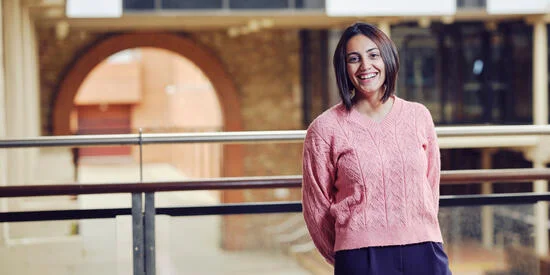
Ramas McRae is rethinking support for the deaf community
Some people may find this content distressing or confronting, particularly those with lived experience of suicide, self-harm, mental ill-health or grief/loss.*
Born deaf in communist Lithuania before moving to Australia, Ramas McRae has experienced firsthand the heavy mental health toll that falls on the deaf community in societies unprepared to fully accept it. Through his PhD research and community advocacy, McRae is pushing hard to improve mental health support and accessibility for deaf Australians.
McRae's deaf community in Lithuania
McRae's early childhood memories are coloured by isolation on multiple levels. As a deaf child growing up in Soviet-era Lithuania, barriers to communication and opportunity were compounded by a country largely cut off from the rest of the world.
It wasn't until the fall of the Soviet Union in 1990 that Lithuania 'opened up' and new opportunities became available to him and his family.
'I remember that time when the world opened up after communism fell, I felt no longer isolated,' McRae says. 'My mum is also deaf and self-educated. She knows multiple languages and her initial dream was to work as an office administrator. However, under communist rule, we were disconnected from the world and the only jobs available to deaf people were as factory workers. When communism fell, the world opened up to us, and we were then able to go to university.'
Studying first in Lithuania and then in the UK, McRae found himself drawn to working with the deaf community. He spent time as a research assistant with a deaf cognition research centre – the 'seed of inspiration' that would lead him to a PhD at Deakin University.
But McRae's drive to improve mental health for the deaf community is also deeply personal, shaped by the loss of a classmate shortly after starting university.
'My classmate was incredibly gifted in the field of mathematics,' McRae says. 'When year 12 was almost complete, the principal asked about our future plans. I said I'd like to be a primary school teacher whilst my classmate, the maths whiz, was offered a scholarship to a prestigious university. We were all excited for him. We thought he would go on to do great things. However, a few weeks after starting university [in Lithuania], my classmate decided to end his own life and that really hit me.'
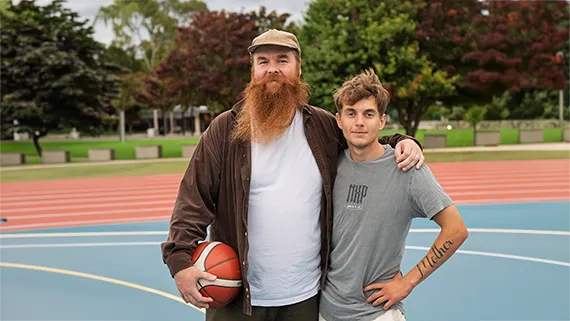
Fighting for better mental health support
Growing up deaf, Ramas McRae understands the barriers his community faces and the consequences when support isn't accessible.
Mental health in the deaf community: McRae's PhD
Looking back, McRae says that he can now recognise signs of his friend's mental health struggles that he missed at the time. And now, with the deeper focus of his PhD research, McRae says that mental health issues are all too common in the deaf community.
'340 deaf people participated in my survey and one of the questions was focused on suicidal ideation,' McRae says. '172 participants out of that 340 – so approximately 50% of those participants – experienced suicidal ideation within my deaf community, so that was a huge number.'
It’s a confronting statistic. McRae believes many mental health challenges in the deaf community stem from schooling.
'I found that adverse mental health outcomes within adulthood were influenced by the type of school attended. There was a higher likelihood of suicidal ideation by a factor of three for students who went to a mainstream high school in which they were one of a small number of deaf students in a hearing cohort compared to a deaf child that went to a deaf school. The likelihood was even higher for those at primary school.’
Next steps: providing greater support for deaf people
Through his PhD, McRae also asked survey participants how they would improve mental health support for deaf people. The biggest answer: founding a dedicated centre for deaf mental health services.
'As a hearing person, you have access to Beyond Blue or Lifeline,' McRae says. 'So if it's two or three o'clock in the morning and you have thoughts of taking your own life, you can pick up the phone and make a call, and there’s a person on the other end of the line who’ll go through strategies with you and hopefully reduce the risk of you taking your life. As a deaf community member, we only have access to a text line now.'
‘For a lot of people who have Auslan as their first language, written English will be their second language. Now, if you're going through a dark time, you're having thoughts of suicide, and then you have to try and text and articulate how you're feeling in your second language would be incredibly difficult. So therefore, if we had access 24/7 to a video call service where we could call someone and use our own natural language – sign language – and they would be able to converse with us directly, that would be a significant improvement on what is currently available.’
The idea is part of McRae’s broader push for a deaf centre of excellence in Australia. Beyond providing dedicated mental health crisis support, McRae sees the centre as a place for hearing parents to find advice on raising deaf children – and that’s just the beginning.
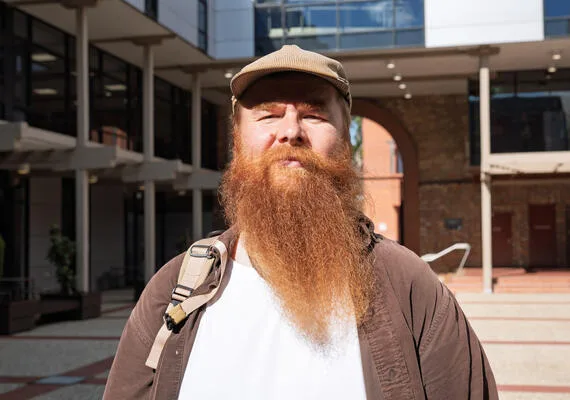
You go to a shopping centre and it's a one-stop shop. You have everything you need – clothing, technology, food. You go to one place, you buy everything that you need, you go home. That's my vision for a centre of excellence for deaf mental health – everything that you need in one place.
Graduate researcher
How McRae supports the deaf community in Australia
Ramas McRae's research could never be considered hands off. In his search for solutions to mental health crisis in the deaf community, he takes his surveys and interviews directly to the people and communities affected. 'I want the approach to be bottom up rather than top down, so I sit with the deaf community eye to eye as peers,' McRae says.
This has meant travelling to remote Indigenous communities and respectfully seeking acceptance from elders before engaging with deaf community members. He’s also organised deaf community events like Auslan saved my life! – a one-day event to highlight the need to improve deaf communication and mental health services for deaf Australians – and successfully petitioned the AFL to offer sign language at the Grand Final.
McRae understands that the mental health problems facing the deaf community won’t be solved by him alone. But, with the passion and drive to make a real difference to his community behind him, he knows that his PhD research and community commitment can be the start of real change.
'Maybe people are seeing my work and thinking, this is something small, but they need to really step back,' he says. 'It’s like dominoes – you might think that one is small, doesn't have much of an impact. But when you line the dominoes up and one domino is knocked, it has a huge impact, a significant impact. I want people to listen, to watch, to learn, to be open minded.'
*This article and video includes discussion of suicide, self-harm, mental health issues, emotional distress and trauma. Some people may find this content distressing or confronting, particularly those with lived experience of suicide, self-harm, mental ill-health or grief/loss.
We encourage you to prioritise your wellbeing while watching. You can pause, skip sections or stop the video at any time. If you or someone you know needs support, help is available: