How can virtual reality be used in a medical setting?
'You're lying in a hospital bed,' begins Tjasa Savoric, speaking to the crowd at Deakin University’s 2025 Three Minute Thesis (3MT) grand final. 'The constant beeping of machines. The lights never dim. You haven't seen outside in days. You're scared, far from your family, unsure of what will come next. What if you could mentally step away without ever leaving your bed?'
This is the idea behind Savoric's PhD thesis, titled ‘Gamified virtual reality: Overcoming stress and anxiety in isolation.' With her setting established and the crowd hooked, Savoric has a little under three minutes remaining to explain her idea, with the 3MT competition challenging PhD students to distil their research into a tantalising soundbite.
So, how does Savoric propose to weave virtual reality (VR) technology into a medical setting? Let’s explore.
How can virtual reality be used in healthcare?
Healthcare settings can be tough. While patients go to hospital for high-quality healthcare, the environment itself can create some negative effects.
'Patients in intensive care are exposed to constant noise, artificial light and limited mobility,' says Savoric. 'Conditions that often result in sensory overload, disorientation and loss of control. As a result, up to 77% of patients are at risk of anxiety during their stay and 46% report clinically significant symptoms of anxiety months after discharge.'
Savoric’s PhD thesis proposes a potential solution to anxiety that avoids medication. The idea, she says, is to go even further than other non-pharmacological anxiety treatments like music therapy.
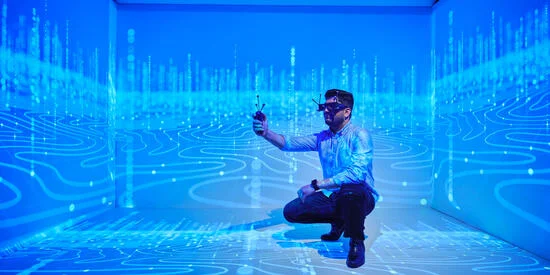
Using virtual reality in a medical healthcare setting, Savoric’s proposed therapy takes patients away from the potential stresses of the hospital and the isolation of their rooms. As Savoric said in her opening, the goal of medical virtual reality is to help remove these factors for patients, without them ever having to leave their bed.
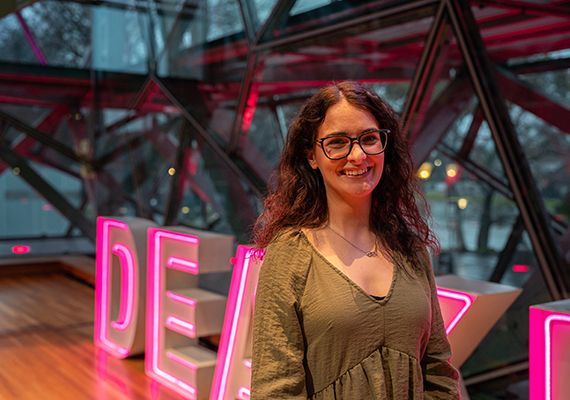
View Tjasa's 3MT presentation
Watch Tjasa explain her research on using VR in healthcare setting in just three minutes.
How can Tjasa’s virtual reality research help transform healthcare?
As she explained to the 3MT crowd, Savoric’s medical virtual reality concept combines elements of video games, escapism, art and therapy.
'I am designing a gamified, art-inspired virtual reality experience, co-created with intensive care professionals and game designers for real clinical impact,' Savoric says. 'We invite patients into an attic filled with memory-evoking treasures, because we all have one. A favourite object. A warm book from our childhood, a music box that plays the lullaby our grandma used to hum. Something that brings us calm, comfort and the sense of us, even while we are surrounded by machines.'
By creating a virtual world of warmth, comfort and familiar objects, Savoric hopes to provide patients with an anxiety-reducing reprieve from the traditional hospital experience – particularly when it comes to intensive care.
With research finding a high rate of anxiety and depression among intensive care patients, Savoric hopes her unique approach with medical virtual reality will offer benefits beyond simple entertainment.
Anxiety doesn’t just feel bad; it slows healing, increases sedative use and prolongs hospital stays. So, if we can help patients to stay calm, connected and in control, there is a real possibility we could improve their outcomes.
How can virtual reality assist with isolation?
Hospitals can be isolating. Though some patients may experience true isolation (like in quarantine because of a highly infectious disease), simply being admitted to hospital can trigger feelings of isolation. Research suggests that hospitalised patients can quickly develop negative feelings like loneliness and, potentially, more serious psychiatric disorders.
Technology like Savoric's gamified virtual reality could transform healthcare for those experiencing isolation by offering patients a familiar, enjoyable and relaxing escape from their hospital room – without ever having to physically leave.
While it won’t connect users to a social environment, Savoric suggests her medical virtual reality concept could help ‘build emotional resilience and help patients to stay motivated in their recovery,’ keeping them feeling mentally healthy during a period of relative isolation.
How has Deakin's 3MT program platformed Tjasa's research?
While PhD theses like Savoric's medical virtual reality concept can seem niche or esoteric to non-experts, the 3MT is designed to break down barriers and convey complex ideas to everyone. One of the guiding principles of the competition is to describe a thesis idea in under three minutes in words 'appropriate for a non-specialist audience.' In this sense, 3MT platforms PhD candidates by bringing their ideas to a public that might otherwise not get to hear or understand them.
The 3MT program also helps students develop job-ready skills and their thesis itself. Based on past experiences – like that of Dilendra Wijesekara, who as a PhD student won the 2024 Asia-Pacific 3MT People's Choice Award for her presentation on silk-based biomaterials – entrants can expect increased understanding and recognition of their work by the public, the chance to network with peers and help structuring their thesis.
And, of course, the 3MT competition comes with a prize incentive. With $3,000 up for grabs for the 3MT Grand Final winner (plus $2,000 for the runner up and $500 for the people’s choice), it’s safe to say that the platform provided by the program can be a big help to our next wave of PhD students.
Interested in investigating important issues like how to create better health outcomes? Explore your PhD options at Deakin.