Where should universities draw the line on AI?
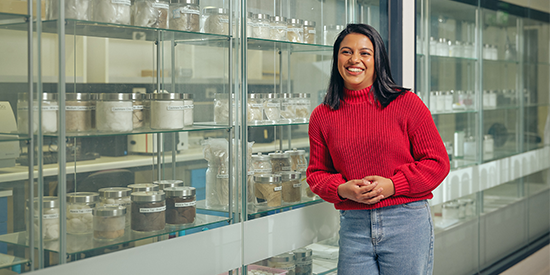
Graduate researcher Ghazal Fatemi is exploring how generative artificial intelligence is reshaping academic writing, integrity and learning experiences for international students – helping universities navigate one of higher education's biggest emerging challenges.
'I watched classmates, most of whom were from non-English speaking backgrounds, have their Turnitin similarity scores projected in front of the entire class, names included,’ recalls Ghazal Fatemi. ‘They had cited their sources and were blindsided.’
This experience with Turnitin, a digital program used to detect plagiarism, would inspire her research at the intersection of generative artificial intelligence (GenAI) and international students' experiences of higher education.
Years later, when tools like ChatGPT rapidly entered universities, Ghazal recognised them as the next chapter of an ongoing conversation – one centred on academic integrity, language, equity and student support.
Now in the final year of her PhD with Deakin's School of Education and the Deakin Centre for Research for Educational Impact, Ghazal is exploring one of the biggest questions facing higher education: where should universities draw the line when it comes to AI and student learning?
How AI is changing learning for international students
International students often navigate complex challenges around academic writing, language barriers and academic integrity expectations. Ghazal's research examines how generative AI tools can both support and complicate that experience.
‘GenAI has emerged as both a potential support and a new complication,’ she explains.
‘My research aims to understand where the line sits when GenAI genuinely helps students overcome challenges and develop their skills, and when it risks undermining academic integrity and authentic learning.’
Ghazal hopes her work encourages universities to take a more nuanced approach to AI and how it can be used to support international students, rather than taking punitive measures when AI is detected.
I’d love for my findings to inform how educators, institutions and policymakers think about GenAI,’ she says. ‘Not simply as a threat to be blocked, but as a tool that needs to be understood, guided, and integrated thoughtfully and ethically.
Graduate researcher
Researching AI in higher education
One of the most exciting parts of the project, Ghazal says, is researching an issue that is evolving in real time.
‘GenAI is changing so rapidly that the landscape looks different from one year to the next,’ she says.
Her research has involved conversations with a wide range of people working closely with international students, including students themselves, academics, university professional staff, policymakers and sector leaders.
‘Hearing how this issue is experienced and understood from so many different angles has given my research a depth I didn't anticipate,’ she says. ‘It makes the findings feel genuinely meaningful.’
A research journey driven by impact
Before beginning her PhD, Ghazal had already started contributing to conversations around plagiarism and international students, publishing a paper that has since received more than 120 citations.
‘That told me there was still a real gap to fill,’ she says.
When ChatGPT emerged and students immediately began experimenting with it, she knew exactly where her research needed to go next.
Supporting international students has become a defining thread throughout her academic journey, and one she plans to continue after submitting her thesis.
'I’m keen to remain in academia and continue building on this research,' she says. 'Whether through teaching, further research or working with institutions to put these findings into practice.'
Finding the right research environment
For Ghazal, choosing Deakin came down to finding the right research environment and mentorship.
‘A significant reason was my principal supervisor, Professor Ly Tran, who is a leading figure in the field of international student education in Australia,’ she says.
Her supervisory team also includes Dr Rebecca Cairns, whose support has been both academically rigorous and personally encouraging.
‘Both are deeply invested in academia and in finding better ways to support international students,’ she says. ‘They've helped me stay grounded when the field was shifting quickly beneath my feet.’
She also credits Deakin's broader culture for helping her research thrive.
'Deakin's focus on equity and its progressive approach to technology in education created an environment where this research could flourish,' she says.
Thinking about a PhD in education?
As she approaches the final stages of her project, Ghazal's advice for future researchers is deeply personal.
‘Choose a topic that genuinely matters to you, not just intellectually, but personally,’ she says. ‘The PhD journey is long, and there will be difficult stretches where your "why" is the only thing that keeps you going.’
For her, that "why" remains tied to the memory of those students in the classroom years ago. ‘Find your moment like that,’ she says. ‘Hold onto it and let it pull you forward.’
Interested in research that creates meaningful change? Explore PhD and research opportunities in Deakin's School of Education.