Centre for Intelligent Systems Research

CISR Media coverage


Universal Motion Simulator on Discovery Channel

“If you’ve ever wanted to slip on a fighter pilot suit, or step right into a video game, or try landing a helicopter with engine failure; then this is your wildest fantasy come true”. This was the introduction for the CISR Universal Motion Simulator (UMS) when it recently featured on the March 22 episode of the Discovery Channel series, Daily Planet.

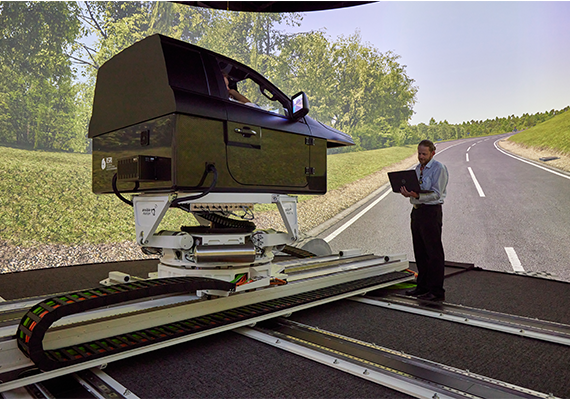
Presenter Dan Riskin described Deakin's Universal Motion Simulator as the “ultimate virtual experience”, a platform that can simulate just about any vehicle, from motorcycles to tanks. Currently the UMS is used as a flight simulator for fighter pilots; it’s safer and costs much less than taking you up in a real jet.

In the Universal Motion Simulator, the pilot looks through 3D virtual-reality goggles for a realistic view, is bombarded by “killer speakers” and subjected to intense aerial manoeuvres that can pull several g’s of force. But what sets the UMS apart is how it feels. As CISR Director Professor Saeid Nahavandi explains even the control stick is designed to feel like the real thing: “It can reflect the forces external to the aircraft, bringing it to the user’s hand”.

As Discovery Channel viewers learned, at the Centre for Intelligent Systems Research we can also read the reaction of a pilot’s brain as he flies using electroencephalograph (EEG) signals. “We want to see through the analysis of EEG signals whether a person has certain behaviour and can learn certain tasks faster, or if the person is not suitable for certain tasks. We want to detect whether a person is suitable to become a pilot” says Prof. Nahavandi. The Discovery Channel feature shows researchers testing pilot’s behaviour in severe weather conditions to find out who adapts more quickly in different scenarios.

“People who see the simulator always have the same reaction: how can I take a ride on that?” If this is you, why not check out the CISR YouTube Channel to see more UMS footage or contact us for details on joining the team!

Watch the episode online....Discovery Channel

See more UMS....CISR YouTube Channel

A Universal Motion Simulator pilot wearing EEG equipment
EEG analysis from an experienced pilot


CISR Universal Motion Simulator on Catalyst

The CISR team recently put science communicator Dr Graham Phillips through his paces on the new Universal Motion Simulator (UMS). Dr Phillips' report on his experience aired on the first episode of ABC TV's premier science program, Catalyst on March 15 2012.

As Dr Phillips discovered, the UMS looks very different to more conventional flight simulators because it is designed to overcome some of their limitations, providing a higher range of motion compared to traditional Stewart platform simulators, at a lower cost. CISR Director Professor Saeid Nahavandi explained that the UMS can "provide realistic-type motion, whether it is a land vehicle, air vehicle or sea vehicles".

Dr Phillips revealed that the simulators controls feature "advanced force generators and haptic technology" developed at the Centre for Intelligent Systems Research. Prof. Nahavandi explained that these force reflective devices allow the pilot to feel as though they are actually flying a real aircraft, "if you hit some turbulence, you can actually feel the force in your hand".

Dr Phillips found during his test flight that "the UMS's robotic arm doesn't respond to just the pilot's controls. Rather, to provide more realism, it's one of the new breed of simulators that creates a virtual model of aircraft being flown, together with the forces that affect it, such as turbulence. That entire virtual environment is packaged up and sent to the robotic arm, and that determines how it moves."

Impressed by its capability, Dr Phillips called the UMS an amazing machine, "Very realistic, I must say".

The CISR Haptically-Enabled Universal Motion Simulator The Universal Motion Simulator control room

Watch the report online....ABC iView


Catalyst....details

Deakin newsroom....details


Senator Kim Carr launches CISR Universal Motion Simulator

The next generation in flight simulation was unveiled at the Centre for Intelligent Systems Research (CISR) today by Federal Innovation Minister Kim Carr. CISR's Haptically Enabled Universal Motion Simulator (UMS) will take trainee pilots and drivers through their paces in a safer, cheaper and more realistic training environment than currently available elsewhere in the world.

Universal Motion Simulator launch slideshow

"Traditional flight simulators have restricted movement and a limited ability to replicate a real flying experience. Robotic experts at CISR have integrated the latest in haptics technology - adding a sense of touch and feel to virtual or remote objects - to produce a commercial system that is ideal for flight simulation," Senator Carr said.

Senator Carr said that the Australian Government is proud to have invested $285,000 in this technology through the ARC Linkage Infrastructure, Equipment and Facilities scheme. "We are excited that new funding of $210,000 - recently awarded under the ARC Linkage Projects scheme - will help CISR researchers utilise the technology to develop effective pilot training methods and improve aviation safety."

"No other simulator can provide the full experience of flying a military jet with all the gut wrenching G-forces while only seven metres off the ground," explained Professor Saeid Nahavandi, Director of the Centre for Intelligent Systems Research.

"What sets the UMS apart from standard simulators is the integration of haptics technology, which provides a sense of touch and feel to virtual or remote objects, and its ability move at high speed and in any direction."

"While suited for training pilots, the UMS is also the perfect platform for simulating land based vehicles including tanks and other armoured vehicles, trucks, race cars and motorbikes. Its training capabilities are endless."


Further Information

Deakin newsroom....details

Innovation Minister....details

Geelong Advertiser....details(2.2 MB)

The Australian....details(102 KB)

Defence iQ....details

Australian Popular Science....details

IEEE Spectrum....details

iTWire....details

Australian Aviation....details

Geelong Advertiser....details

Universal Motion Simulator Flyer(466 KB)


Related Publications

PDF File Nelson, K., Black, T., Creighton, D. and Nahavandi, S.
“A Simulation-Based Control Interface Layer for a High-Fidelity Anthropomorphic Training Simulator”
Proceedings of the Interservice/Industry Training, Simulation & Education Conference (I/ITSEC) 2010, Orlando, USA.
PDF (252 KB) | Web | BibTeX | Endnote/RefMan

Recent CISR Publications


Funding Boost for ICT Geelong

ICT Geelong

On 8 December, Minister for Technology Gordon Rich-Phillips announced $100,000 funding to support the activities of ICT Geelong, Victoria's high-tech development cluster.

Minister Rich-Phillips said the funding was provided under the government's Innovation Through Clusters program to promote the region's ICT potential, foster collaboration and progress key projects which would continue to deliver economic benefits to the Geelong region.

Robert Reed, Chairman of ICT Geelong, said the region had some great infrastructure and capability to leverage off. “Deakin University is undertaking world-class research and live projects with industry partners in haptics, robotics and simulation.”

Read more....The Australian


CISR and Wittenstein collaborate on Universal Motion Simulator

CISR Universal Motion Simulator

Leading mechatronic company Wittenstein is showcasing CISR's Universal Motion Simulator (UMS) in the October edition of their MOVE magazine.

The Universal Motion Simulator is a state-of-the-art haptically enabled, full motion simulator for training and performance analysis which features Wittenstein's control loading systems (CLS) to replicate helicopter control. Wittenstein's CLS includes a cyclic stick, a collective stick and directional pedals which allow the simulator user to feel completely immersed in the real-world training environment.

"This project is another opportunity for CISR to discover and deliver innovative research that directly benefits society through the creation of knowledge and the provision of solutions to real-world problems", says CISR Director, Professor Saeid Nahavandi.

CISR's Universal Motion Simulator project is also supported by the Australian Department of Defence, the Australian Research Council and Rockwell Collins.

- Read the full story Wittenstein MOVE magazine(273 KB)

      CISR Universal Motion Simulator        CISR Universal Motion Simulator


CISR OzBot™ a Bright Idea

Mick Fielding and James Mullins with OzBot

CISR's Ozbot™ mobile platform recently featured in the November issue of the Qantas inflight magazine.

"a diminutive mechanical superhero - the OzBot, a nimble machine that can check for explosive devices using 3D stereovision, tow a 4WD vehicle or, using X-ray equipment, approach an armed offender during a hostage situation"

- Extract from Qantas inflight magazine(1.3 MB)


OzBot™ - Moving with the times

CISR's Ozbot™ ruggedised mobile platform provides first-responder capability for tactical reconnaissance or mission critical tasks.

OzBot™ uses haptic technology that allows a user to "feel" objects being inspected by the robot, despite being up to 500 metres away.

The OzBot™ platform is suitable for both urban and unstructured terrain including missions that require a stair climbing capability.

Deakin newsroom....details


Haptically-enabled OzBot


CISR OzBot on The New Inventors

CISR OzBot on The New Inventors CISR's OzBot, as featured on the the New Inventors program along with CISR team members Mick Fielding and James Mullins


Professor Saeid Nahavandi

Can technology help the blind 'see' art?
A question for Professor Saeid Nahavandi

The Age....details (118 KB)

The Australian....details

Creative Innovation....details

Deakin newsroom....details

RealTime....details


Touch of reality for virtual medicine

Dr James Mullins Haptic technology gives sense of touch to virtual medical procedures

Deakin newsroom....details


Victoria Police rolls out its latest technological gadget - CISR's very own OzBot

Policelife February 2010
(PDF 939KB)

"OzBot is one of Victoria Police's greatest assets. It goes where no humans dare - under cars, into the room with an armed offender and next to a suspicious package. It is fearless"

- Extract from Police Life magazine, February 2010

Watch the BlueTube video of OzBot in action

- Video from the
Victoria Police BlueTube website

BlueTube video


Thousands of Australians up for 'nude' airport scanners

The Age....details


CISR wins New Inventors episode

Haptic Gripper The Haptic Gripper, invented by Prof Saeid Nahavandi & Zoran Najdovski, was featured on a recent episode of the New Inventors

Simulation Australia....details


CISR meet with Defence Homeland Security delegation in India

CISR were participants at an Australian Defence & Homeland Security Business Delegation, comprising of 6 companies, which recently visited New Delhi and Mumbai.

Frontier India Strategic and Defense....details


Scientific path for military potential - OzBots

The OzBot, developed by Deakin University's Centre for Intelligent Systems Research, uses haptic technology that allows an operator to physically feel remote environments through position-force control and experience realistic force feedback.

Canberra Times (p. 2)....details (194 KB)


CISR researchers win ARC award to help the blind and visually impaired through the use of haptics

Project title: Haptic realisation of visual art for the blind and visually impaired

Australian Research Council....details (37KB)


Tim Black demonstrates the OzBot robot at Careers Night

Geelong College AD Astra magazine (p. 20)....details (2.4MB)


In good hands

The Greek word haptikos means a sense of touch, so Professor Saeid Nahavandi thought it would be perfect as the name for a futuristic device that might have come straight from a science fiction novel.
It's a device that would allow a surgeon in Melbourne to operate directly on a patient hundreds of kilometres away, out in the Mallee or up in the mountains. Or even permit an astronomer on Earth to pick up and feel and test the soil on the moon or Mars.

The Age....details


CISR team awarded ARC Linkage Grant

Professor Saeid Nahavandi and Dr Doug Creighton have been awarded funding for their ARC Linkage Project titled "Distributed Real-time Multiobjective Scheduling for Joinery Manufacturing Processes using Discrete Event Simulation".

Australia's furniture manufacturing industry is a major contributor to the economic wealth of the Australian economy with an annual $9.5 billion turnover. The Australian Furnishing Industry Association (AFIA) estimates that there are 15,000 furniture design and manufacturing firms, employing 66,000 people. However, Australian manufacturers are experiencing high levels of fixed cost (associated with plant and equipment) and low equipment-utilisation ratio and long delivery time. This research aims to enable Australian manufacturers to stay competitive in the dynamic global market, by providing a better strategy to allocate their constrained resources including workforces and facilities.


Technology: from the laboratory to the battleground

CTD success stories....Several other CTD projects have also been selected for further development towards implementation under the new CTD Extension Program. One of these success stories is a counter-improvised explosive device robot being developed in collaboration with Deakin University

DSTO website....details


Fast track for 'sense of touch' robot

A major grant has been awarded to researchers at Deakin University developing an intelligent robot that allows its operator to feel what the robot's gripper is feeling.

Deakin University media release....details (23 KB)


Feely robot keeps troops in touch

A unique robot that can deliver sensory information to Australian soldiers as they use the machine to inspect suspicious or dangerous objects from a distance could be on the front line within two years

The Age....details (134 KB)


Local robot lands in Wall-E territory

When Andrew Nowrojee was busy making his postapocalyptic robot film, little did he know that film giant Pixar was coming up with a lookalike creatures

The Herald Sun....details (118 KB)


Deakin's software platform has airport security systems in the bag

Software developed in Australia that uses rapid modelling tools and techniques to improve airport security systems could be on the market within 12 months

The Australian... details (161 KB))


Deakin beefs up airport security

Deakin researchers have developed initiatives which are revolutionising airport security systems across the globe

The Geelong Advertiser... details (107 KB)


Deakin software bags airport security

The innovative software platform, developed by Deakin University's Centre for Intelligent Systems Research, is based on "discrete event" simulation technology, using software algorithms developed in-house.

Australian IT....details


Baggage simulator

The researchers' software simulates the functionality of baggage-handling systems and can portray how a system at a typical airport would cope with upgrades to security systems, taking into account individual airport infrastructure and flight schedules.

The Engineer....details


Software will boost airport security

Deakin University researchers have developed an innovative software platform - believed to be the first of its kind - which allows for simulation of baggage handling systems and how they would cope with changes to airport security.

The Economic Times....details


Deakin University acknowledges the traditional land owners of present campus sites.

24th April 2012