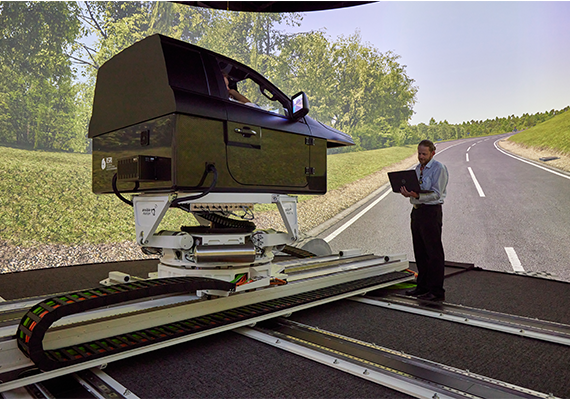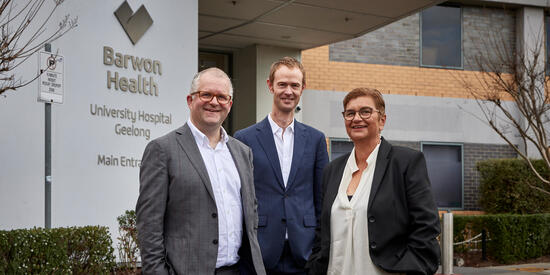
CISR hosts Committee for Geelong's Ambassador DelegationOn Friday 31st May, the Centre for Intelligent Systems Research (CISR) hosted the Committee for Geelong's Ambassador Delegation and demonstrated the group's research capabilities. The delegation comprised His Excellency Paul Madden, British High Commissioner, Mr Daniel Taylor, New Zealand Consul General and Ms Mary Burce Warlick, Consul General of the United States of America. In his blog, His Excellency Paul Madden provides a very frank assessment of CISR's Universal Motion Simulator (UMS), "We saw a researcher being jolted about on the end of a robotic arm as he experienced flight simulation." High Commissioner Madden also describes how he was fascinated to visit CISR and experience haptics for the first time: "This was a new word for me. It's basically about technology which gives the user a sense of touch in virtual simulations or remote control." Committee for Geelong....details His Excellency Paul Madden's blog....details |
|
|
CISR researcher invited to participate in Japan-Australia Marine Science WorkshopCISR's Mr Kyle Nelson was recently invited as one of eighteen Australian experts, including five early-mid career researchers, to participate in the Japan-Australia Marine Science Workshop: Understanding global change impacts and opportunities in tropical and subtropical marine ecosystems, held in Tokyo from 11-12 July 2013. The workshop was jointly organised by the Australian Academy of Science together with the Australian Institute of Marine Science (AIMS) and the Japan Agency for Marine-Earth Science and Technology (JAMSTEC), and was co-funded by the Australian Government Department of Industry, Innovation, Climate Change, Science, Research and Tertiary Education (DIICCSRTE) and the Japanese Ministry of Education, Culture, Sports, Science and Technology (MEXT). The workshop included keynote presentations and breakout discussions across three themes. Mr Nelson was invited to participate in the third theme discussing the new technologies required to better explore and routinely observe tropical and subtropical marine systems, where he contributed research relating to multi-view super-resolution and vision-based measurement in underwater environments. As a result of the workshop, it was agreed that both countries would develop a work program to guide future collaborative research into tropical and sub-tropical marine science between Japan and Australia. Australian Academy of Science....details |
|
CISR researcher contributes to Symposium on Cognitive Neuroengineering and Computational NeuroscienceCISR's Ms Imali Hettiarachchi recently participated in a joint DSTO & UniSA Symposium on Cognitive Neuroengineering and Computational Neuroscience, held at the University of South Australia from 11-12 July 2013. Ms. Hettiarachchi presented her work on source level information flow analysis using Event Related Potential (ERP) data. The symposium provided a specialised forum for Australia's leading cognitive neuroengineering and computational neuroscience researchers to showcase their current research, connect with like-minded researchers, and consider the future of cognitive neuroengineering. The primary focus of this symposium was the enabling technologies, systems, methodologies, techniques and future developments that underpin cognitive neuroengineering and computational neuroscience research with a special focus on Defence applications and their impacts. |
CISR PhD Student Kristan Marlow wins Alfred Deakin Medal and Vice Chancellor's PrizeAt the Faculty of Science, Engineering and the Built Environment's recent graduation ceremony, CISR student Kristan Marlow graduated from his Bachelor of Engineering (Mechatronics and Robotics) with first class honours. His outstanding academic achievement and contribution to Deakin University was also recognised with two special awards, the Alfred Deakin Medal and Vice Chancellor's Prize, two of the highest honours awarded to undergraduate students. The Alfred Deakin Medal recognises the eight most outstanding students graduating from Deakin University, who have achieved the highest academic performance in their faculty and have also contributed to the university and community while studying. Kristan's involvement at Deakin included tutoring students, acting as an Academic Mentor while living at the student residences, assisting with open days and O-week activities, representing Deakin at multiple engineering careers expos and engineering challenge days, as well as undertaking industry placements and a study tour of China. The Vice Chancellor's Prize is awarded in recognition of the top two honours theses in each Faculty. Kristan completed his honours project, titled Design and Development of a Novel Six Degrees of Freedom Haptic Interface, with the Centre for Intelligent Systems Research (CISR). The project included mechanical, electrical and software design, and prototyping the physical haptic device from concept to production. |
|
|
Kristan also received multiple awards from the Faculty of Science, Engineering and the Built Environment, including the Engineers Australia Award for the having the highest overall academic performance in the final year of the Bachelor of Engineering, the Godfrey Hirst Australia Award for the highest honours grade in the Bachelor of Engineering, and the Shell Geelong Refinery Award for the most outstanding final year project in the Bachelor of Engineering. Since graduating, Kristan has commenced postgraduate studies with CISR and is investigating novel parallel robotic structures. The entire team at CISR congratulates Kristan on his recent achievements and eagerly anticipates his future successes. |
CISR and Defence Science Institute collaborate to improve Australian military equipmentRecently during the 2012 Land Warfare Conference and Exhibition the University of Melbourne's Defence Science Institute and Deakin University's Centre for Intelligent Systems Research (CISR) signed a Memorandum of Understanding to enable further collaborative research. The agreement paves the way for the rapid evaluation of advanced combat uniforms and equipment for Australian military personnel. Under the agreement, new joint research will develop a virtual testing environment able to deliver feedback to testers while simulating a wider range of test scenarios.
“This timely initiative brings together research teams that are recognised as world leaders in this field,” said Professor Saeid Nahavandi, Alfred Deakin Professor and Director of CISR. “At CISR we have a long history of carrying out research that contributes to national security, including projects in robotics, haptics and simulation for the Department of Defence and DSTO.” “Our state of the art universal motion simulator (UMS) will provide the perfect testing environment for the projects to be undertaken under this initiative.” Read more....Defence Science Institute DSI's Associate Director Clint Heinze experiences CISR's Universal Motion Simulator....details
|
|
CISR Team wins Best Paper Award at 2012 Land Warfare ConferenceThe Hon Warren Snowdon, Minister for Defence Science and Personnel, presented the best paper award to CISR researchers at the Land Warfare Conference 2012. The paper titled, “Low Cost Multimodal Facial Recognition via Kinect Sensors” was authored by M. Hossny, D. Filippidis, W. Abdelrahman, H. Zhou, M. Fielding, J. Mullins, L. Wei, D. Creighton, V. Puri and S. Nahavandi. “These awards recognise the excellent contributions of scientists and academics who undertake leading edge research to support the capability of Australia's land forces,” Minister Snowdon said. “I congratulate the winners on their fine work which benefits our men and women in uniform by improving their capability and survivability.” |
|
The winning paper presents novel low cost 3D facial recognition using gaming sensors such as Kinect™. The paper describes the hardware, calibration and infrared noise and pattern interference challenges of integrating multiple Kinect sensors. The preliminary results show a promising trend for low cost solutions that can be populated in crowded facilities such as malls and airports. Hossny, M., Filippidis, D., Abdelrahman, W., Zhou, H., Fielding, M., Mullins, J., Wei, L., Creighton, D., Puri, V., Nahavandi, S. |
|
|
Associate Professor Chee Peng Lim wins Australia-India Fellowship and Australia-Japan ExchangeCISR's Dr. Chee Peng Lim was recently awarded both an Australia-India Senior Visiting Fellowship and an Australia-Japan Emerging Research Leaders Exchange. The 2012-2013 Australia-India Senior Visiting Fellowships are funded by the Australia-India Strategic Research Fund (AISRF) and administered by the Australian Academy of Science. The aim of this fellowship is to establish a close research partnership between Deakin University and Gandhigram Rural Institute-Deemed University, India. Associate Professor Lim will be collaborating with Prof. P. Balasubramaniam, Head of Department of Mathematics at Gandhigram, in the area of computational intelligence during his two-week visit in India. |
|
Inspired by human intelligence, computational intelligence models are designed to mimic our behaviours and capabilities in solving complex tasks, e.g., learning, adapting, and reasoning. The fellowship will lead to the development of innovative computerised intelligent systems for solving real-world problems in the medical and industrial areas. The systems will be used for decision support in complex tasks, e.g. helping doctors to make accurate and timely decisions in disease diagnosis based on patients' symptoms and conditions. Other potential applications include fault detection of industrial machines and optimisation of manufacturing processes. The 2013 Australia-Japan Emerging Research Leaders Exchange Program is funded by the Australian Government and the Japanese Society for the Promotion for Science (JSPS), and administered by the Australian Academy of Technological Sciences and Engineering (ATSE) and the Engineering Academy of Japan (EAJ). The aim of this exchange program is to establish close research linkages in the area of S&T between Australian and Japanese organisations. Associate Professor Lim will be developing research networks and strengthening institutional cooperative opportunities in ICT (with specific attention to Kansei or affective engineering) during his two-week visit in Japan. Kansei is concerned with our spontaneous, intuitive feeling and emotion when we interact with things, e.g. products or services. Kansei engineering aims to incorporate customers' psychological feelings and needs into products or services. The exchange program will allow Dr. Lim to meet and exchange notes with prominent researchers, industrial practitioners, and policy makers of Kansei engineering in Japan. This will enhance his research initiatives in integrating computerised intelligent systems and Kansei engineering for product development or improvement. At the institutional level, the program will further strengthen research and educational collaborations between Deakin University and Japanese universities and industrial organisations in the general area of ICT. |
|
CISR hosts inaugural IT Student Innovation ChallengeWednesday, the 17th of October saw the return of 40 eager and inventive VET IT students from Belmont High School and The Gordon back to CISR. This was part of ICT Geelong's (the Geelong region IT advocacy body) inaugural IT Student Innovation Challenge. Up for grabs was $2000 in prizes. In September, students had the opportunity to experience first-hand some of CISR's world-leading IT centric technologies, in areas such as robotics, simulation and haptics. Advances in these new and exciting technologies are shaping our modern world, with application to the games & entertainment, sports, health & well-being, education & training, and defence, emergency services & manufacturing industries.
The brief was simple. The students had one month to invent a 'new real-world application' for the advanced technologies available to them at CISR. After a month of idea generation, the students returned on 17th October to pitch their ideas to a panel of judges. They were judged on the merit of their idea and how they pitched it. The students had to: The ideas and enthusiasm the students bought with them on the day was fantastic. A total of six pitches were presented, with prizes awarded to the two best pitches.
The runner up prize went to a team of three, who proposed a haptic interface for artists called Tru-Draw. Grasping a haptic pen, users could experience the realistic touch forces of painting or drawing with many different artist brushes and pencils on different surfaces. This technology could help artists across the world experience the creation of art, while reducing resource wastage. We could also foresee this technology used in entertainment products for young children or disabled to create and experience artwork. The winning group of four proposed a haptic-based exercise machine, with a yet to be decided working title of the "Hapticisor". Using a small, configurable interface the haptics technology would provide realistic and adaptive force resistance to a user. This device would eliminate the need for large, bulky gym equipment or spotters. This idea was deemed to be the most inventive by the panel, with a unique take on the technology, and a quick and realistic path to market. Thank you and congratulations to all the participating students and teachers of Belmont High School and The Gordon. We hope you enjoyed the inaugural IT Student Innovation Challenge. CISR is once again proud work together with ICT Geelong to help reveal the amazing places ICT and engineering can take students in the Geelong region. Thanks to Matthew Sun of BCC Computers, Robert Reed of FE Technologies, and Craig Hill of ICT Geelong for their generous support of this event, and many other on-going ICT related activities in the Geelong Region. |
|
Dr Mo Hossny & Dr Doug Creighton win Best Paper Award at IEEE UKSim 2012CISR's Dr Mo Hossny & Dr Doug Creighton received the Best Paper Award at the 14th IEEE UKSim International Conference on Computer Modelling and Simulation (UKSim 2012) for their paper titled "An Evaluation Mechanism for Saliency Functions Used in Localized Image Fusion Quality Metrics". Most image fusion quality metrics depend on estimating the amount of information transferred from each source image into the fused image. This paper presents an algorithm that objectively evaluates the realism of saliency functions used in image fusion quality measures. The algorithm rebuilds the fused image using the estimated information from each source image and compares it to the original fused image. Hossny, M., Nahavandi, S., Creighton, D. |
CISR collaborates with Deakin Motion.Lab on Mixed Reality Performance LabDeakin Motion.Lab Ph.D. student Gorkem Acaroglu recently won prestigious Australia Council Inter-Arts funding to develop an Artlab to investigate mixed reality performance. This Artlab will research the limits and opportunities for using technology as subject in theatre, where the technology performs as an actor does in traditional theatre: examining the interface between bodies as subject and technologies as subject, where the technology is capable of real-time spontaneous interaction with actors in dramatic theatre works. The Mixed Reality Performance Lab (MRPL) is a series of research laboratories conducted over two years developing cross-disciplinary methodologies into the interface between bodies and technology including:
This research takes place through a series of residencies in technology centres with collaborations between theatre practitioners, new media artists, dancers and visual artists who work with electronic arts (at the Deakin Motion.Lab), and with scientists and engineers that are developing cutting edge technologies (robotics, haptics, embodied control of virtual worlds) at the Centre for Intelligent Systems Research. MRPL will test the use of these technologies in dramatic theatre works with characters that audience empathise with and a closed fictional world developed and accessed through dialogue. |
Deakin Motion.Lab and CISR welcome Thinker in Residence Garry StewartDeakin University's Thinker in Residence program brings leading researchers from all over the world to work with our research groups to engage, develop and invigorate our research community. Next week the Deakin Motion.Lab welcomes Garry Stewart as Thinker in Residence. Garry Stewart is one of Australia's most innovative and successful choreographers. He is internationally acclaimed for his unique style and high-risk, high-tech collaborative works that explore philosophical and technological domains. Garry will work with Deakin Motion.Lab Director Kim Vincs and the art/technology DML team to develop new ways of using motion capture, CG animation, 3D stereography and game engine technology for live dance performance with assistance from CISR. |
![]() ![]()
|
International Immersive Simulation Workshop hosted by CISR, Boston Dynamics and the Defence Science InstituteOn 2 May CISR hosted the Immersive Simulation: Challenges and Opportunities workshop, at Deakin University. Workshop participant's experienced the latest developments in modelling and simulation, with sessions covering the creation, application and benefits of virtual human models, crowd behaviour simulation and analysis, human performance measurement, biomechanical and ergonomic modelling, and more. Attendees learned how to create digital human models for real life scenarios involving everything from manufacturing, law enforcement and logistics management to medicine and defence. Several workshop sessions focused on recent developments with Boston Dynamics' DI-Guy Human Simulation Software. Participants learnt how to interface Motion Capture systems and the Microsoft Kinect with DI-Guy scenarios allowing dynamic avatar control for crowd behaviour simulation. A second workshop session demonstrated the integration of haptic devices with DI-Guy for disaster management and evacuation scenarios. Those in attendance were shown how models of real life robotic platforms, such as CISR's OzBot, can be controlled using a 3D mouse and a desktop haptic device for virtual search and rescue training tasks. Additional workshop sessions highlighted the use of DI-Guy for rehabilitation and remote education, human performance modelling and measurement using Digital Biomechanics software, and the design and development of virtual reality systems for part task training and ergonomic analysis. CISR would like to thank all event partners including Boston Dynamics, the Defence Science Institute, Simulation Australia, DI-Guy, Deakin University and the State Government of Victoria. |
|
CISR's Dr. Asim Bhatti designs improved multielectrode array at Georgia Institute of TechnologyDr. Asim Bhatti, senior research academic at CISR, was awarded an Australian Endeavour Fellowship in 2011 that led to multidisciplinary research in collaboration with renowned Georgia Institute of Technology researchers. The joint research with Prof. Hamid Garmestani (Laboratory of Micromechanics of Materials) and A/Prof. Steve Potter (Potter Lab - Laboratory for Neuroengineering) focussed on the design and development of improved multielectrode arrays. Microelectrode arrays are electronic devices used to integrate with living neuron cells to investigate their working principles and behaviour in response to different environmental influences and stimulations. In vitro multichannel recordings from neurons have been used as important evidence in neuroscientific studies to understand the fundamentals of neural network mechanisms in the brain as well as to study the effect of structural, biochemical and electrical abnormalities on the overall capabilities of the brain. |
|
Dr. Bhatti's research developed an improved multielectrode array architecture featuring:
This ongoing collaboration has facilitated the design of new Ti/SiN/Ag multielectrode arrays with improved cage-like electrode geometry to better interface with neurons. School of Materials Science and Engineering at Georgia TechDepartment of Biomedical Engineering at Georgia Tech and Emory University |
|
|
CISR's Zoran Najdovski wins 2012 Australian Endeavour Research Fellowship for JapanCISR post-doctoral research fellow, Dr. Zoran Najdovski, has won the prestigious 2012 Endeavour Research Fellowship, to join Professor Toshio Fukuda's group at Nagoya University, Nagoya, Japan. While in Japan, Zoran will investigate modelling haptic interaction for medical robotic teleoperation. The Endeavour Awards are a part of the Australia Awards initiative which was announced in November 2009. The Australia Awards have been established to maximise the benefit to Australia of its extensive scholarship programs, and to support enduring ties between Australia and our neighbours. Further information is available at www.australiaawards.gov.au |
![]() |
CISR revs up for the 2012 Formula 1 Australian Grand PrixCISR researchers have returned from displaying a number of robots to the crowds attending the 2012 Formula 1 Australian Grand Prix in Melbourne. On display were robots ranging from factory automation tugs, police explosive handling robots and the next generation of military bots. The hugely successful display was met with enthusiasm from school children, industry representatives and members of parliament alike. Minister Richard Dalla-Riva (State Minister for Manufacturing, Exports & Trade) spent time on the stand using military robot prototypes and discussing their capabilities and future within the manufacturing and exports space. CISR wishes to thank the Defence Science Institute for providing stand space for use during the Grand Prix. Defence Science Institute....details |
![]() |
CISR welcomes Prof. Anthony Maciejewski as an Honorary ProfessorProf. Maciejewski's research and teaching interests centre on the analysis, simulation, and control of kinematically redundant robotic systems. His current work focuses on how kinematic redundancy can be utilized to design failure tolerant robotic systems for remote operations. His research has been supported by NSF, Sandia National Laboratories, DARPA, NASA, National Imagery and Mapping Agency, Missile Defense Agency, Non-lethal Technology Innovation Center, the NEC Corporation, Caterpillar, AT&T, H-P, Intel, Wolf Robotics, and the TRW Foundation. Prof. Anthony A. Maciejewski received the B.S.E.E (summa cum laude), M.S., and Ph.D. degrees in Electrical Engineering in 1982, 1984, and 1987, respectively, all from The Ohio State University. In 1988, Prof. Maciejewski joined the faculty of Purdue University as an Assistant Professor of Electrical Engineering. He was promoted to Associate Professor in 1993 and Full Professor in 1998. In August of 2001 he joined Colorado State University where he is currently a Professor and Head of the Department of Electrical and Computer Engineering. |
![]() ![]() ![]() |
CISR hosts Suzanne Cory High SchoolApproximately 60 Year 9 & 10 students from Suzanne Cory High School recently visited the CISR facilities as part of a 3-day Orientation/Leadership program organised by the Deakin YMCA. The program, designed to promote team building and student awareness of university research programs, gave 400 visiting students a hands-on look at many of the exciting research projects happening within Deakin University. Places were limited, but the lucky students and staff who stopped by the CISR area were able to try their skills on a haptic dental training simulator, 'feel' virtual materials such as jelly, clay and water, or even 'touch' a virtual beating heart! Students and teachers were also invited to participate in a live-demo of CISR's Universal Motion Simulator, a next-generation air and ground vehicle simulator. The multi-million dollar simulator allows a person to pilot an aircraft using force-enabled controls and a 3D headset and experience ultra-realistic forces, or drive a virtual vehicle down a track and feel every bump! The simulator, designed to evaluate pilot performance and safely train for difficult missions, can move the pilot into any orientation, even upside-down, and pull up to 6g's of acceleration. CISR thanks both the Deakin YMCA and Suzanne Cory High School for the opportunity to participate in the program. Further InformationSuzanne Cory High School Newsletter(117 KB) CISR Haptics Research Lab CISR Universal Motion Simulator Deakin University Homepage |
![]() |
CISR BBQ Group PhotoA recent CISR group barbeque held in conjunction with our weekly 2012 Research Seminar Series proved to be the perfect opportunity to capture some of the ever-expanding team of intelligent systems researchers in attendance. ![]() |

|
In preparation for Christmas this year Santa has made the trip down-under for some flight training! Santa tested his skills on the new CISR Haptically-Enabled Universal Motion Simulator (UMS) to make sure that he can deliver all of his presents on time this Christmas Eve. We have a feeling Santa's reindeer will be flying super-fast this year, hope you've been good!
|

![]() ![]() |
CISR wins two ARC awardsAt the ARC Major Grants Announcement at Parliament House on 1 November 2011 Senator The Hon Kim Carr, Minister for Innovation, Industry, Science and Research visited the Deakin University stand to get a grip on using haptics. Professor Saeid Nahavandi is shown left describing the outcome of some recent ARC funded awards. CISR was awarded both a discovery and linkage grant at the announcement. CISR's discovery award(50 KB) will develop new interval type-2 fuzzy logic system-based tools for quantifying uncertainties present in complex systems. The outcome of this project will greatly help all Australian industries and organisations that directly or indirectly use model-based estimation for prediction and forecasting purposes. CISR was also awarded a linkage grant(41 KB) to focus on adaptive scenario generation and performance evaluation for virtual training of helicopter pilots. This project will develop effective pilot training methods, delivered through virtual simulation, to improve aviation safety. |
![]() |
CISR's Aung Kyaw Soe develops method for degassing PDMS with readily available equipmentCISR PhD student Aung Kyaw Soe has devised a method of degassing a PDMS mixture without a vacuum desiccator or a laboratory centrifuge and curing the PDMS chip in an ordinary kitchen oven. See Chips and Tips for further details |
![]() |
Prof. Anthony Maciejewski visits CISRIEEE Fellow, Professor Anthony A. Maciejewski visited the Centre for Intelligent Systems Research in August 2011 as part of an ongoing research collaboration between CISR and the Articulated Motion (ArM) Laboratory at Colorado State University. Joint research between the groups has focused on kinematic redundancy and fault tolerant robotics. |
![]() |
CISR's Khashayar Khoshmanesh wins Prestigious Research AwardCISR post-doctoral research fellow, Khashayar Khoshmanesh, has won the very prestigious 2011 American Australian Association Fellowship to join Professor Juan G. Santiago's group at Stanford Microfluidics Laboratory, Stanford University, USA. Khashayar will investigate rapid detection of bacterial infections in blood samples using microfluidics. The American Australian Association awards individual fellowships for advanced study in the United States of up to US$30,000 each year. The fellowships build on existing strong social and economic partnerships and foster intellectual exchange between the United States and Australia. Fellowships are named Sir Keith Murdoch Fellows after the association's principal founder.
|
![]() |
CISR hosts VDMC SeminarCISR recently hosted a meeting of Victorian Direct Manufacturing Centre (VDMC) participants at their Deakin University research centre. Ron Mack, a case manager with Commercialisation Australia (CA) presented a seminar on CA's grant's programs, eligibility and merit criteria. ![]() |
![]() |
CISR wins ARC grant with Boeing, General Motors and VestasThe outcome of the latest round of Australian Research Council grants was announced by Senator The Hon Kim Carr, Minister for Innovation, Industry, Science and Research, on 30 May 2011. CISR was awarded a linkage grant (52KB) with three of the world's largest companies as research partners; Boeing, General Motors and Vestas. The project will develop methods to optimise and schedule networks of smart and traditional cameras in a manufacturing environment to capture knowledge, manage performance and identify causes of quality degradation. This research will assist Australian manufacturers to stay competitive in the dynamic global market. CISR's proposal was the only winner in the Manufacturing Engineering field of research. |
![]() |
CISR successful in Collaborative Research Network (CRN) project bidA joint 'Self-sustaining Regions Research and Innovation Initiative' involving Deakin University and the University of Ballarat was recently announced. This Collaborative Research Network (CRN) project is aimed at strengthening regional 'well-being' and driving regional rejuvenation through an alliance of research excellence in regional landscape change; regional social connectedness and health; and regional information use and systems optimisation. Deakin University, including CISR, will contribute expertise in modelling and optimisation, visualisation and material research. |
![]() |
2011 World Conference on Innovative Virtual Reality (WINVR2011)CISR researchers Prof. Saeid Nahavandi and Wael Abdelrahman recently attended the ASME 2011 World Conference on Innovative Virtual Reality (WINVR2011) in Milan, Italy. ![]() |
![]() |
CISR welcomes Prof. Toshio Fukuda as an Honorary ProfessorProf. Toshio Fukuda received the B.S. degree from Waseda University, Tokyo, Japan, in 1971, and the M.S and Dr. Eng. from the University of Tokyo, Tokyo, Japan, in 1973 and 1977, respectively. Prof. Fukuda is currently Director of the Center for Micro-Nano Mechatronics and Professor of the Department of Micro-Nano Systems Engineering at Nagoya University. His research focuses on the fields of intelligent robotic and mechatronic systems, cellular robotic systems and micro- and nano-robotic systems, in which he has published over 700 journal papers and 1000 conference papers. |
![]() |
CISR and ETH Zurich collaborate on Haptics Modelling in MedicineDuring a visit to ETH Zurich, PhD Student Wael Abdelrahman has extended data-driven methods in haptic simulation to multiple points of contact. The collaboration between researchers in the vision group at ETH and CISR is addressing haptics deformation modelling challenges in the medical field, to simulate manipulation of soft tissue and organs. |
![]() |
CISR's Hamid Abdi investigates Fault Tolerant Robotics at Colorado State UniversityFault tolerance is a current research challenge in the robotics community to design and control robots to be safe and reliable. CISR recently sent PhD researcher Hamid Abdi to Colorado State University (CSU) to initiate research collaboration with IEEE Fellow Professor Anthony A. Maciejewski in the department of Electrical and Computer Engineering (ECE). During this time Hamid investigated reliability for fault tolerant robotic workspaces and fault tolerance of haptics. He also commenced collaborative work connecting fault tolerant techniques for rehabilitation and modelling motion behaviour of disabled people. While visiting CSU, Hamid implemented fault tolerant motion of a PA-10 Mitsubishi robot in the ECE Articulated Motion (ArM) Laboratory. |
![]() |
ARC awardCISR researchers win ARC award (37KB) to help the blind and visually impaired through the use of haptic with their HEAR - Haptic-Enabled Art Realisation research project |
![]() |
Dr Zoran Najdovski explores Nano-manipulation and Medical Haptics in JapanUnder the Endeavour Fellowship program 2010, CISR's Dr Zoran Najdovski recently took part in a collaborative research project with eminent Professor Toshio Fukuda, Director of the Centre for Micro-Nano Mechatronics at Nagoya University (Japan). The joint research focused on precision nano-manipulation and medical haptics. Nanotechnology has demonstrated the potential to provide advanced solutions within electronics and medicine. Due to the complexity of nano-scale dynamics, the goal of this work was to identify and control the interaction forces experienced during the initial contact with a nano-scale object. The medical haptics component of the research focused on the integration of haptics with medical robotics. Haptics technology was successfully used to remotely control a catheter insertion robot, allowing a doctor to feel forces relating to the catheter tip contacting the interior walls of an artery model. The force feedback utilised deformation measurements of photoelasticity effects from the artery model. |
![]() |
Haptically Assisted Microrobotic Cell InjectionVisiting researcher Ali Ghanbari, from the University of Canterbury (NZ), has spent over six months at CISR investigating Haptically Assisted Microrobotic Cell Injection. Ali's research has utilised haptic interaction to enhance human-in-the-loop cell injection by assisting the operator's control of a micropipette. Experimental results have demonstrated the operation of the approach and considered the relationship between workspace scaling and the operator's resolution. Image processing techniques were used to extract necessary cell parameters and a new potential field haptic virtual fixture was introduced to assist the operator in penetrating the cell at the desired location. A virtual fixture plane was also utilised to prevent the operator from moving the micropipette tip beyond the deposition target. |
![]() |
Prof. Saeid Nahavandi at the University of South FloridaCISR Director Professor Saeid Nahavandi makes an invited talk at the University of South Florida, USA, December 2010 |
![]() |
Fukuda Laboratory Invited TalkCISR Director Professor Saeid Nahavandi gives an invited presentation at Fukuda Laboratory, Nagoya University September, 2010 |
![]() |
Keynote Speech at KES'2010CISR Director Professor Saeid Nahavandi makes a keynote speech at the 14th International Conference on Knowledge-Based and Intelligent Information & Engineering Systems KES'2010 Cardiff, Wales, UK, September 2010 |
2010 I/ITSEC Conference, Orlando FloridaCISR attend 2010 I/ITSEC Conference in Orlando, Florida as part of the Australian JSF team. |
![]() |
Airport Passenger ScreeningCISR research has had a direct impact on improving airport security in Australia, with recent government announcements to changes in airport security measures. Related Coverage: "Airport x-rays hide naked truth" - Herald-Sun |
![]() |
Air Cargo ExaminationThe Australian Government announces upgrades to Air Cargo security, following a recent detailed performance and economic study by CISR. |
![]() |
Baggage HandlingCISR develops simulation software to study the behaviour of baggage-handling systems and to estimate system responses to security upgrades. |
![]() |
Port Simulation3D simulator to aid Melbourne port navigationDEAKIN University has provided the state channels authority with a 3D simulation to show how the port will cope with bigger ships The Geelong Advertiser....details (93 KB) |
Good sign, GeelongVRCA .... are currently working on a navigation simulation (NavSim) project for the port of Geelong. That project has used the facilities and expertise of Deakin University's Centre for Intelligent Systems Research (CISR) LLoyds List....details (153 KB) |