
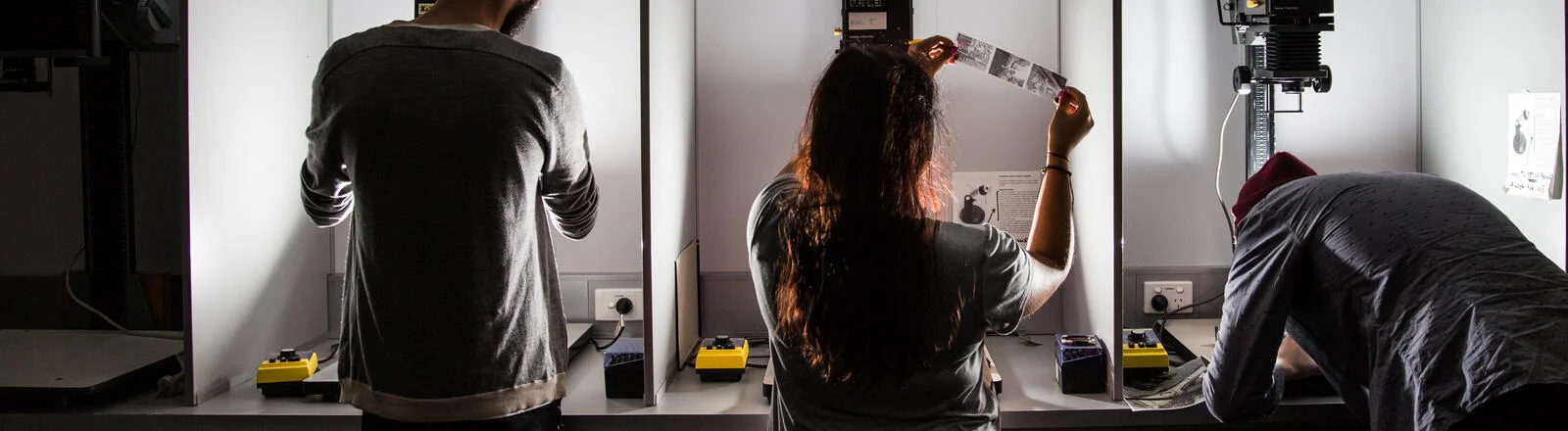

Professional studios for creating and showcasing

Join a vibrant network of practitioners and peers

Pathway to masters or research degree
Why choose communication and creative arts at Deakin
Explore advanced creative projects and research through a Bachelor of Communication and Creative Arts (Honours). Undertake specialised study combining the theory and practical skills gained throughout your undergraduate degree. With a strong interdisciplinary focus, you will collaborate with students from across communication and creative arts disciplines — including dance, theatre, film, television, animation, photography, design, digital media and visual arts — while developing your creative practice and scholarly research skills.
Guided and supported by a supervisor you will undertake an individual creative project. You will build your skills, critical engagement and depth of knowledge in your chosen area of study. Look forward to expanding your knowledge in an area you are passionate about and gaining invaluable research and life skills. On graduation you can continue studying into the Master of Fine Arts or a Master of Arts, or you could pursue a PhD.
-
Connected creative community
Expand your network, grow through critical feedback from peers, practitioners and academic experts deeply embedded in arts and media organisations.
-
Industry-leading creative spaces
Access design and performance studios, green-screen and editorial hub, virtual production facilities and gallery spaces at the #1 university in the state of Victoria for facilities and resources.
-
Research-led honours year
Build independent practice through a supervised creative project, with a pathway to the Master of Fine Arts, research masters or a PhD.
-
Learn from experts
Be nurtured at the #1 university in the state of Victoria for student support, guided by academic staff who are active researchers and experienced educators.

Connected to industry
Deakin’s strong industry connections help shape your learning. Build practical experience in real workplace contexts through work-integrated learning, mentoring and networking opportunities. Industry advisory boards also help shape our degrees, which means what you study is current, relevant and aligned to what your future employers need.

Deakin puts employability first
Career outcomes
Develop advanced creative practice, research capability and transferable communication skills for work across creative arts and cultural industries or build a pathway to further study in your chosen specialisation.
Animator
Create 2D and 3D animation for film, television, digital media and other creative projects. Develop concepts, storyboards and visual sequences, then use specialist software to bring images and ideas to life.
- $85k
Typical salary in Australia
- 9.9%
Projected job growth in 5 years


Photographer
Plan and produce artistic or commercial images in studios or on location. Work with clients, select equipment and settings, capture subjects and refine images using digital editing tools.
- $75k
Typical salary in Australia
- 4.5/5
Job satisfaction

Careers depend on areas of specialisation:
- Dance
- Visual arts
- Film
- Communication design
- Theatre
- UX design

Key dates

Direct applications
Trimester 1 2027 applications close 7 February 2027
*Deakin references data from a range of government, higher education and reputable media sources. Learn more about our achievements on our University rankings page, or explore our sources page for supporting references.
What will I study in the Bachelor of Communication and Creative Arts (Honours)?
You will move through a tightly focused structure that blends research development, discipline-specific refinement and a major supervised project.
Sharpen your creative focus
Build your research approach
Learn how to frame questions, investigate contemporary practice and choose methods that suit your area. This gives your creative work or scholarly inquiry a clear, rigorous backbone.
Develop discipline-specific practice
Connect theory with practice. Extend the skills, techniques and conventions of your field.
Complete a supervised final project
Undertake a major project that can lean towards creative practice, industry engagement or disciplinary inquiry.
Course structure
To complete the Bachelor of Communication and Creative Arts (Honours), you must pass 8 credit points.
Most units are equal to one credit point. As a full-time student you will study four credit points per trimester and usually undertake two trimesters per year.
Are you a current student? For course information that applies to the year you started your degree, visit the handbook.
All students are required to meet the University's academic progress and conduct requirements
Units
Compulsory 0-credit point module
To be completed in the first trimester of study:
Units
Students will be supported to choose one unit from:

What to expect while studying
You may be able to study available units in the optional third trimester to fast-track your degree, however your course duration may be extended if there are delays in meeting course requirements, such as completing a placement.
At Deakin, we're committed to ensuring an inclusive environment that supports all students to belong, thrive and succeed. We work closely with students, where needed, to identify potential barriers to participation and where possible, provide tailored support so students can engage with learning and assessment activities.
If you are neurodivergent, have a disability, health condition or mental health condition that may impact your study or participation in university life, and want to know how Deakin could support you, contact our Domestic students (opens in a new window) or International students (opens in a new window) or Disability Resource Centre (opens email client) teams for a collaborative and confidential discussion. This discussion is to support you to make plans for your studies and future career and will not have any bearing on your application to the course.
When can I start?
When you study depends on your course, location and available intakes. Check the table to see when you can start and how study is offered throughout the year.
Your course learning outcomes describe the knowledge, skills and capabilities you’ll develop and be able to demonstrate by the time you graduate. Built into your course through your units and assessments, they provide a clear picture of what you’ll be equipped to know, understand and do – preparing you to apply your learning with confidence beyond university.
| Course Learning Outcomes |
|---|
| Identify and apply critical analysis, engagement and evaluation within discipline specific contexts. |
| Articulate discipline specific and interdisciplinary ideas, through a range of practical creative processes, to inform discussions of approach and relevant contemporary ideas. |
| Utilise a range of technologies and digital strategies to research, develop and actualize projects within discipline specific contexts |
| Engage in high-level independent critical thinking to investigate, describe and synthesize ideas and their application within discipline specific discourses. |
| Identify, evaluate and select the methods, techniques, concepts and processes to investigate and apply effective solutions. |
| Exercise autonomy, adaptability, responsibility and a continued commitment to learning and skills development in professional, creative and scholarly contexts. |
| This Course Learning Outcome is not explicitly assessed |
| Apply self-reflexivity and critical analysis to personal cultural values, privileges, and biases while engaging with diverse perspectives, particularly Indigenous Knowledges, in the development of research and creative and industry specific works. |
Approved at Faculty Board May 2025
- Award granted
- Bachelor of Communication and Creative Arts (Honours)
- Year
2027 course information
- Deakin code
- A450
- Level
- Undergraduate
- Australian Qualifications Framework (AQF) recognition
The award conferred upon completion is recognised in the Australian Qualifications Framework at Level 8
Fees
Estimated tuition fee
$11,916
for 1 yr full-time - Commonwealth Supported Place (CSP)
The estimated tuition (student contribution) fee above is based on a typical first-year full-time enrolment of 8 credit points and is provided as a guide only. Your student contribution is determined by the units you enrol in and will vary depending on the units you choose, your study load, the course duration, and any approved recognition of prior learning. You may also be eligible for a HECS-HELP loan to defer payment of all or part of your student contribution.
Check your eligibility or learn more about CSP or HECS-HELP.
Scholarships
We want to help you excel at Deakin. Our scholarships recognise your dedication and achievements, providing financial support that can ease the cost of living and studying. With less pressure, you'll have more freedom to focus on what matters most – your education and future success.
Applications for 2027 are open
Ready to take the next step? Apply now to start your journey at Deakin and get ready for what’s next.
Key dates
Direct applications
Trimester 1 2027 applications close 7 February 2027
Apply now

Apply direct
Simply create an account in the Deakin Application Portal, enter your personal and educational details, upload your supporting documents and submit your application.
Additional applicant instructions
Please refer to the additional requirements in the expression of interest document. Please have the document completed, ready to upload to the applicant portal.
Recognition of prior learning
We value your previous study and experience. Recognition of prior learning enables you to get credit for what you've already achieved. When you apply, we'll consider your previous study and experience for recognition of prior learning.