
The text of this article is licensed under the Creative Commons Attribution (CC BY) 4.0 International license. We'd love for you to share it, so feel free. Images, videos, graphics and logos are not covered by the CC BY license and may not be used without permission from Deakin or the respective copyright holder. For more information on how to share or reuse this content, please contact researchcomms@deakin.edu.au.
Bridging the distance in STEM education
Research news
2 June 2026
Deakin University researchers are making it easier for students in regional secondary schools to learn STEM (science, technology, engineering and maths) through hands-on experiences.
They’ve created a new educational communications platform, RoboCom, allowing students to control real lab equipment remotely, including world-class robot arms hundreds of kilometres away.
Able to be used even in areas with unreliable internet connections, the platform allows students to undertake practical experiments no matter where they live.
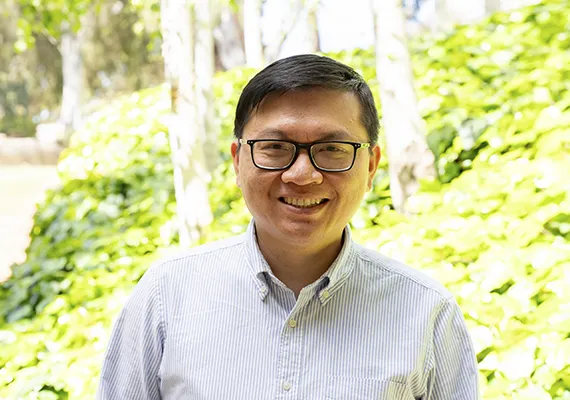
Led by Dr Van Thanh Huynh from Deakin’s School of Engineering, the multidisciplinary project team includes Associate Professor Zoran Najdovski from the Deakin Institute for Intelligent Systems, Professor Julianne Lynch from the Centre for Research for Educational Impact and PhD candidate Riley Bain.
Overcoming barriers to access
Many students in rural and regional areas want to learn more about STEM, but most labs with special equipment are in big cities, so they’re hard to access regularly.
As a result, these students often miss out on hands-on learning experiences that can be critical for understanding physics, engineering and technology subjects.
This project was motivated by a desire to reduce that gap by enabling students to physically interact with real laboratory equipment over the internet, rather than only by viewing simulations
Enabling hands-on learning
The learning platform allows students to interact with real laboratory equipment like the robot arm located in Deakin’s Mechatronics lab over the internet using haptic, or touch-based, interfaces.
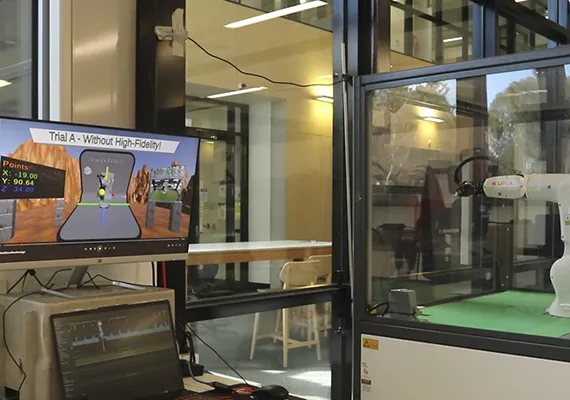
When a student moves a controller in their classroom, that movement is transmitted in real-time to equipment located in the lab. At the same time, resistance or motion from the equipment is sent back to the student’s device, allowing them to feel how the system responds.
This two-way interaction allows the student to experience the equipment as if they were physically present in the laboratory, even if they’re hundreds of kilometers away.
Co-designing solutions with teachers
The research team partnered with four teachers from two regional Victorian secondary schools to help design learning experiences that meet real classroom needs.
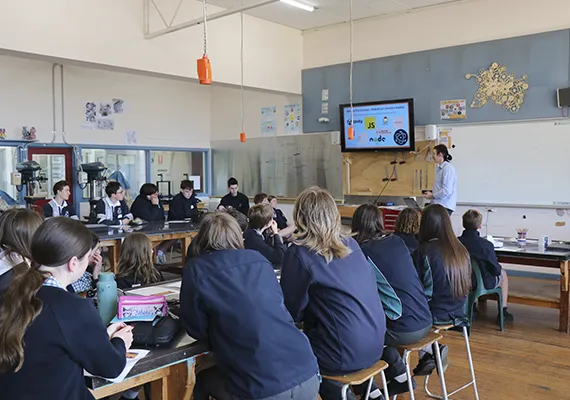
‘Teachers contributed to shaping the learning activities, selecting suitable experiments and ensuring the technology aligned with curriculum requirements,’ says Dr Huynh.
‘Importantly, they also helped identify practical constraints like class time, available resources, and local internet performance, ensuring that the platform would be usable in real classroom conditions.’
Real-world trials in regional Victoria
Working with schools including Heywood Secondary College and Portland Secondary College, Dr Huynh and his team have been testing the technology in real classrooms, improving it based on feedback from students and teachers.
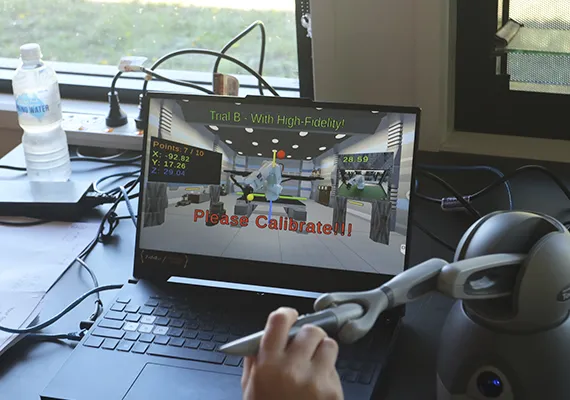
The system is built to handle unreliable internet, adjusting in real time to delays and data loss so it stays stable, even in regional and rural areas where connections can be unpredictable.
So far, feedback from participating schools has noted the responsiveness and reliability of the interactions, as well as increased student understanding and immersion.
As a next step, the team hope to scale the platform to support multiple students and teachers across different geographical locations, allowing them to work together within the same online STEM lab.
This project is supported by the auDA Foundation’s Community Grant program.