
Truth and justice commissions: Oscar Kee’s PhD proposal
For PhD candidates, a thesis can take years to prepare. At Deakin’s Three Minute Thesis (3MT®) competition, audiences get a summary in just 180 seconds. Here, complex ideas are distilled into approachable soundbites, easy enough for any of us to understand.
Deakin University PhD candidate Oscar Kee has channeled all his empathy, intelligence and passion into a noble cause close to many Australians’ hearts: truth and justice commissions.
What is a truth and justice commission?
‘A truth and justice commission is a fact-finding inquiry which seeks to document colonial harms, promote healing and recommend solutions,’ Kee explains.
The first truth and justice commission held in Australia – Victoria’s Yoorrook Justice Commission – presented parliament with thousands of firsthand accounts from First Nations peoples, detailing everything from ‘land injustice to health and housing.’
After the defeated Voice referendum, the Greens introduced the Truth and Justice Commission Bill 2024 to set up a federal truth and justice commission.
The bill’s goal, as stated in its outline, is to ‘establish a Commission to inquire into and make recommendations to Parliament on particular matters relating to historic and ongoing injustices against First Peoples in Australia and the impacts of these injustices on First Peoples.’
Why is a truth and justice commission a cornerstone of reconciliation?
When the Yoorrook Commission concluded this year, it presented 100 recommendations for reforms based on the evidence heard. The idea sounds like a respectful and considered path forward, and, in theory, a truth and justice commission should be a cornerstone of reconciliation.
There's a problem, however.
In Kee’s colourful words, these sorts of truth and justice commissions ‘suck’.
‘They suck because fundamental understandings of truth and justice are completely different between First Nations philosophies and predominantly Western philosophies that govern Australia,’ he says. ‘That in turn, leads to an inability or unwillingness for the government to listen to First Australians. That dooms truth commissions to failure from the start.’
Kee also points to Australia’s historic royal commissions – the Royal Commission into Aboriginal Deaths in Custody and the National Inquiry into the Separation of Aboriginal and Torres Strait Islander Children from Their Families. As he explains,these well-meaning commissions have resulted in little real change for Indigenous Australians.
‘We are 30 years on from two major truth and justice commissions,’ he says. ‘One said stop over-incarcerating Indigenous Australians. The other said stop stealing Indigenous children from their families. Instead of improving things, we have instead doubled the rate at which we incarcerate First Australians. We have doubled the rate at which we steal Indigenous children from their families. To add to this, a year ago a commission in Melbourne handed down 46 commission recommendations to the government, of which it supported only four.
That sucks.’
Taking action: How Kee’s research could transform truth and justice commissions
Kee hopes to reform the way these commissions are run in the future andensure they actively improve the lives of Australia’s First Peoples.
For things to get better, we must listen to what First Australians want out of these commissions and what they want to see from the outcomes and procedures, which is where my research comes in.
As part of his research, Kee is conducting extensive interviews to harness the knowledge and insights of people close to, and affected by, truth and justice commissions.
‘I am interviewing politically active and nonacademic Australians to understand what they want out of these crucial commissions,’ he says. ‘I have also interviewed ex-commissioners about what they have done and what they would do differently, could they do it all over again. Armed with this knowledge, we can ensure that future truth and justice commissions won't have just four recommendations supported, they would have a majority of recommendations supported.’
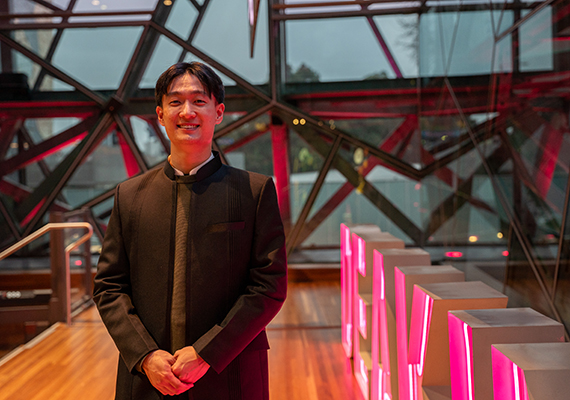
View Oscar's 3MT presentation
Watch Oscar condense his research into an engaging three-minute talk.
How 3MT gave Oscar a platform to explore dark truths
PhD research is deep, giving candidates a way to hone their academic skills and make their own mark on their chosen field. The complexity of PhD theses can make it difficult for those outside the sphere to understand but, with 3MT, these ideas are condensed and made approachable to a wider audience.
It’s an important initiative, and not just because 3MT finalists stand a chance of taking home $3000 if they win the competition. By bringing research like Kee’s to the public, 3MT allows important ideas to be shared and understood – hopefully helping spur on real change.
‘This affects not just Australia, but other countries like Canada and New Zealand as well,’ Kee says of his research into truth and justice commissions. ‘Now, granted, the impact from this research won't be seen in a year or a decade but over a generation. Societal change takes time, but it starts here with listening.’
As the 3MT audience can attest, the world is definitely listening.
Interested in investigating important issues like Indigenous rights? Explore your PhD options at Deakin.
If this content has raised anything for you, support is available. The following services operate 24 hours a day:
- Beyond Blue: 1300 224 636
- 1800RESPECT: 1800 737 732
- MensLine Australia: 1300 789 978
- Lifeline: 13 11 14
- Suicide Call Back Service: 1300 659 467
- 13YARN: 13 92 76