How can workplace safety training better protect frontline workers?
We all deserve to feel safe at work. Yet for many people, simply doing their job carries risk – and the workplace safety training designed to reduce that risk doesn’t always reflect the realities of hands-on roles.
At Deakin University’s 2025 Three Minute Thesis (3MT) competition, PhD candidate Hayley Keane explores how current workplace safety training can fall short for frontline workers. Her research examines how worker voice and lived experience, particularly in hospital catering, cleaning and linen services, could be better used to inform training that is relevant, accessible and effective.
In just three minutes on stage, Hayley distils years of research into a clear idea: if workplace safety training is disconnected from how people actually work, it may fail to keep them safe.
Why is safety training important in the workplace?
Hayley's research focuses on workplace safety training broadly, but is grounded in firsthand experiences from catering, linen and cleaning service workers in a public hospital.
'Most of you will have been inside a hospital,' Hayley says. 'You will have seen the doctors and the nurses, but I'm wondering if you noticed the person delivering the meal or the one cleaning. These workers are critical to the successful running of our hospitals. And just like you and I, they must complete their mandatory safety training.'
As staff told Hayley during her research, workplace safety training is vital to protecting both workers and patients. During her fieldwork, Hayley also experienced a frightening near-miss herself in a moment that underscored just how important relevant safety training can be.
'I realised the workers were right about the relevance of training to the role when another worker physically stopped me from collecting a sheet that had dropped from the claws of the sheet-folding machine onto the floor,' Hayley says. 'If she hadn’t done that, I would have been hit on the head by the claws of the machine.'
Workplace safety training isn't just an administrative requirement – it's critical to keeping people safe at work. Hayley's research shows, however, that for training to be effective, it must be shaped by the lived experiences of the workers it's designed to protect.
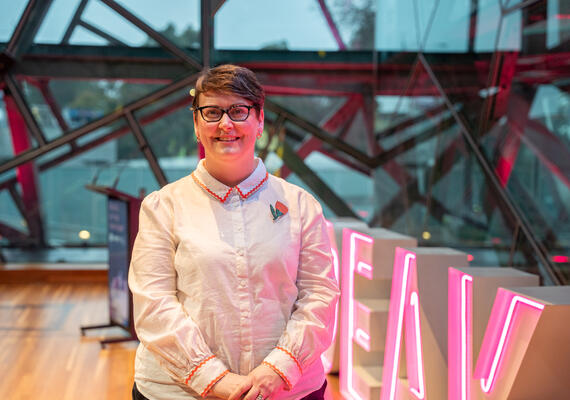
View Hayley's 3MT presentation
Watch Hayley condense her research into an engaging three-minute talk.
What is the current state of workplace safety training?
By working as a laundry hand, catering worker and cleaner herself, Hayley experienced workplace safety training from the inside. While workers were required to complete online training modules, these were often difficult to navigate and poorly aligned with their day-to-day roles.
In a blog post for Deakin’s Research for Educational Impact (REDI), Hayley explains that this kind of workplace safety training can also overlook workers' digital capabilities, creating an additional barrier to completion.
'Through my research I have confirmed that there is a disconnect between the digital skills required to undertake a work role and the digital skills required to undertake mandatory safety training,' Hayley writes.
How can online workplace safety training be made more relevant for hands-on workers?
The workers Hayley studied are often labelled 'unskilled' – a description she strongly challenges.
'These workers are far from unskilled,' Hayley says. 'They have developed important knowledge about workplace safety, but there’s a mismatch between their knowledge and experience and the information being provided in safety training.'
As Hayley discusses in her REDI blog, online safety training modules are not always suitable for this cohort. Instead, she argues that training should reflect the informal, peer-to-peer learning already taking place on the job.
'They have knowledge about workplace safety that has been developed through years of collaborative experience and by-the-side, peer-to-peer instruction and modelling,' Hayley writes. 'These workers are experts in workplace safety and workplace learning related to their own work environments and roles. For workers to be kept safe at work, this expertise needs to inform the design and delivery of mandatory safety training that is relevant, accessible and effective.'
We are going to make it relevant to the work completed every day. We're going to make it learn the way that workers learn at work and we're going to make it engaging because we really only have one plan: keep the workers safe at work.
Deakin PhD candidate
What is Hayley Keane’s vision for workplace safety training?
Watching Hayley speak at 3MT, it's clear she brings both deep care and practical ambition to improving workplace safety training.
One of the most significant outcomes of her research could be a shift in how training programs are designed – moving away from top-down models and toward approaches informed by workers themselves.
'I’ve got a plan,' Hayley says. 'I have an education manager, a learning designer and workers previously labelled as unskilled ready to work with me to redesign safety training. We are going to make it relevant to the work completed every day. We're going to make it learn the way that workers learn at work and we’re going to make it engaging – because we really only have one plan: keep workers safe at work.'
How has 3MT helped platform Hayley’s research?
PhD research doesn’t always reach a mainstream audience. Like the workers Hayley studies, important insights can remain unseen, particularly when academic research is complex or highly specialised.
The Three Minute Thesis competition is designed to change that. By challenging PhD candidates to explain their research in just three minutes, using language appropriate for a non-specialist audience, 3MT helps bring vital research into the public conversation.
For Hayley, that platform offers an opportunity to spotlight gaps in workplace safety training and to push for changes that could make work safer for people whose roles are too often overlooked.
Interested in investigating important issues like workplace safety? Explore your PhD options at Deakin.