
Indigenous leadership: from community to global impact
Human rights lawyer and Deakin University Associate Dean, Indigenous, Marijke Bassani has dedicated her career to creating opportunities for others.
‘I don't want to help people – I want to awaken them to the power they already hold within themselves. It is my job to use my platform to elevate that power and the voice that embodies it,’ says Bassani. ‘I didn’t get all these degrees and attend all these fancy institutions so I could have a great salary or further promote myself. I did it so that I could come home and actually make a real difference because of how I grew up.’
A Lama Lama/Lamalama, Binthi Warra (Guugu Yimithirr Nation) and Bulgun Warra Aboriginal woman raised in the Cape York Peninsula, Bassani has made it her life’s work to use her education and experience to create impactful change for Indigenous communities and beyond.
Today, she is a powerful example of the impact Indigenous leadership can have, from local communities to the global stage.
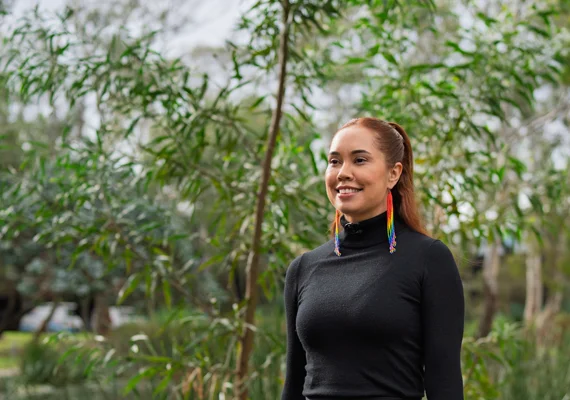
A platform for Indigenous voices
Marijke Bassani shares how she's using her education and experience to create change for Indigenous communities.
The community foundations of Indigenous leadership
Bassani describes her upbringing as remote and rural. While her relationship to her home is one of peace and joy – ‘When things feel overwhelming, I always go back to Country,’ she says – growing up on Country also exposed her to the challenges many people in the region face. It’s this contrast that shaped her deep sense of empathy.
‘That remoteness and that rural upbringing and that very, very close proximity to poverty that I had growing up made me develop a bigger container than I think most ordinary people would have when it comes to compassion, empathy and understanding,’ she says. ‘I was surrounded by people from all walks of life, people who had spent their life in and out of prison, people who were escaping domestic violence, people who were committing domestic violence, people who were in chronic unemployment and substance abuse, people who were carrying significant complex trauma and untreated mental health issues.’
These experiences would later fuel Bassani’s determination to pursue opportunities that had rarely been available to people from her community.
‘I was the first in my family to complete high school and attend university, which led to becoming the first international human rights lawyer in the entire region. This led to Oxford and Berkeley where I completed a cross-institutional PhD while serving as a visiting scholar and the human rights lawyer in-residence, becoming the first Australian to hold the latter role,’ she says.
Marijke’s journey from commercial law to human rights advocacy
Bassani’s career began in corporate law – though it’s not a period she remembers fondly. The experience gave her valuable legal training, but defending large corporations never felt like a long-term fit. It was far removed from the community-centred approach at the heart of her leadership.
‘Many human rights lawyers don't have commercial training,’ she says. ‘Many started out in community law, which is really important, but the pace is different, the workload is different and there are no billable hours. So, I went down the commercial law firm road for the training but after a couple of years the work started to weigh very heavy on the spirit because I was literally the devil's advocate.’
Tired of fighting on the side of big business, Bassani returned home and found inspiration waiting for her.
‘I ended up leaving the firm to practice native title law. It was an opportunity for me to return home to work on Country in the Cape, to work for my own people, my own communities and many other Cape York communities,’ she says. ‘It reawakened that spark and passion. It reminded me why I chose this path. It was always for the community – the First Nations community, and vulnerable marginalised members of the wider community. I love our shared humanity. That's why I do this work.’
Refreshed and reinvigorated, Bassani left the Cape again to become a discrimination lawyer and start her career in academia and, eventually, international human rights advocacy.
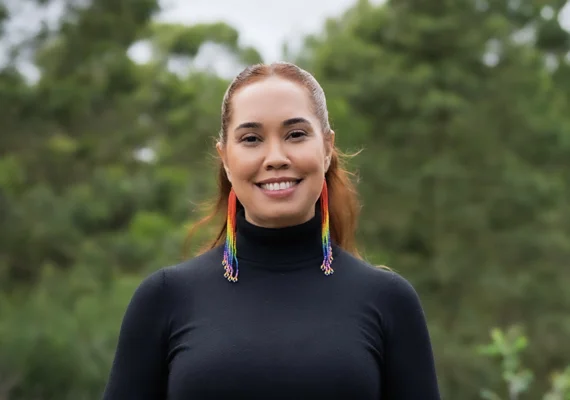
It's on everyone – not just First Nations people – to move the world, our country, our nation and our community forward and in a direction that actually values and respects everyone's differences.
Associate Dean, Indigenous
Bringing Indigenous advocacy to the global stage
Nowadays, Bassani’s work has long taken her far beyond Cape York Peninsula.
She has taken her passion for international human rights law and Indigenous advocacy across the globe, spending time as a cross-institutional PhD law candidate, visiting scholar and human rights lawyer in-residence at UC Berkeley, joining Oxford University’s Intersections Gender Justice Project, and delivering a statement on Indigenous LGBTQIA+ rights at the UN, which led to publishing multiple works with Oxford University Press.
Yet Bassani’s pursuit of global opportunities was never about prestige. Instead, it was a way ti 'reclaim, reframe and reimagine a future where the only path forward is the one we take together because that’s what it will take to affect real structural change. What we’re fighting for now is each other’.
‘Those experiences abroad also highlighted for me the importance of advancing higher and further within white Western frameworks of success,’ Bassani says. ‘I knew that attending those elite institions and having those names behind me would make it harder for my voice to be excluded from rooms I had every right to be in. Throughout my career many Australians in the legal profession and academia have told me implicitly and explicitly that I didn’t belong, but Berkeley, Oxford and Harvard made it difficult to argue, let alone prove, that.’
How Indigenous leadership is shaping Deakin’s future
Creating lasting change requires collective effort, and universities, governments, communities and individuals all have a role to play. At Deakin, that commitment is reflected through initiatives such as the Indigenous Research Strategy, which aims to support the next generation of First Nations researchers and academics through community-led research and employment opportunities and pathways for growth.
But while institutions can create opportunities, Bassani believes that Indigenous leadership, and leadership more broadly in Australia, also begins with individuals and the choices they make within their own communities and homes.
‘It's on everyone – not just First Nations people – to move the world, our country, our nation and our community forward and in a direction that actually values and respects everyone's differences,’ she says.
Creating that change requires more than just good intentions, marches and social media activism. It demands courage.
‘Indigenous leadership and leadership in Australia more broadly is very important, but the current climate calls for a braver, more courageous style of leadership than we've seen before, because these are not comfortable times that we're living through,’ Bassani says.
‘These uncomfortable times call for uncomfortable conversations. And whether you're Indigenous or non-Indigenous, if you lack the courage to sit in that discomfort, and have those conversations or more specifically lead them, then maybe you should rethink whether you are cut out to be a leader in the first place. Excellent leadership calls for, and welcomes, radical compassionate honestly first with ourselves, and then with each other.’
While Bassani believes there is still much work to be done, there is plenty of reason to be optimistic.
‘This work is not for the faint hearted, but we owe it to ourselves, our descendants and each other to keep going because at the end of the day, we all have to call the same place home. Let’s make it safe for everyone, especially those most vulnerable in our societies”.