Meet Deakin’s first 3MT winner, Anthony Ware
PhD theses are deep dives into narrow fields – not the kind of research that easily fits into 180 seconds. But that’s exactly what the Three Minute Thesis (3MT®) competition is all about.
In the 3MT® competition, graduate researchers are challenged to stand in front of a non-expert audience and explain their PhD thesis without it turning into a Lord of the Rings-style epic. They get just three minutes to translate years of work into an elevator pitch – and they could walk away with a cash prize for doing so.
If it sounds like a challenge, that’s because it is. But for competitors like Deakin’s first 3MT® winner Anthony Ware, it’s also a serious opportunity to reframe their research, sharpen their communication skills and bring their work to a wider audience.
From PhD to 3MT® winner
Since the mid-1980s, Anthony Ware has been fascinated with Myanmar. Back then, he felt like the only one.
‘In 1988, one year before the Tiananmen Square massacre, there was a massacre in the streets of Myanmar,’ Ware says. ‘But there were no TV news reporters, so it didn't make our TV screens – nobody knew about it. Three thousand people shot dead on the streets, and nobody seemed to know a thing about it.’
20 years later, Ware began his PhD thesis, looking at the plight of non-governmental organisations (NGOs) in Myanmar.
‘At that point in time Myanmar was a dictatorship, and the international community had applied a range of sanctions, so sending money to Myanmar was often illegal or very complicated,’ Ware says. ‘So, for an international NGO to operate in the country without colluding with a dictator that had been sanctioned by the international community, and yet having permission to operate from that dictatorship, was a really complicated tightrope of permissions and approvals.’
Ware found that not only was life complicated for NGOs in Myanmar – it was complicated for him and his PhD thesis, too. He found himself under a ‘mountain of data’, struggling to align his extensive field work with his research question. That’s when his research supervisor, Professor Matthew Clarke, suggested Ware give the 3MT® competition a go.
‘He tapped me on the shoulder and said, “This would be really good for you,”’ says Ware.
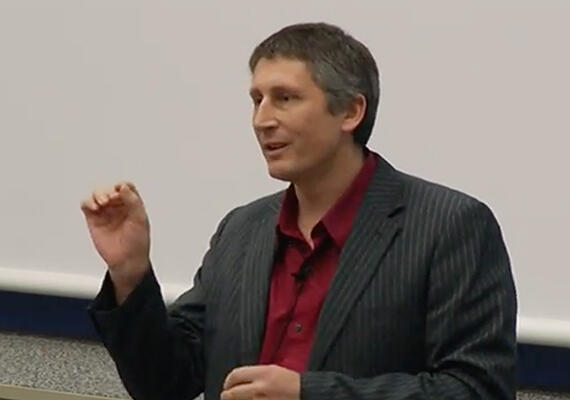
Watch Anthony Ware's winning 3MT talk
See how Anthony Ware distilled complex research into a compelling three-minute talk that helped him win Deakin’s first 3MT competition.
Ware’s experience of the 3MT® competition
For Ware, the 3MT® competition was a chance to refine his own research and sharpen his focus. He certainly never expected to become a 3MT® winner – let alone Deakin’s first – which made his eventual victory even sweeter.
‘I really couldn't quite believe it when I was announced the winner of 3MT®,’ Ware says. ‘I was very nervous. I've done a reasonable amount of public speaking beforehand, but I've never been particularly comfortable with public speaking, and I could certainly never speak from memory. I can't memorise a script, so I had written notes in front of me. Most of the other contestants had memorised their scripts, so I wasn't convinced I was going to win.’
While the prestige of victory and the bonus of a cash prize make being a 3MT® winner a worthy goal, for Ware, the real reward was what he learned along the way.
‘It's helped me to stay accountable and to be able to focus on being able to communicate clearly and succinctly in layman’s terms so that non-academics or people from other disciplines can hear and understand what it is I'm doing before their eyes glaze over.’
Why the 3MT® competition is important for graduate researchers
Ware is aware that academics aren’t always viewed so positively outside the university system – and he believes part of that is because of poor communication. One of the big benefits of 3MT® is that it can help academics become more personable and their research more approachable to the public.
‘3MT® matters because academics and researchers need to be able to explain their research in ways that show its relevance,’ he says. ‘The world, politicians and news media tend to switch off from academics as being disconnected from the real world. Most of our research is very grounded and has massive implications, and we need to get our message across a lot better.’
As Ware explains, academics can be victims of their own expertise. Competing in 3MT® can help translate those huge swathes of data, deep insights and complex language into terms others can understand – giving graduate researchers a head start on valuable communication skills.
‘Three minutes is the maximum you can push even your closest family and friends before they completely switch off,’ Ware says.
The ability to summarise three years of work down to a single page so a policymaker can say, “Okay, that's what I should do”. I think that's the power of 3MT®. It forces you to learn that discipline early.
Associate Professor of Humanitarianism and Development
Ware’s advice to aspiring 3MT® winners
As a seasoned academic, Ware now gets the chance to mentor the next wave of graduate researchers. While 3MT® is just a small part of the potential PhD experience, Ware sees plenty of benefits and always pushes his students to take the opportunity.
‘Since my own 3MT® experience, every one of my PhD students, I've strongly encouraged them to participate because I can see the benefit it has for them in their candidature,’ he says.
So, if you’re looking for advice, take it from a 3MT® winner: go for it, because it’s definitely worth it.
‘Firstly, it will help you clarify your research question – it'll help you get your PhD written and completed,’ he says. ‘Secondly, it'll help you communicate to other people what on earth you're doing and why.’
3MT® winner and beyond: Anthony Ware’s current research
Life in academia moves fast. While Ware can look back fondly on his 3MT® winning speech and the benefits he’s found, his focus is firmly back on Myanmar. These days, his research is focusing on Myanmar’s Rohingya refugees, millions of whom have been displaced to bordering Bangladesh.
‘Rohingya refugees have been languishing in refugee camps in Bangladesh for eight years now,’ Ware says. ‘They're not allowed to work, there's no education being offered in the camps; they're not technically allowed out of the camps.
'So, you imagine kids that were five, six, seven at the time, they had to flee because of ethnic cleansing, genocide – and then they’re stuck in a camp for another eight years. If my research helped open the door for their repatriation or for those kids to have a future, that alone would be worth my whole career.’
Alongside this, his work also explores how humanitarian and development agencies can address the root causes of violent extremism, such as inequality, injustice and marginalisation, while navigating the risks of engaging in this space through a ‘do no harm’ approach.
The purpose of 3MT® is to help PhD students refine and reframe their focus – not just so they can become a 3MT® winner, but so their research can blossom and make a real difference in the world. Just like Ware’s is.
'If I can't communicate that in 30 seconds with you, then what's the point?’ he says. ‘If I can't convince a politician that this is actually a really important issue, then my research has minimal value and minimal impact.’
Want to hear from more 3MT® winners and success stories? Explore the experiences of Dilendra Wijesekara, Houson Hu and Oscar Kee.