
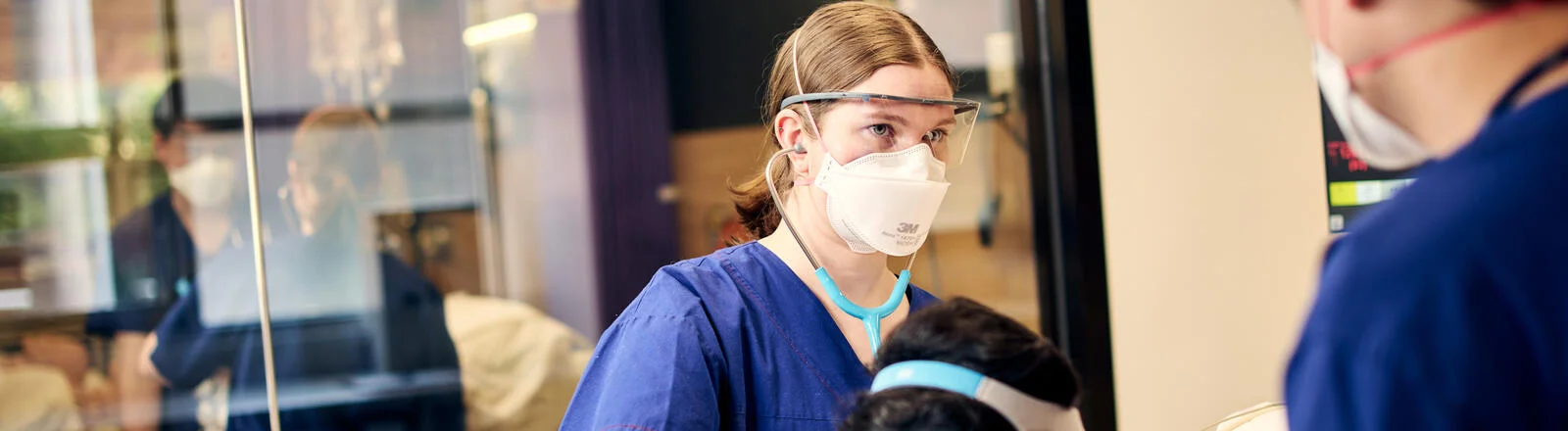

#14 in the world for nursing

Advanced nursing studies

Flexible online courses for practising nurses
Why choose emergency nursing at Deakin
Emergency departments present some of the most varied and complex patient cases in healthcare. Deakin’s Graduate Certificate of Emergency Nursing builds your capability to assess, prioritise and manage patients across a wide range of acute conditions.
Study with Deakin’s School of Nursing and Midwifery, ranked #14 in the world, and learn from experts in emergency and critical care practice. You will develop advanced skills in triage, patient assessment and clinical decision-making, preparing you to respond effectively in fast-paced, high-pressure environments.
Designed for working nurses, this flexible online course allows you to continue practising while you study, applying your learning directly within your emergency care setting through Deakin’s strong network of healthcare partners across metropolitan, rural and regional Australia.
-
Global nursing reputation
Study at a school of nursing ranked #14 in the world, recognised for high-quality teaching and research.
-
Unique emergency nursing specialisation
Study at one of the only universities in Melbourne offering dedicated emergency nursing postgraduate courses.
-
Flexible study for professionals
Online study options let you build advanced emergency nursing capability while continuing in clinical practice.
-
Confidence in clinical skills
Deakin postgraduate nursing students report higher confidence in their skills development than the national average.


Connected to industry
Deakin’s strong industry connections help shape your learning. Build practical experience in real workplace contexts through work-integrated learning, mentoring and networking opportunities. Industry advisory boards also help shape our degrees, which means what you study is current, relevant and aligned to what your future employers need.

Deakin puts employability first
Career outcomes
Advance your emergency nursing practice and prepare to lead and educate teams responding to urgent, unpredictable and complex patient needs.
Nurse manager
Lead emergency nursing teams in fast-paced environments. Coordinate resources, support clinical decisions and maintain safe, responsive care during periods of high demand.
- 13.6%
Projected job growth over 5 years
- $145k
Typical annual salary in Australia


Nurse educator
Prepare nurses to assess, prioritise and respond confidently to urgent presentations. Design education that supports rapid decision-making, teamwork and safe emergency care.
- 5,000
Nurse educators employed
- $138k
Typical annual salary in Australia
Other jobs
- Clinical nurse specialist
- Clinical nurse consultant
- Advanced practice nurse
- Nurse researcher
- Quality and safety coordinator
- Healthcare leader

FAQs
The cost of studying at Deakin depends on your degree, units and study load – tuition fees are listed on degree pages under the fees and scholarships tab. Beyond tuition, you will need to budget for Overseas Student Health Cover (OSHC), accommodation, transport, groceries and textbooks. Find out more about the cost of living in Australia, use the Study Australia calculator to estimate living expenses and explore international scholarships which may help to reduce your tuition costs.
Deakin offers a range of merit-based scholarships that can reduce your postgraduate tuition fees by 20%, 25%, 50% or 100% for the duration of your degree. Eligibility varies by scholarship and the degree you choose, but you will automatically be considered for most scholarships when you apply to Deakin. Use the Find a scholarship tool and filter by 'citizenship' to see what is available to you, or explore Australia Awards scholarships if you are from an eligible country.
It depends on the degree and how you study. Graduate certificates typically take six months full time or one year part time. Graduate diplomas usually take one year full time and masters degrees typically take one to two years full time. Recognition of prior learning can reduce your study time. Check the degree page for full details.
Australia is widely regarded as one of the safest and most welcoming countries in the world for students, with strong legal protections, reliable public services and a multicultural community. In fact, Melbourne is ranked the #4 student city in the world! At Deakin, you will be part of a supportive community, with 24/7 help, dedicated campus security and practical tools to help you feel safe, confident and connected. Deakin’s SafeZone app also connects you directly to campus security and support services if you ever need help. Find out more about studying in Australia.
We value your experience and qualifications. That is why every new degree application at Deakin is assessed for recognition of prior learning (RPL). Through RPL, Deakin can assess your previous study and life experience and may award course credit that could reduce your study duration, as well as the cost of your study. Qualifications from universities and private tertiary institutions worldwide are considered, as is informal learning related to your degree. Use the RPL calculator to see how much credit you may be eligible for.
Deakin offers a wide range of support to help you settle in and succeed throughout your studies – we are ranked the #1 university in Melbourne for student support. You can access 1:1 study support, English language support, career planning help, disability services and free counselling, as well as financial assistance if you need it. On campus, the SafeZone app and 24/7 security services mean help is always within reach. You can explore the full range of support services for international students or start an online chat with a student ambassador before you arrive.
To enrol in a postgraduate degree at Deakin, many degrees require a minimum IELTS score of 6.0 (or equivalent). Some degrees require higher scores, so check the entry requirements tab on the degree page for details. You may also meet the requirement through recent secondary or university study completed in English, or by demonstrating five or more years of living and working in an English-speaking country. Eligibility is assessed on a case-by-case basis. If you do not yet meet the requirement, the Deakin University English Language Institute (DUELI) offers pathway programs to help develop your English reading, writing, listening and speaking skills. Completion of DUELI’s English for Academic Purposes can give you the minimum English language requirements for most Deakin degrees.
Deakin’s postgraduate degrees are designed to advance your career, whether you want to deepen expertise in your field, move into a specialist role or shift direction entirely. All our degrees are shaped by industry partners, so what you learn reflects what employers need now and into the future. We’re proud to be the #1 university in Melbourne for international student graduate employment. With flexible study options and financial support available, Deakin helps you gain the skills, recognition and confidence to reach your next professional goal.
*Deakin references data from a range of government, higher education and reputable media sources. Learn more about our achievements on our University rankings page, or explore our sources page for supporting references.
What will I study in the Graduate Certificate of Emergency Nursing?
Build your advanced capability in emergency care, focusing on assessment, triage and management in complex, high-acuity environments.

Emergency nursing practice
Emergency assessment and triage
Apply structured approaches to prioritise and manage patients in fast-paced, unpredictable emergency settings.
Managing diverse presentations
Develop capability across trauma, mental health, paediatrics and complex patient groups.
Clinical decision-making
Strengthen your critical thinking, autonomy and teamwork to support safe, high-quality emergency care.
Course structure
To complete the Graduate Certificate of Emergency Nursing, you must pass 4 credit points.
Most units are equal to one credit point. This course is available part time only, with students typically studying one to two credit points each study period.
Are you a current student? For course information that applies to the year you started your degree, visit the handbook.
All students are required to meet the University's academic progress and conduct requirements
Units
Professional recognition
Nurses employed under the Victorian public hospital award receive a higher duties allowance for postgraduate qualifications relevant to their practice.

What to expect while studying
To undertake this course you must independently secure employment of at least 24 hours per week in an emergency care setting within a collaborating hospital in Australia.
Course duration may be affected by delays in completing course requirements, such as failing of units or accessing or completing clinical requirements.
As a student in an online course in the Faculty of Health you will be expected to spend 11-13 hours every week studying, interacting via CloudDeakin and completing assessment tasks for each unit in your course.
At Deakin, we're committed to ensuring an inclusive environment that supports all students to belong, thrive and succeed. We work closely with students, where needed, to identify potential barriers to participation and where possible, provide tailored support so students can engage with learning and assessment activities.
If you are neurodivergent, have a disability, health condition or mental health condition that may impact your study or participation in university life, and want to know how Deakin could support you, contact our Domestic students (opens in a new window) or International students (opens in a new window) or Disability Resource Centre (opens email client) teams for a collaborative and confidential discussion. This discussion is to support you to make plans for your studies and future career and will not have any bearing on your application to the course.
When can I start?
When you study depends on your course, location and available intakes. Check the table to see when you can start and how study is offered throughout the year.
Your course learning outcomes describe the knowledge, skills and capabilities you’ll develop and be able to demonstrate by the time you graduate. Built into your course through your units and assessments, they provide a clear picture of what you’ll be equipped to know, understand and do – preparing you to apply your learning with confidence beyond university.
| Course Learning Outcomes |
|---|
| Demonstrate safe psychomotor skills and clinical practice commensurate with emergency nursing theoretical knowledge, evidence-based practice and person-centred care. |
| Demonstrate communication skills to develop and implement plans of care to ensure the delivery of quality, safe nursing care to patients in the emergency care setting. |
| Evaluate information using digital technologies to effectively disseminate relevant emergency care information to patients and/or the multidisciplinary team. |
| Identify and evaluate complex data from multiple sources to inform clinical decision making in the emergency care setting. |
| Apply specialised nursing knowledge and skills to routine and complex problems in the emergency care setting to optimise patient outcomes. |
| Demonstrate professionalism, accountability, reflection, and personal autonomy as an emergency nurse. |
| Establish and maintain inclusive, collaborative professional relationships with all members of the multidisciplinary team. |
| Display accountability for, and sound professional judgement in behaviours that uphold ethical principles of practice within diverse social, cultural, and environmental contexts. |
- Award granted
- Graduate Certificate of Emergency Nursing
- Year
2027 course information
- Deakin code
- H566
- Level
- Postgraduate (Graduate Certificate and Graduate Diploma)
- Australian Qualifications Framework (AQF) recognition
The award conferred upon completion is recognised in the Australian Qualifications Framework at Level 8
Fees
Estimated tuition fee
$14,700
AUD
The estimated tuition fee above is based on a typical enrolment of 4 credit points undertaken within the same academic year and is provided as a guide only. Your tuition fees are determined by your course and unit enrolment. Your tuition fees will vary depending on your study load, the course duration, and any approved recognition of prior learning.

Scholarships
Deakin scholarships recognise your hard work and achievements. Our support can ease the financial pressure of studying in Australia so you stay focused on your success. Numbers are limited, so apply early for the best chance.
Apply now

Apply directly to Deakin
Applications can be made directly to the University through StudyLink Connect - Deakin University's International Student Application Service.
We recommend engaging with a Deakin Authorised Agent who can assist you with the process and submit the application.
Applicant declaration
Applicants must complete the Applicant declaration as part of their application.
Recognition of prior learning
We value your previous study and experience. Recognition of prior learning enables you to get credit for what you've already achieved. When you apply, we'll consider your previous study and experience for recognition of prior learning.
Pathways
Upon successful completion of the Graduate Certificate of Emergency Nursing, students have the option to further their studies by articulating into the below course: