The best online program to grow your arts and cultural management career
If you’re working in the creative industries, finding time to upskill can feel almost impossible. Long hours, project-based work and unpredictable schedules don’t always align with traditional study.
That’s why more professionals are turning to online arts and cultural management programs – to build skills, expand their networks and open new career pathways, without putting their work on hold.
Whether you're an artist transitioning into management or an experienced professional formalising your expertise, flexible online study can help you take the next step – as it did for arts and cultural management students Jochen Gutsch and Ellie Bracci at Deakin.
A new career path in the arts
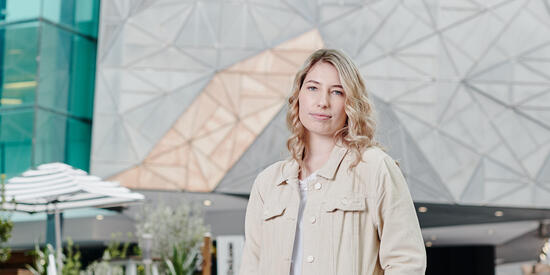
Ellie Bracci had growth in mind. She’s a degree-qualified photographer, an exhibition and artist coordinator, five years into her career in commercial galleries.
She says, ‘I wanted to look at what I wanted to do next in my career.’ So, she looked at arts and cultural management courses, choosing to enrol in Deakin's Master of Business (Arts and Cultural Management) to ‘expand outside of my bubble,’ and see new possibilities.
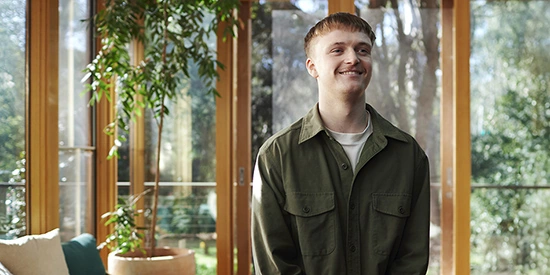
Career consolidation was the motivation for Jochen Gutsch, a musician active in Australia and Germany, after 14 years as the program curator and event manager for the Goethe-Institut in Sydney. ‘I was looking for a framework, like a formal recognition, for what I'm doing,’ he says.
A university qualification was his answer to access new learning and solidify his professional identity. So, he enrolled in the Graduate Certificate of Business (Arts and Cultural Management).
Why choose Deakin for online study?
When it came to choosing a course, flexible, online study was mandatory for both, and Deakin’s arts and cultural management courses ticked that box.
Ellie’s choice was backed by friends who recommended Deakin’s online learning experience, and she valued the practicality of a course based in the business school.
For Jochen, Deakin’s recognition of his experience was crucial, allowing him to start a postgraduate degree without prior studies in the field.
Once they had commenced, the benefits of specialist study started accruing almost immediately.
I think the biggest factor is not having to travel as well. When I did my undergrad, I was travelling four hours every day, so now there's so much time saved.
Master of Business (Arts and Cultural fManagement)
How online study fits your lifestyle
Online learning makes a huge difference. Jochen logs in from Sydney and Deakin’s online flexibility makes it possible ‘to time manage my study load while still working full-time and doing lots of other things as well.’
But even with the flexibility of online study, there’s still structure and support.
‘It is structured week by week, so you know where you're supposed to be up to,’ says Ellie.
Jochen adds, ‘I feel very appreciated and seen.’
Making arts and management career progress while studying
Only in her third trimester of study, Ellie secured a new role, making a move into non-profit art in an Indigenous arts organisation.
She credits the Arts Fundraising and Sponsorship unit for unlocking the opportunity.
‘I probably wouldn't have even gone for this role if I hadn't been learning about non-profit, public organisations. I had really just been in commercial art, and prior to that, working as a professional photographer.’
The course expanded my thinking and showed me the different job opportunities that are out there.
Master of Business (Arts and Cultural Management)
Gaining new perspectives through arts management
For Jochen, it was the business-focused learning, via units in human resource management and financial interpretation, that had the most immediate impact.
‘In comparison to the other units, these are not very arts-oriented,’ he says, ‘It’s different from how I normally think and operate, even though I do handle a lot of budgets at work. It was like diving into a new kind of world.’
Taking the time to apply theoretical frameworks is helping him avoid some of the pitfalls of work in arts management.
‘In the Arts, it's always quite hectic and can get a little chaotic. I'm learning to be more strategic about the choices I make at work, or the way that I roll out projects,’ he says. ‘I'm now more often taking a step back from the project and have a bird's eye view on it.’
Stories of arts and cultural management
Hear from two Arts and Cultural Management students about their experiences at Deakin.
What does a course in arts and cultural management offer?
The reason an arts and cultural management course is worth it is not only its content, but in the strength of its community, leadership and real-world application.
A vibrant community
The benefits of the course content have been greatly enhanced by the passionate community around the course, both teachers and students.
Jochen says, ‘I feel that the exchange with other students is on a very high level, it's one of the highlights of the course.’
Student discussions are facilitated by Deakin’s online learning platform and offer valuable insight and shared experiences across their diverse roles.
Engaged leadership
The commitment of the course leaders shone through for Jochen as well. ‘The biggest highlight is that the people behind the program are really invested in it. They really want to make it a good course,’ he says. With queries and discussions, Jochen found staff accessible and responsive with quick answers and willingness to engage.
Real-life insights
‘There's a lot of real-life examples with real problems and real solutions,’ says Jochen.
Ellie concurs, ‘We've had so many case studies, which has been really good for expanding my knowledge.’
Often the insight comes straight from the source, with a range of guest lecturers from different creative industries and locations. This was a highlight for Ellie. She says, ‘Last trimester, we had someone from the Barbican Centre in London do a talk with us, which was really interesting, hearing an international perspective.’
Building skills in arts management
After completing his Graduate Certificate, Jochen felt there was more to learn and signed on for more study. He says, ‘I'm now doing the Master of Business (Arts and Cultural Management), because I really want to reach a better professional level in what I'm doing.’
Looking at his peers in the course, he sees himself on the same career path. He says, ‘All these people have already done a lot of things, but they are still ambitious to get better at what they're doing, advance their careers and get the confidence to step into some kind of leadership role. It’s not just about skills and knowledge, it's also about confidence.’
For Ellie, moving into her new role was enabled by study that broadened her perspective, expanded her skills and opened up new opportunities.
She says, ‘Going to university and studying these kinds of courses, you're expanding outside of your bubble and your organisation, you’re learning from other people's experiences and learning different skills that you probably wouldn't learn if you didn't do this kind of training.'
Frequently asked questions about arts and cultural management
Arts and cultural managers combine creative insight with strong business capability. They lead organisations through change with strategic thinking, build meaningful engagement with diverse communities through marketing and audience development, and ensure financial sustainability through sound planning and resource management. Their work requires expertise in project and event delivery, governance and ethical decision-making, alongside cultural intelligence. An entrepreneurial and innovative mindset is also essential, enabling them to identify opportunities and respond confidently to a constantly evolving sector.
Arts and cultural managers connect creators, audiences and organisations through strategic and ethical leadership. They develop organisational strategy and business plans, manage budgets and funding streams, and ensure financial and operational sustainability. Their practice includes programming festivals, seasons and exhibitions, building partnerships and securing investment, leading teams and stakeholders, and designing audience-centred engagement strategies. Effective arts and cultural management also requires strong governance, ethical decision-making and cultural intelligence, ensuring organisations operate responsibly, inclusively and with long-term impact.
Deakin’s Master of Business (Arts and Cultural Management) is one of Australia’s most established programs, with over 30 years of shaping leaders across the cultural sector. Delivered 100% online through a business school, it combines strong business foundations with creative industry insight and real-world learning shaped by industry partners. With a global and sustainability focus and an exceptional professional network of academics, alumni and sector leaders, the program equips graduates to lead confidently across diverse cultural contexts.