

Top 150 worldwide for computer science

High global demand for AI professionals

6 credit points of recognised prior learning
Why choose Deakin
In a world where artificial intelligence (AI) is reshaping industries, many companies are seeking to understand and harness this transformative technology. With Deakin’s Master of Applied Artificial Intelligence, you will develop the specialised knowledge and skills essential to design and develop software solutions powered by AI, preparing you for in-demand roles worldwide. Deakin is ranked #1 in the state of Victoria for computing and information systems median salary, and 92.9% of Deakin computing and information systems postgraduates found employment within four months.
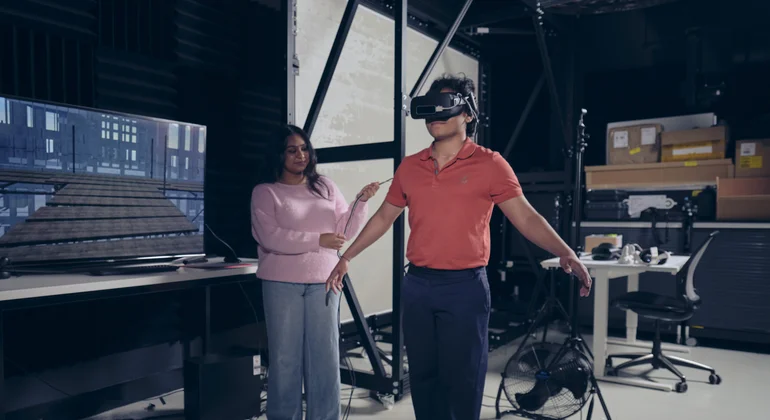
Embrace the future of digital disruption as you explore AI technologies, including deep learning and reinforcement learning. Apply these algorithms in areas such as computer vision and speech processing, and experience practical learning using state-of-the-art software, robotics, virtual reality (VR), and cyber-physical systems in fully equipped labs and studios.
Students who have successfully completed Great Learning’s Postgraduate Program in Machine Learning and Artificial Intelligence and who satisfy the entry requirements for this course will undertake further studies at Deakin.
-
Pathway to a masters degree
Progress from a recognised program into a Deakin masters degree, building advanced expertise in artificial intelligence and intelligent systems.
-
Advance your expertise as a professional
Build on your IT, analytics, or technical background with advanced skills in AI, machine learning, automation, and intelligent technologies.
-
Study a high-growth discipline
Artificial intelligence is transforming industries worldwide, creating strong demand for professionals with advanced AI capability.
-
Build skills employers value
Graduate with practical experience in machine learning, intelligent systems, data-driven decision-making, and AI solution development for real-world applications.


Connected to industry
Deakin’s strong industry connections help shape your learning. Build practical experience in real workplace contexts through work-integrated learning, mentoring and networking opportunities. Industry advisory boards also help shape our degrees, which means what you study is current, relevant and aligned to what your future employers need.

Deakin puts employability first
Career outcomes
Build on your existing AI and machine learning knowledge to pursue specialist careers, developing intelligent solutions that help organisations solve complex challenges across a wide range of industries.
Data scientist
Analyse complex datasets to uncover insights, develop predictive models and support better decision-making. Apply machine learning and AI techniques to solve business and technical challenges across a range of industries.
- $125k
Typical annual salary in Australia
- #11
Fastest-growing job globally
- 4.2/5
Job satisfaction


AI engineer
Design, build and deploy artificial intelligence systems that solve complex problems and automate tasks. Combine machine learning, software development and data engineering to create intelligent applications that improve products, services and decision-making.
- #1
Fastest-growing role in Australia
- 53.3%
Roles offering hybrid work


Other jobs
- AI software engineer
- AI researcher
- Prompt engineer
- AI product manager
- AI architect
- AI ethicist

FAQs
The cost of studying at Deakin depends on your degree, units and study load – tuition fees are listed on degree pages under the fees and scholarships tab. Beyond tuition, you will need to budget for Overseas Student Health Cover (OSHC), accommodation, transport, groceries and textbooks. Find out more about the cost of living in Australia, use the Study Australia calculator to estimate living expenses and explore international scholarships which may help to reduce your tuition costs.
Deakin offers a range of merit-based scholarships that can reduce your postgraduate tuition fees by 20%, 25%, 50% or 100% for the duration of your degree. Eligibility varies by scholarship and the degree you choose, but you will automatically be considered for most scholarships when you apply to Deakin. Use the Find a scholarship tool and filter by 'citizenship' to see what is available to you, or explore Australia Awards scholarships if you are from an eligible country.
It depends on the degree and how you study. Graduate certificates typically take six months full time or one year part time. Graduate diplomas usually take one year full time and masters degrees typically take one to two years full time. Recognition of prior learning can reduce your study time. Check the degree page for full details.
Australia is widely regarded as one of the safest and most welcoming countries in the world for students, with strong legal protections, reliable public services and a multicultural community. In fact, Melbourne is ranked the #4 student city in the world! At Deakin, you will be part of a supportive community, with 24/7 help, dedicated campus security and practical tools to help you feel safe, confident and connected. Deakin’s SafeZone app also connects you directly to campus security and support services if you ever need help. Find out more about studying in Australia.
We value your experience and qualifications. That is why every new degree application at Deakin is assessed for recognition of prior learning (RPL). Through RPL, Deakin can assess your previous study and life experience and may award course credit that could reduce your study duration, as well as the cost of your study. Qualifications from universities and private tertiary institutions worldwide are considered, as is informal learning related to your degree. Use the RPL calculator to see how much credit you may be eligible for.
Deakin offers a wide range of support to help you settle in and succeed throughout your studies – we are ranked the #1 university in Melbourne for student support. You can access 1:1 study support, English language support, career planning help, disability services and free counselling, as well as financial assistance if you need it. On campus, the SafeZone app and 24/7 security services mean help is always within reach. You can explore the full range of support services for international students or start an online chat with a student ambassador before you arrive.
To enrol in a postgraduate degree at Deakin, many degrees require a minimum IELTS score of 6.0 (or equivalent). Some degrees require higher scores, so check the entry requirements tab on the degree page for details. You may also meet the requirement through recent secondary or university study completed in English, or by demonstrating five or more years of living and working in an English-speaking country. Eligibility is assessed on a case-by-case basis. If you do not yet meet the requirement, the Deakin University English Language Institute (DUELI) offers pathway programs to help develop your English reading, writing, listening and speaking skills. Completion of DUELI’s English for Academic Purposes can give you the minimum English language requirements for most Deakin degrees.
Deakin’s postgraduate degrees are designed to advance your career, whether you want to deepen expertise in your field, move into a specialist role or shift direction entirely. All our degrees are shaped by industry partners, so what you learn reflects what employers need now and into the future. We’re proud to be the #1 university in Melbourne for international student graduate employment. With flexible study options and financial support available, Deakin helps you gain the skills, recognition and confidence to reach your next professional goal.
*Deakin references data from a range of government, higher education and reputable media sources. Learn more about our achievements on our University rankings page, or explore our sources page for supporting references.
What will I study in the Master of Applied Artificial Intelligence (Global)?
This degree combines a pathway program with Deakin study, where you build foundational knowledge before progressing to advanced artificial intelligence, machine learning and intelligent systems development.

Advanced artificial intelligence and intelligent systems
Mathematics and AI foundations
Build the mathematical, statistical and computational knowledge that underpins artificial intelligence and machine learning systems.
Machine learning and intelligent technologies
Learn how to design, train and evaluate machine learning models, applying AI techniques to solve complex problems and generate meaningful insights.
Applied AI and emerging technologies
Develop practical skills in AI solution design, intelligent automation, natural language processing and implementation of AI systems across industries.
Course structure
To complete the Master of Applied Artificial Intelligence (Global) you must pass 12 credit points.
Graduates of the Postgraduate Program in Artificial Intelligence and Machine Learning (PGPAIML) who have successfully completed Great Learning units equivalent to 6 credit points as recognised by Deakin; and will have met the minimum requirements for admission to Deakin, will be eligible for enrolment into the Deakin course with 6 credit points of Recognition of Prior Learning (RPL) and will be required to successfully complete 6 units with Deakin University in online mode in order to qualify for the Deakin Master of Applied Artificial Intelligence (Global) Award. i.e.
- 6 x Deakin units
- 6 x RPL
The Deakin component of the structure consists of all existing units which will be delivered online over a period of a year (3 x trimesters). Students will enrol part-time, undertaking 2 units (2 credit points) each trimester. Outlined below are the units.
Are you a current student? For course information that applies to the year you started your degree, visit the handbook.
All students are required to meet the University's academic progress and conduct requirements
Units
You are required to complete 10 core units and two course elective units (these are essential units for this degree).
In your first trimester you must also complete a 0-credit point unit which is compulsory for all Deakin University degrees.
Recognition for prior learning (RPL) (based on Great Learning programs)
Totalling 6 credit points:
2 x level 7 course-grouped units
Deakin units
^ Recognition for prior learning (RPL) granted upon entry into the course

What to expect while studying
You can expect to participate in a range of teaching activities each week. This could include classes, seminars, practicals and online interaction. You can refer to the individual unit details in the course structure for more information. You will also need to study and complete assessment tasks in your own time.
When can I start?
This course is only available to students via the Great Learning pathway. This course is not available to international students studying onshore in Australia. This course is offered part-time only.
Your course learning outcomes describe the knowledge, skills and capabilities you’ll develop and be able to demonstrate by the time you graduate. Built into your course through your units and assessments, they provide a clear picture of what you’ll be equipped to know, understand and do – preparing you to apply your learning with confidence beyond university.
| Course Learning Outcomes |
|---|
| Develop an advanced and integrated knowledge of the technologies of artificial intelligence, including deep learning and reinforcement learning, with detailed knowledge of the application of AI algorithms across a range of domains and applications including computer vision and speech processing. Design, develop and implement software solutions that incorporate novel applications of artificial intelligence. Design artificial intelligence solutions that incorporate safe ethical decision making. |
| Communicate in professional and other contexts to inform, explain and drive sustainable innovation through artificial intelligence and to motivate and effect change by drawing upon advances in technology, future trends and industry standards, and by utilising a range of verbal, graphical and written methods, recognising the needs of diverse audiences including specialist and non-specialist clients, industry personnel and other stakeholders. |
| Identify, evaluate, select and use digital technologies, platforms, frameworks, and tools from the field of artificial intelligence to generate, manage, process and share digital resources and justify digital tools selection to influence others. |
| Questions assumptions and seeks to uncover inconsistencies and ambiguities in information and judgements, critically evaluates their sources and rationales, to inform and justify decision making in the field of artificial intelligence. |
| Apply expert, specialised cognitive, technical, and creative skills from artificial intelligence to understand requirements and design, implement, operate, and evaluate solutions to complex real-world and ill-defined computing problems. |
| Apply reflective practice and work independently to apply knowledge and skills in a professional manner to complex situations and ongoing learning in the field of artificial intelligence with adaptability, autonomy, responsibility, and personal and professional accountability for actions as a practitioner and a learner. |
| Work independently and collaboratively within multidisciplinary environments to achieve team goals, contributing advanced knowledge and skills from artificial intelligence to advance the teams objectives, employing effective teamwork practices and principles to cultivate creative thinking, interpersonal adeptness, leadership skills, and handle challenging discussions, while excelling in diverse professional, social, and cultural scenarios. |
| Engage in professional and ethical behaviour in the field of artificial intelligence, with appreciation for the global context, and openly and respectfully collaborate with diverse communities and cultures. |
- Award granted
- Master of Applied Artificial Intelligence (Global)
- Year
2027 course information
- Deakin code
- S732
- Australian Qualifications Framework (AQF) recognition
The award conferred upon completion is recognised in the Australian Qualifications Framework at Level 9
Apply now

Apply through Great Learning
Applications can be made directly to Great Learning. (Note this link is for Great Learning applicants based in India. It is unavailable when accessing from Australia). For more information on the application process and closing dates, please email Great Learning or call +91 804 718 7565.
Recognition of prior learning
We value your previous study and experience. Recognition of prior learning enables you to get credit for what you've already achieved. When you apply, we'll consider your previous study and experience for recognition of prior learning.
Pathways
The Master of Applied Artificial Intelligence (Global) builds upon the postgraduate programs from Great Learning with units that extend students into the AI area. Units within the Deakin delivered content are independent of each other and will enable students to acquire the specialised knowledge and skills essential for designing and developing software solutions that leverage the power of AI.