


#1 Victorian university for course satisfaction

#1 Victorian university for science facilities

Top 100 worldwide for sustainability
Why choose sustainability at Deakin
Do you want to build a rewarding career driving positive change? Study Deakin's Master of Sustainability and gain the skills to address national and global sustainability issues. Learn how to implement strategies that balance environmental, social and economic considerations.
Graduates of Deakin's Master of Sustainability are well positioned to develop and deliver practical solutions to complex sustainability challenges. You will apply your learning through projects or practical experience that reflect current industry needs. With the sustainability sector projected to create up to 24 million new jobs globally by 2030, you could pursue employment opportunities across government, non-government organisations and the private sector. Be the catalyst for a more sustainable future.
-
Skills employers want
Build skills to address complex environmental and social challenges. Graduate ready to contribute across the government, business and community sectors.
-
Work-integrated learning
Apply your learning through practical projects that connect you with real sustainability challenges and industry contexts.
-
Interdisciplinary learning approach
Explore sustainability across science, policy and systems thinking, giving you a broad skill set to solve industry problems.
-
Pathways to leadership roles
Develop advanced knowledge and strategic thinking to support careers in sustainability management, consulting and policy.


Connected to industry
Deakin’s strong industry connections help shape your learning. Build practical experience in real workplace contexts through work-integrated learning, mentoring and networking opportunities. Industry advisory boards also help shape our degrees, which means what you study is current, relevant and aligned to what your future employers need.

Deakin puts employability first
Career outcomes
Develop advanced skills to address complex sustainability challenges and drive meaningful change. Graduate ready to develop and implement practical solutions across government, non-government organisations and the private sector.
Environmental manager
Plan and oversee environmental programs that help organisations manage their environmental impact. Support compliance, assess environmental risks and implement strategies to improve environmental performance.
- $180k
Typical annual salary in Australia
- 11.5%
Projected job growth in 5 years


Sustainability officer
Evaluate community needs and environmental impacts, and develop programs that support more sustainable practices. Work with stakeholders to deliver projects and recommend ways to reduce negative impacts.
- $100k
Typical annual salary in Australia
- 24%
Net growth in Australia by 2030
Professional areas
- Environmental protection
- Natural heritage management
- Land and water management
- Natural resource management
- Agriculture
- Communications and planning

Key dates

Direct applications
Trimester 1 2027 applications close 7 February 2027
FAQs
To start a career in environmental management, build capability in sustainability systems, climate change, policy, environmental governance and stakeholder engagement. Deakin’s Master of Sustainability develops these skills through applied sustainability learning, supporting pathways into sustainability advice, environmental management, climate policy, ESG and community sustainability roles.
A Master of Sustainability is a strong choice if you want to work on climate change solutions. Deakin’s course develops capability in sustainability systems, environmental management, climate policy and sustainable development, helping you prepare for roles in government, business, non-governmental organisations and community organisations responding to climate and sustainability challenges.
A Master of Sustainability can lead to roles such as sustainability adviser, environmental manager, climate policy adviser, ESG analyst, sustainability consultant or community sustainability coordinator. Deakin’s Master of Sustainability develops applied capability in sustainability systems, environmental management, climate change and policy, supporting professional pathways across public, private and community sectors.
Environmental science usually focuses on scientific understanding of natural systems, while sustainability brings together environmental, social, policy and organisational change. Deakin’s Master of Sustainability develops applied capability in sustainability systems, climate change, environmental management and sustainable development for public, private and community sector pathways.
Relevant professional experience may be considered for credit toward a Master of Sustainability if it aligns with course learning outcomes. Deakin’s recognition of prior learning process can help you prepare evidence of prior study, work or training in sustainability, environmental management, policy or related fields.
*Deakin references data from a range of government, higher education and reputable media sources. Learn more about our achievements on our University rankings page, or explore our sources page for supporting references.
What will I study in the Master of Sustainability?
The Master of Sustainability is typically completed in 1.5 years full-time or part-time equivalent. You will build advanced knowledge to address complex environmental and social challenges across global and local contexts.
Foundations in sustainability practice
Explore sustainability principles and systems
Understand environmental, social and economic systems and how they interact in real contexts.
Build interdisciplinary perspectives
Examine sustainability challenges through science, policy and social lenses to broaden your thinking.
Tailor your sustainability focus
Choose areas of interest to deepen your expertise and align your studies with your career goals.
Advanced application and specialisation
Engage with real challenges
Apply your learning through projects or practical experiences that reflect current industry and community needs.
Build industry connections
Build valuable connections with industry partners, government agencies, research leaders and sustainability professionals.
Graduate career ready
Graduate with a professional portfolio showcasing applied work across placements, projects and coursework.
Course structure
To complete the Master of Sustainability, you must pass 12 credit points. The number of credit points required may vary, depending on your entry point or how much credit you receive as recognition of prior learning (RPL) based on your professional experience and previous qualifications.
Most units are equal to one credit point. As a full-time student you will study four credit points per trimester and usually undertake two trimesters per year.
Are you a current student? For course information that applies to the year you started your degree, visit the handbook.
All students are required to meet the University's academic progress and conduct requirements
Units
You are required to complete three core units (these are essential units for this degree)
In your first trimester you must also complete two 0-credit point units which are compulsory for this degree.
You must choose from one of these pathways.
Advanced discipline coursework pathway
Five (5) course elective units (5 credit points) from the course elective list.
OR
Industry practice pathway
You must complete one of these specialisation sequences.
Refer to the details of each specialisation for availability.
Students studying S728 Master of Sustainability (Professional) or S727 Master of Sustainability can choose any units from the list below to fill the course elective unit options (subject to meeting unit prerequisites).
Course elective units may also be chosen from the remaining specialisations (ie students enrolled in the environmental management specialisation may choose electives from within the health and environment specialisation).
Environmental management
Health and environment
Sustainable regional development
Cities
Communities and wellbeing
Communications and attitude formation
Cultural heritage
Data science for sustainability
Digital tools for online influencing
Energy
*Must have an engineering background; unit chair approval is required for admission for any students outside of the School of Engineering.
Food, land and health
Global geopolitics and sustainable development
Greening business and industry
Inclusive and sustainable development
AHL701 Principles of Humanitarianism and Disaster Management [No longer available for enrolment]
International development
Policy and governance
Professional studies
Professional recognition
The Master of Sustainability is professionally accredited by the Environment Institute of Australia and New Zealand (EIANZ). As a student of this course, you are encouraged to apply for EIANZ student membership and connect with the professional network that can support your future career as an environmental professional.

What to expect while studying
You may be able to study available units in the optional third trimester to fast-track your degree, however your course duration may be extended if there are delays in meeting course requirements, such as completing a placement.
Any unit which contains work integrated learning, a community placement or interaction with the community may require a police check, Working with Children Check or other check.
You can expect to participate in a range of teaching activities each week. This could include lectures, seminars, workshops, site visits and online interaction. You can refer to the individual unit details in the course structure for more information. You will also need to study and complete assessment tasks in your own time.
Elective units may be selected that include compulsory placements, work-based training, community-based learning or collaborative research training arrangements.
Students will have an opportunity to complete work experience as part of the industry practice pathway.
At Deakin, we're committed to ensuring an inclusive environment that supports all students to belong, thrive and succeed. We work closely with students, where needed, to identify potential barriers to participation and where possible, provide tailored support so students can engage with learning and assessment activities.
If you are neurodivergent, have a disability, health condition or mental health condition that may impact your study or participation in university life, and want to know how Deakin could support you, contact our Domestic students (opens in a new window) or International students (opens in a new window) or Disability Resource Centre (opens email client) teams for a collaborative and confidential discussion. This discussion is to support you to make plans for your studies and future career and will not have any bearing on your application to the course.
When can I start?
When you study depends on your course, location and available intakes. Check the table to see when you can start and how study is offered throughout the year.
Your course learning outcomes describe the knowledge, skills and capabilities you’ll develop and be able to demonstrate by the time you graduate. Built into your course through your units and assessments, they provide a clear picture of what you’ll be equipped to know, understand and do – preparing you to apply your learning with confidence beyond university.
| Course Learning Outcomes |
|---|
| Demonstrate mastery and specialist knowledge of natural and social sciences related to sustainability, environmental management, health and environment and sustainable regional development. Demonstrate well-developed judgement and responsibility to review, analyse and develop sustainability strategies based on holistic principles. |
| Present a reasoned argument that highlights essential details of sustainability, environmental management and sustainable regional development, theory and application, key observations, results and conclusions of scientific research in a professional manner using appropriate style, language and references including local, national, and international contributions or contexts. Apply listening skills and effective communication skills to accommodate, encourage and answer questions from a range of audience and to defend research/project findings and sustainability implementation propositions. Interpret the boundaries or limits of social and scientific information, data, discuss error, probability, uncertainty, conclusions and arguments to justify theoretical propositions, methodologies, methods, techniques, conclusions and professional decisions. |
| Use well-developed technical skills, judgement and responsibility to independently locate, analyse, evaluate the merits of, synthesise and disseminate sustainability data, information and literature in the planning and implementation of projects to a range of stakeholders in sustainability, environmental management and sustainable regional development. Reflect on information, data and results and develop strategies for disseminating research outcomes in a digital world. |
| Appraise complex social, economic and scientific methodologies and information from a broad range of interdisciplinary sources using critical, analytical and logical reasoning from multiple perspectives for evaluating and providing solutions to sustainability issues that incorporate the holistic principles. Formulate research questions to test and/ or contest ideas, concepts and theoretical propositions through an evidence-based well-structured project. |
| Plan and implement sustainability research investigation by using traditional and emerging techniques and technologies to identify problems and by applying analysis and synthesis skills, and triple-bottom line principles to solve research and/or practical problems. Demonstrate complex problem-solving skills by identifying and creating solutions to real world sustainability through social, economic and/or scientific inquiry. Contribute to advancements in scientific knowledge through mastery in the use of traditional and emerging instruments and techniques to device an investigation, and in the collection, interpretation, analysis, synthesis and dissemination of issues pertaining to the identification of issues and solutions to improve sustainability in general and/or environmental management and/or sustainable regional development. |
| Take personal, professional and social responsibility within changing national and international professional contexts to develop autonomy as researchers and evaluate own performances. Work autonomously, responsibly and safely to solve unstructured problems and actively apply knowledge of social frameworks and scientific methodologies to make informed choices based on the triple-bottom line principles. |
| Work independently and collaboratively with advice from the supervisor towards achieving the outcomes of a project and thereby demonstrate interpersonal skills including the ability to brainstorm, negotiate, resolve conflicts, managing difficult and awkward conversations, provide constructive feedback and work in diverse professional, social and cultural contexts. |
| Apply principles of sustainability and environmental management knowledge and skills with a high level of autonomy, judgement, responsibility and accountability in collaboration with the supervisor to articulate the place and importance of social and scientific inquiry in the local and global context. |
- Award granted
- Master of Sustainability
- Year
2027 course information
- Deakin code
- S727
- Level
- Higher Degree Coursework (Masters and Doctorates)
- Australian Qualifications Framework (AQF) recognition
The award conferred upon completion is recognised in the Australian Qualifications Framework at Level 9
Fees
Estimated tuition fee
$9,880
for 1 yr full-time - Commonwealth Supported Place (CSP)
The estimated tuition (student contribution) fee above is based on a typical first-year full-time enrolment of 8 credit points and is provided as a guide only. Your student contribution is determined by the units you enrol in and will vary depending on the units you choose, your study load, the course duration, and any approved recognition of prior learning. You may also be eligible for a HECS-HELP loan to defer payment of all or part of your student contribution.
Check your eligibility or learn more about CSP or HECS-HELP.
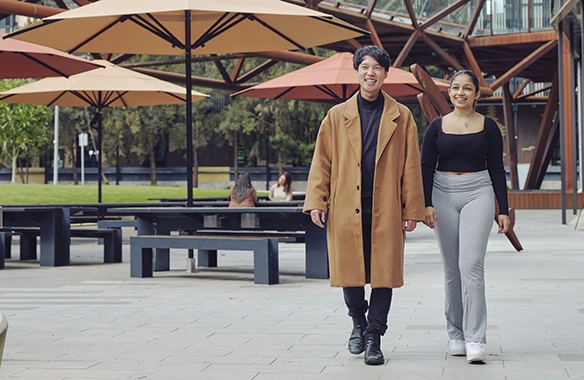
Scholarships
We want to help you excel at Deakin. Our scholarships recognise your dedication and achievements, providing financial support that can ease the cost of living and studying. With less pressure, you'll have more freedom to focus on what matters most – your education and future success.
Applications for 2027 are open
Ready to take the next step? Apply now to start your journey at Deakin and get ready for what’s next.
Key dates
Direct applications
Trimester 1 2027 applications close 7 February 2027
Apply now

Apply direct
Simply create an account in the Deakin Application Portal, enter your personal and educational details, upload your supporting documents and submit your application.
Recognition of prior learning
We value your previous study and experience. Recognition of prior learning enables you to get credit for what you've already achieved. When you apply, we'll consider your previous study and experience for recognition of prior learning.
Recognition of prior learning may be granted to applicants based on prior studies and/or equivalent industry experience.
Pathways
Upon completion of the Master of Sustainability you could use the credit points you’ve completed to enter into the Master of Sustainability (Professional) (S728)