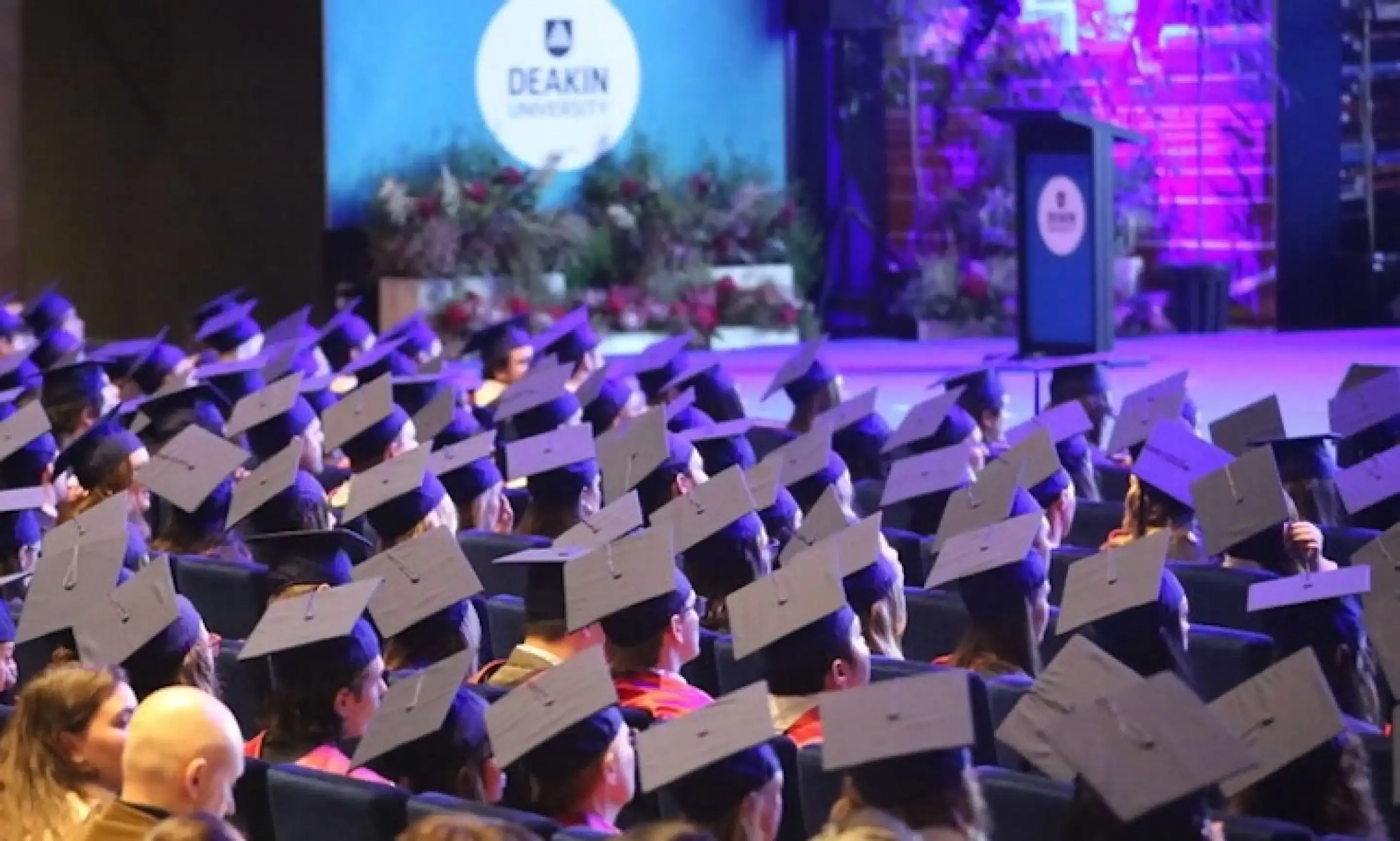
A statute of the University states:
"Members of the University shall wear academic dress when attending any public occasion or ceremony of the University convened for academic purposes and such other occasions as the Council may determine."
The legislation continues with a detailed description of the required academic dress for the various members of the University. Universities all over the world have legislation like this because academic dress is an important reminder of the long history of the university in Western civilisation. The first institutions recognisable as universities were established in twelfth-century Europe and academic dress worn today has its origins in those remote times.
The three main elements of academic dress are the gown, the hood and the head-dress. Gowns, cloaks, capes and hoods were once articles of everyday outer dress and, of course, fashions changed over the centuries - from closed to open gowns, for example, and especially in the style of sleeve.
Both gowns and hoods, when in common use, were often lined and this lining was decorative as well as practical. To make the most of the decorative element, gowns were designed so that the lining was revealed. In medieval and later times, the higher the rank of the wearer, the more sumptuous the gown. In universities, therefore, there was and still is this difference in the apparel of scholars of various ranks.
Today's academic head-dress evolved from various hats and bonnets of earlier times. The trencher, or mortar board as it is sometimes called, was originally in two parts - a kind of skull-cap with a large, flat bonnet worn on top. The skull-cap part of it is a reminder that university cloisters were cold and draughty places in the past.
Deakin University's academic dress, like that of most Australian universities, derives from that of the Universities of Oxford and Cambridge. The gowns are "open" rather than "closed", and the sleeves, hoods and head-dress are in the English rather than Continental style.
Scholars of doctoral degree wear gowns which distinguish them from Masters and Bachelors and, also, from each other in that different styles of gown denote the various doctorates. Masters and Bachelors all wear the same style of gown but with variations in the colour and style of the lining and hood. It was during the later seventeenth century that Oxford University adopted the practice of allocating a particular colour to each faculty of the university and in Australian universities this practice is followed, although in some cases colours denote faculties whereas in others they denote specific academic awards.
Those who have qualified for degrees, postgraduate diplomas or postgraduate certificates wear hoods lined in these colours whereas undergraduates who have qualified for diplomas or certificates wear a stole of the relevant award colour.
Many members of the University staff are graduates of universities other than Deakin, of course, and on ceremonial occasions they wear the academic dress prescribed for their rank in the universities in which they graduated.
Some members of the University wear dress which denotes not their academic rank but their position in the University. The Chancellor, the Deputy Chancellors and the Vice-Chancellor wear distinctive dress and, in keeping with their high office, their dress is the most elaborate, being extensively trimmed with gold bullion braid.
A description of the faculty/award colour worn by graduands appear after the award title in the ceremony proceedings.
Maces were originally medieval weapons. According to some authorities, they were carried by bishops in battle, the club-like mace being the weapon preferred to the sword to conform with the canonical stricture against the shedding of blood.
![]() |
In later times maces were carried by sergeants-at-arms, bodyguards to kings and others of high rank. Later again, the mace became of ceremonial rather than practical significance and thus organisations such as civic corporations and universities adopted the mace as a symbol of the rule of legal authority.
The University's mace is displayed at meetings of the University Council and on such ceremonial occasions as conferring ceremonies. The bearer of the mace, in academic processions, "guards" the Chancellor in the tradition in which the medieval sergeants-at-arms marched as bodyguards of kings and princes.
In academic processions, the order of precedence on entry is from junior to most senior. The Chancellor, therefore, brings up the rear of the procession and is followed by the mace-bearer.
The mace-bearer carries the mace in the "sloped-arms" position on the left shoulder, and steadies it with the right hand as well. On arrival on the dais, the mace-bearer stands facing the Chancellor and places the mace on its stand in front of the Chancellor.
At the end of the ceremony, the mace-bearer takes the mace from its stand. The procession departs in reverse order, led by the mace-bearer, followed by the Chancellor and so on.
The late Mr Donald Kingsley Thomson was an off-campus student in the School of Social Sciences. He graduated as a Bachelor of Arts, at the age of 79, in May 1987. Towards the end of his studies, in September 1986, he suggested to the Vice-Chancellor that the University should have a mace and he wrote a cheque for $100 to start a "mace fund".
The Vice-Chancellor passed the cheque to Deakin University Foundation and that body agreed to pursue the project subject to Council's approval. Council gave approval in December 1986 and, early in 1987, enquires were begun into such matters as who designed and made maces and how much they cost.
The Chairman of Deakin University Foundation, Sir Wilfred Brookes, approached Alcoa of Australia seeking a contribution to the mace fund. Alcoa's generous reaction was to offer to bear half the cost and also to assist in the design and fabrication of a mace. It was understood, of course, that the mace would be an aluminium one! Equally generously, Sir Wilfred volunteered to make up the balance of the cost.
With the assistance of Alcoa, Deakin University Foundation began negotiations with Mr Don Shiel, a metalwork designer and craftsman in Melbourne. He submitted designs which were approved by the Foundation and then began to make the mace.
The mace was presented to the University by Mr Thomson, Sir Wilfred Brookes and Mr Norman Stephen (Managing Director of Alcoa Australia) at the conferring ceremony on Friday 22 May 1987. Mr Thomson graduated at a ceremony on the following day and that was the first ceremony at which the mace was carried in procession.