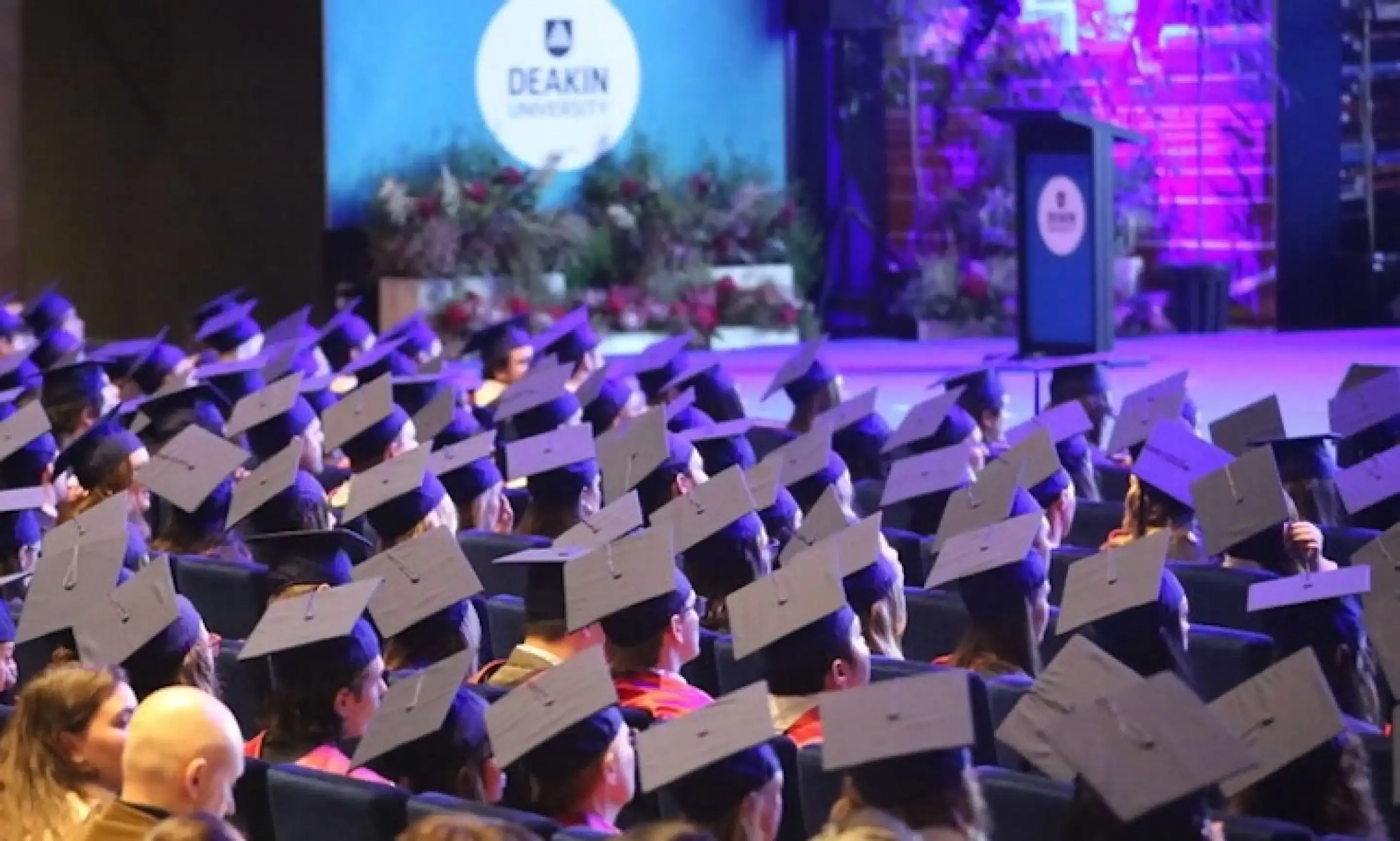
Past ceremonies

Friday 5 October at 5pm

Geelong - Costa Hall

Faculty of Education

Faculty of Science and Technology Geelong - Costa Hall

Stage Party

Deputy Chancellor, Mr Adrian Kloeden presided assisted by the Vice-Chancellor, Professor Sally Walker.

MC - Vice-President and Council Secretary, Ms Lin Martin.
Mace-bearer - The Faculty of Science and Technology General Manager, Mr Darren Taylor.

Presenters were:
Interim Dean Faculty of Education, Professor Chris Bigum.
Interim Dean, Faculty of Science and Technology, Professor Chris Gray.
Chair of the Academic Board, Professor Frank Stagnitti.
Student Response was delivered by Dr Michael Silcock - PhD.

Honorary Doctorate Recipient

An Honorary Doctor of Science was awarded to Emeritus Professor Pip Hamilton AM, in recognition of his outstanding achievement in the scientific discipline of radio-astronomy, his contribution to the Australian higher education sector and his outstanding contribution to research at Deakin University.

Doctoral Degrees

PhD receipients
Phd Receipients

Doctor of Technology

Dr Andrzej Stanislaw Krajewski
Whose thesis was entitled:
"Improving Nonwoven Web Quality with a New Web Scanning Device."

Summary
The thesis presents a novel web scanning device with high processing speed and optical sensitivity and a study of the interrelationships between dimensional parameters and functional properties of nonwovens using such a web scanning device.

Doctor of Philosophy

Dr Piotr Bankowski
Whose thesis was entitled:
"Stabilisation of Brown Coal Fly Ash Using Geopolymers."

Summary
This research explored geopolymer technology as a means of stabilising fly ash from power stations. By controlling the synthesis process, geopolymeric materials incorporating fly ash were synthesised. Successful stabilisation of strontium and barium was achieved, though attributed to side reactions. The geopolymer did not contribute significantly to stabilisation of fly ash.

Dr Maree Bilandzic
Whose thesis was entitled:
"Molecular Analysis of The Human Copper Uptake Protein HCTR1."

Summary
This study examined the role of the high-affinity copper uptake protein hCTR1 in cellular copper homeostasis and found hCTR1 was internalized in response to raised copper levels. The work from this thesis supports a model in which the regulation of hCTR1 is partially or wholly dependant upon internal copper levels.

Dr Edwin Thomas Chester
Whose thesis was entitled:
"Resource Heterogeneity for Stream Detritivores."

Summary
Invertebrate animals in headwater streams depend upon leaves, wood and bark for both food and living space. This project demonstrated the strength of that dependence where the patchiness in habitat is influenced at the smallest spatial scales by the movement of sediments, and at the largest by agricultural clearing.

Dr John Cripps Clark
Whose thesis was entitled:
"The Role of Practical Activities in Primary School Science."

Summary
The roles, patterns of use and emphases of practical activities depend fundamentally on teachers' backgrounds and beliefs. Students' intense engagement with real objects was found to encourage exploration and enjoyment, and support recall. The study also identified the variety and value of science conducted outside the normal classroom.

Dr Ali Dehghan Manshadi
Whose thesis was entitled:
"The Evolution of Recrystallization During and Following Hot Deformation."

Summary
Recrystallization of austenite during and following hot deformation has been studied in detail in a type 304 austenitic stainless steel. Furthermore, the effect of second phase on the softening process of austenite has been investigated using a 2205 duplex stainless steel. The mechanical and microstructural features have been compared for dynamic and post deformation recrystallization.

Dr Philippa Gerbic
Whose thesis was entitled:
"On-Campus Students' Learning in Asynchronous Environments."

Summary
This study investigated undergraduate student learning in online discussions in a campus-based course. The asynchronous environment, especially its text-based nature, helped student learning, however assessment was the most influential factor. The complementary role of face-to-face and online discussions was identified and an online discussion teaching and learning framework was developed.

Dr Tak Shing Ha
Whose thesis was entitled:
"Workplace Learning of Information Technology Workers in Hong Kong."

Summary
This study found that to information technology professionals in Hong Kong, the workplace was a rich environment in which to learn. However, as information technology changed and became more complex, none of them knew all about the technologies they used and for each technology, there could be different ways of knowing it.

Dr Eva Hakansson
Whose thesis was entitled:
"Characteristics of Conducting Textiles in the Microwave Frequency Range."

Summary
This investigation of textiles coated with a polymer that conducts electricity showed that they can be used for effectively reflecting and absorbing microwaves.
These conducting textiles are an economical, flexible and lightweight alternative to traditional materials for electromagnetic interference shielding of for instance sensitive electronic equipment.

Dr Kirsten Margaret Hutchison
Whose thesis was entitled:
"Rethinking Homework Practices in Contemporary Australia: A Feminist Sociocultural Analysis."

Summary
This thesis develops ethnographically-based case studies to offer new perspectives on the practice of homework in Australia. The thesis argues that homework is not simply a technique for improving school performance but is a form of pedagogical work that mediates home-school relations and generates classed and gendered emotional labour.

Dr Aijing Jin
Whose thesis was entitled:
"Social Transformation and Curriculum Reform in Chinese Physical Education."

Summary
This thesis examines how Chinese physical education teachers are experiencing curriculum reform within the context of broad social change. Using a qualitative framework the research findings reveal how structural, personal and cultural factors converge to limit the extent to which teacher are able to embrace and implement the new curriculum.

Dr Yuk Hei Lam
Whose thesis was entitled:
"Enhancements to Fraud and Deception Prevention in Open Multi-Agent Marketplaces."

Summary
Fraud and deception in online marketplaces has been an on-going problem. This thesis proposed novel techniques and mechanisms using agent technology to protect buyers and sellers in online environments such as eBay. The proposed solution has been rigorously tested and the results show good commercial promise.

Dr Luke Simon Lambeth
Whose thesis was entitled:
"Characterisation and Comparison of Bovine RNA Polymerase III Promoters for RNA Interference."

Summary
The characterisation of novel bovine RNA polymerase III promoters for the expression of short hairpin RNAs for gene silencing resulted in the identification of a highly efficient promoter sequence. The replication of bovine viral diarrhea virus was then suppressed using short hairpin RNAs expressed from this promoter in vitro.

Dr Stephanie Chantal Lebret
Whose thesis was entitled:
"Epithelial-stromal interactions in Mammary Lineage Development and Carcinogenesis."

Summary
This study determined that the microenvironment influences mammary cellular development and that this microenvironment differs between normal and malignant tissue. Cancer-associated fibroblasts, loss of an extracellular protein and presence of a growth factor were demonstrated to influence cancer cell migration, presenting a basis for the understanding of breast cancer metastasis.

Dr Qing Li
Whose thesis was entitled:
"A Study of Dimensional Changes in Wool Fibres and Fabrics."

Summary
Wool fabric dimensional properties were found to be influenced by the temperature and pH of the fabric, and on the fabric tension during pressure steaming. The results show that improvements can be made to standard methods for measuring fabric dimensional properties, and to the design of commercial finishing steaming equipment.

Dr Ben Thomas Maynard
Whose thesis was entitled:
"Investigation of Abalone Mitochodrial DNA and New Applications."

Summary
The work developed and applied new mitochondrial DNA markers to abalone aquaculture and wild fisheries. The number of markers and their success in the areas applied were all firsts in the abalone industry. The work will contribute to the future sustainability of this resource in culture and the wild.

Dr Kevin Magniez
Whose thesis was entitled:
"Structure-Property Relationships of Nylon 6, MXD6, their Blends and Nanocomposites."

Summary
This research project aimed to develop an understanding of the structure-property relationships of nanocomposite materials (injection moulded and fibres) based on nylon 6, MXD6 and their blends, with a layered silicate in combination with polyhedral oligomeric silsesquioxane nanoparticles and SEBS rubber particles.

Dr Janet Mary McDowall
Whose thesis was entitled:
"Technology and Music in Early Years of Schooling."

Summary
An investigation of junior primary school children's use of computer-based music technology found that, with active support from teachers, young children were able to participate effectively in relatively complex musical processes, with particular regard to listening, performing and composing, thus extending the traditional scope of young children's music education.

Dr Scott Andrew Nankervis
Whose thesis was entitled:
"Identification, Distribution and Expression of Natriuretic Peptide Receptors in Trout."

Summary
This study identified cell receptors for trout natriuretic peptide hormone. These hormones protect the heart and maintain fluid balance. Receptor populations on cells depend on whether the animal lives in freshwater or saltwater. Receptors are widely distributed and different receptor types perform different tasks. Their original evolutionary role is suggested.

Dr Patrick Joseph O'Flaherty
Whose thesis was entitled:
"Strategies for Learning that Empower Workers and Enable Organisational Achievement."

Summary
The key findings of the research are:
Learning Strategies in the workplace as part of a Learning Program empower workers and enable organisational achievement.
The organisation is not yet ready to utilise all the empowered workers who successfully completed the Learning Program.
The prevailing management systems and work structures govern the degree the ransfer of workers newly-learned skills to the workplace.

Dr Vincent John Oakley
Whose thesis was entitled:
"Agent-Based Heuristics to Solve Np-Hard Scheduling Problems."

Summary
A novel agent-driven heuristic approach was developed to control the operational scheduling for a local manufacturer. This approach outperformed the traditional kanban control mechanism under numerous simulated benchmarking tests. Using this approach, the individual machine loading was reduced by, on average, 28%, with the loading spread reduced by 85%.

Dr Alex Ong
Whose thesis was entitled:
"Physical Education Curriculum Reform in Singapore (1997 - 2005)."

Summary
Recognising physical education curriculum reform to be a complex and challenging process, the Folio provides new insights into such an undertaking in Singapore by providing an `insider' perspectives from myself as the designer and implementer of the new curriculum supported by the `local voices of the teachers'.

Dr Grant Campbell Palmer
Whose thesis was entitled:
"Ecological Value of Riparian Zones to Birds in Forest Landscapes."

Summary
Riparian zones in eucalypt forests provide high quality habitats that contribute to the diversity of habitats and resources available to birds, with positive benefits for the landscape avifauna. Riparian assemblages are characterised by greater species richness and abundance, distinct species compositions and more temporal reliability when compared to non-riparian assemblages.

Dr Jane Lee Pappin
Whose thesis was entitled:
"`Investigations of Tris(2,2'-bipyridyl)Ruthenium(iii) as a Chirally Selective Chemiluminescence Reagent."

Summary
Enantiomers of Tris(2,2'-bipyridyl)ruthenium(III) were selectively resolved and utilised in chiral kinetic studies. Instrumentation was designed and built for this purpose. After testing the kinetic profiles of various enantiomerically pure analyte reagent combinations results proved to be inconclusive and further testing is still required.

Dr Sung Kin Pun
Whose thesis was entitled:
"Technical Development for Building Demolition Project Management."

Summary
Environmentally friendly demolition methods such as deconstruction are currently not widely accepted due to a lack of economic motivation for demolition contractors. This PHD research aims to economically analyse demolition techniques, and to adopt E-commerce into demolition project management in order to enable higher level of material reuse and recycling.

Dr Michael Dunbar Silcock
Whose thesis was entitled:
"Composite Crashworthy Structures: Manufacture and Modelling."

Summary
This study presents an innovative finite element delamination model which successfully reproduced the experimental failure behaviour observed in axial crush testing. Tests were conducted on tubes manufactured by a novel composite curing process, resulting in the ability to cure tubular profiles in 7 minutes ¿ 95% quicker than traditional autoclave curing.

Dr Susan Elizabeth Snelgrove (presentation)
Whose thesis was entitled:
"Reconstructing the Mosaic of Inclusion for Children with Intellectual Disabilities."

Summary
This thesis proposes new thinking about educational inclusion for children with disabilities. It examines current policies and practices alongside experiences of teachers, parents, aides, students and children with intellectual disabilities. It elaborates the value of (inter)dependence as a guiding principle and identifies `chinks of possibility¿ to drive inclusion efforts.

Dr Sim Sih Yang
Whose thesis was entitled:
"Grouper Aquaculture in Three Asian Countries: Farming and Economic Aspects."

Summary
The study focussed on three key suppliers of fingerlings and live fish in Asia. Grouper hatchery businesses are lucrative even at low survival rates. The findings indicate that farming practices across these countries are similar. Most farmers adopt traditional practices and lack incentives to reduce cost, but remain price focussed.

Dr Leigh Anthony Thwaites
Whose thesis was entitled:
"Irrigation with Reclaimed Water at Portland Aluminium: An Environmental Assessment."

Summary
Through extensive laboratory and field based analysis of soil chemical and physical processes, this research identified and addressed key management issues associated with the sustainable irrigation of municipal wastewater onto sandy water repellent soils, overlaying a shallow aquifer, in an environmentally significant coastal system.

Dr Shayne Thomas Williams
Whose thesis was entitled:
"Indigenous Values Informing Curriculum and Pedagogical Praxis."

Summary
This thesis explores the cultural difference between the value systems of Indigenous and non-Indigenous Australia, and considers how this difference impacts the cultural dynamics of mainstream education and the polemics of knowledge legitimacy. An alternative, and culturally apposite, Indigenous education paradigm is offered in support of independent Indigenous education initiatives.

Occasional Address

Dr Pip Hamilton

The Occasional Address (ilecture recording - requires broadband) was delivered by Dr Pip Hamilton.

Emeritus Professor Hamilton AM commenced his scientific career in 1965 as a lecturer in physics at the University of Tasmania. His work in radio astronomy flourished at that university and under his leadership, the radio astronomy group of the University of Tasmania became the foremost in Australia. In 1989 the University of Tasmania awarded Professor Hamilton its first personal chair when he was appointed Professor of Experimental Physics in recognition of his outstanding research performance.

Professor Hamilton's many scientific achievements include membership of the team responsible for the discovery of the first radio pulsar in another galaxy (the Magellanic Cloud); being a key partner in the Australia Telescope; negotiating the gift of a 26 metre, $10 million radio telescope from NASA to the University of Tasmania where it became a key research facility for Australian astronomers; and making observations of fundamental importance by monitoring a glitch in the rotation of a neutron star using an innovative instrument built by his University of Tasmania group.

Professor Hamilton has published more than 100 papers in the fields of astronomy, electronics, signal processing and computing, including ten publications in Nature, the world's most prestigious science journal. He has also been appointed a Fellow of five learned societies: the Royal Astronomical Society, the Australian Institute of Physics, the Astronomical Society of Australia, the Institution of Engineers Australia and the Institution of Radio and Electronics Engineers (Australia) and he is a member of the International Astronomical Union. In 1982 he was awarded the Norman Hayes Medal of the Institution of Radio and Electronics Engineers (Australia), and in 1992 he received the NASA Group Achievement Award for Southern Hemisphere Very Long Baseline Interferometry.

Professor Hamilton's contribution to Australian and international science is also demonstrated by his active involvement in a number of bodies including the Australian Vice-Chancellor's Standing Committee on Research; the Australian Institute of Nuclear Science and Engineering Council and the Australian Deputy/Pro Vice-Chancellor's (Research) Committee, which he chaired in 1995. Dr Hamilton served on numerous national working parties on research and he also served on committees of the Australian Research Council and the Major National Research Facilities Program.

During his scientific career at the University of Tasmania, Professor Hamilton was Head of the Department of Physics from 1982 to 1991 and in 1990 he was appointed Academic Director of Research to provide research leadership to the broader university community. In 1991 he was appointed as the University of Tasmania's inaugural Pro Vice-Chancellor (Research). In both of those roles Professor Hamilton assumed responsibility for guiding, growing, maintaining and nurturing a strong research culture at that university.

In 1997 Professor Hamilton was appointed Pro Vice-Chancellor (Research) at Deakin University and he became Deputy Vice-Chancellor (Research) in 2002. Under his leadership, Deakin's research performance and research profile flourished with annual research income growing from $2 million in 1996 to $23 million in 2004-a rate of growth which far exceeded the mean for the higher education sector. Professor Hamilton's contribution to the development of a culture of research at Deakin University was also demonstrated by other measures including growth in publications in the national collection from 350 in 1996 to 950 in 2004 and growth in higher degree by research completions from 54 in 1996 to 145 in 2004.

The strategy developed and implemented by Professor Hamilton, which has been a significant factor in Deakin's successful transition to a vibrant culture of research, was to encourage and facilitate the development of research concentrations whereby a critical mass of researchers was aligned into each of a number of priority research areas. The successful establishment of research priority areas provided a stimulating research culture, an excellent environment for research training and optimum utilisation of infrastructure. Professor Hamilton's leadership approach was to focus on teamwork and he brought to his activities a quiet passion and an outstanding intellect, backed by a resolute commitment to encouraging and developing research excellence. Professor Hamilton transformed research across Deakin University with a very strong emphasis on areas of national priority, including the establishment of major centres in biotechnology and materials science and engineering.

Professor Hamilton's contribution to Australian science and his service to research management have been exceptional. In his own discipline he has contributed greatly to the international reputation of Australian astronomy and through his very senior roles in scientific and research associations, he has played a key role in the development and management of Australia's research effort. Professor Hamilton has earned the respect of the higher education sector, his peers and the Deakin University community.

Professor Hamilton retired from the position of Deputy Vice-Chancellor (Research) at Deakin University in August 2006. The loss of the exemplary skill and expertise with which he guided the University's research program and supported the Vice-Chancellor, together with his wisdom and his good humour, have been very keenly felt.

Deakin University acknowledges the traditional land owners of present campus sites.

15th September 2011