Students' gateway to Campus

Graduation - past ceremonies

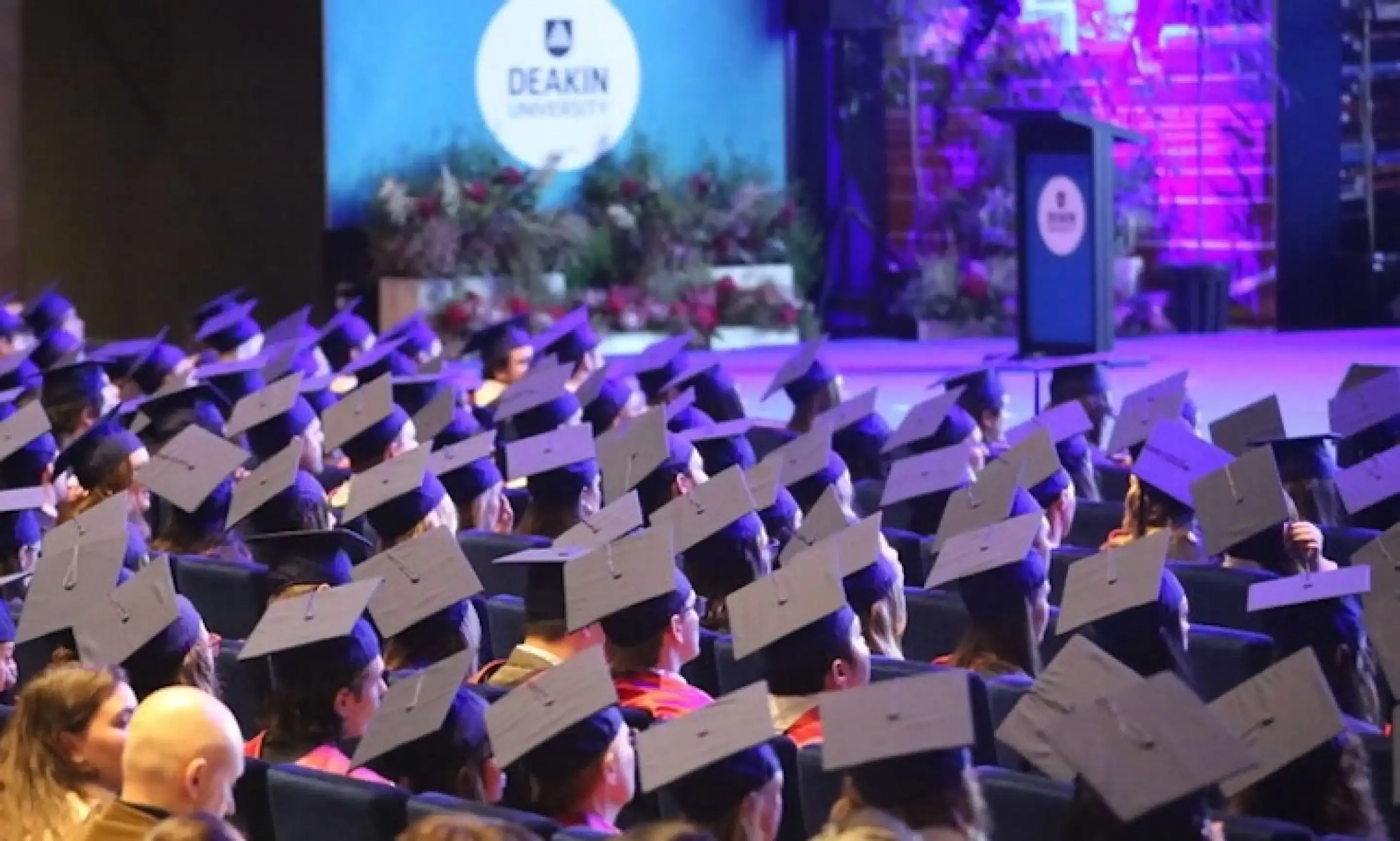
Friday, 30 April 2010 at 5pm

Melbourne Convention and Exhibition Centre

Faculty of Health, Medicine, Nursing and Behavioural Sciences
Faculty of Science and Technology


Stage Party
The Chancellor, Mr David Morgan presided, assisted by the Vice-Chancellor, Professor Sally Walker.
The MC was Executive Director, Office of the Vice-Chancellor, Dr Tony Mordini.
The Mace-bearer was Mr Dale Warren.
The Faculty Representative was Mr Darren Taylor.

Presenters were:
Dean, Faculty of Health, Medicine, Nursing and Behavioural Sciences, Professor John Catford.
Dean, Faculty of Science and Technology, Professor Chris Gray.
Deputy Chair of the Academic Board, Professor Julie Wolfram Cox.

The student response was delivered by Miss Olivia Mills.

Doctoral Degree Recipients

Doctoral Degree Recipients

Dr Kieran John Connolly - Thesis title: “Training Frontline Workers: Drug Education from Theory to Practice.”
Summary
This study investigated the effectiveness of alcohol and other drug education by examining practice change in workers when they returned to their workplace, identifying barriers to and supports for that practice change. The influencing characteristics of the individual, their team environment and their organisation have also been identified.

Dr Margaret Mary McKinnon - Thesis title: “Being a Palliative Care Volunteer.”
Summary
In this research volunteers' experiences in the field of palliative care were explored from the perspective of volunteers. The study made visible the skills, values and wisdom inherent in enactment of the volunteer role and provided new insights into the nature of relatedness between clients/families and volunteers.

Dr Archana Kaur d/o Adab Singh
- Thesis title: “Cross Cultural Examination of Social and Sexual Behaviour in High Functioning Autism and Down Syndrome.”
Summary
The focus of this research was to obtain an understanding of the social and sexual behaviour of adolescents with High Functioning Autism (HFA) or Down Syndrome (DS) in comparison to Typically Developing (TD) adolescents across cultures. The findings highlight the importance of cross-cultural research and indicates the need for sex education.

Dr Shikkiah de Quadros-Wander - Thesis title: “Perceived Control and Subjective Wellbeing in Older Adults.”
Summary
Across age, the ability to accept what cannot be changed increases while feelings of control remain stable. The growth of acceptance preserves, rather than compensates for, older adults' sense of being in control. In later life, acceptance and control appear to operate together to maintain wellbeing.

Dr Daniel John Rylatt - Thesis title: “Non-retinal Light Stimulation and the Human Biological Clock.”
Summary
Since 1998, debate has occurred over whether light synchronises the human biological clock through the visual system only, or if the light penetrating our skin is also influential. This work provides definitive, debate ending, evidence that skin exposure to even intensely bright light has no impact on circadian timing.

Dr Leah Joan Brooke - Thesis title: “On the Relationship Between Child Abuse and Eating Pathology.”
Summary
This thesis examined variables that could potentially mediate the relationship between child abuse and eating pathology. The relationship was found to be intricate and multifaceted with important gender differences. The most novel finding was that drive for muscularity was significantly associated with child abuse in males and in females.

Dr Rita Tess Cauchi - Thesis title: “Police Officers' Note-Taking of Interviews with Alleged Child Abuse Victims.”
Summary
An examination of note-taking in forensic interviews found: (a) documentation of initial interviews with child abuse witnesses was poor, (b) under optimal note-taking conditions police still failed to provide a verbatim record, and (c) considerable variability was observed in the quality of officers’ notes and strategies used to document interview content and structure.

Dr Celia Veronica Goncalves - Thesis title: “An integrative Model of Relationship Functioning.”
Summary

This thesis presents an integrative model of relationship functioning, delineating the factors that significantly influence the way in which couples experience lasting and satisfying relationships. Given that marital relationships are complex, multiple intra and interpersonal factors need to be considered in order to better understand the pathways which lead to healthy relationships. The integrative nature of the model is therefore argued to capture the intricate dynamics inherent in couple functioning.

Dr Nasrin Parsian - Thesis title: “Spirituality and Coping in Young Adults with Diabetes.”
Summary
This study addressed an important aspect of life in young adults with diabetes using quantitative and qualitative methods. The study aimed to explore how spirituality that focused on innerself and transformation can enhance coping with stressful situations and diabetes management. The results help health professionals integrate spirituality into diabetes care.

Dr Jessica Louise Mathers - Thesis title: “Effect of Exercise and Protein on Skeletal Muscle Inflammatory Mediators.”
Summary
Intense exercise results in muscular inflammation. Molecular techniques were used to identify novel inflammatory proteins in human muscle. Males and females displayed different levels of exercise-induced inflammatory proteins. Interestingly, dairy protein supplements reduced these inflammatory proteins post-exercise. Increased dietary red meat consumption, with training, had no impact on muscle inflammation, although strength gain was improved.

Dr Wendy Snowdon - Thesis title: “Guiding Policy Change to Reduce Diet-Related Disease in The Pacific.”
Summary

Research was undertaken in Fiji and Tonga to identify the most promising policy interventions to improve diets and noncommunicable diseases. The participatory approach combined with modelling enabled evidence-informed decision-making by stakeholders. The framework developed is practical and systematic and is recommended for use in other countries in the region.

Alfred Deakin Medal Recipient

Samantha Gagovska


Samantha Gagovska


These Medals are awarded annually to candidates with a record of outstanding scholarship as well as service to the community and the University.
The awards are named in honour of Alfred Deakin after whom this University is named and were an initiative introduced by the University to commemorate the life of Alfred Deakin.


Vice-Chancellor's Prize Recipient

Lisa Peggy Newman


Lisa Peggy Newman


The Vice-Chancellor’s Prize is awarded to a student who has submitted the best essay, a piece of creative writing, a work in visual or performing arts, construction of experimental or field work, or piece of scientific writing during the previous year.


Alfred Deakin Professor Acknowlegement

Professor Boyd Swinburn.


The title of Alfred Deakin Professor was awarded to Professor Boyd Swinburn.


Occasional Address

The occasional address was delivered by Alfred Deakin Professor Boyd Swinburn.
Professor Boyd Swinburn is Chair in Population Health and Director of the WHO Collaborating Centre for Obesity Prevention within Deakin University’s Faculty of Health, Medicine, Nursing and Behavioural Sciences. Professor Swinburn has been a member of Deakin’s academic staff since 2001. Before this he was Medical Director of the National Heart Foundation in New Zealand and an Associate Professor at the University of Auckland. His specialist training is in endocrinology and his research interests started in the areas of metabolic effects of diet on fat, carbohydrate metabolism and energy balance. Over the last 10–15 years he has undertaken public health research on obesity prevention, particularly in children and adolescents.
Professor Swinburn has successfully established the Sentinel Site for Obesity Prevention– a program of community-based research in partnership with the Department of Human Services Barwon- South Western region and with support from the Australian Department of Health and Ageing, Department of Human Services Victoria and VicHealth. The aim of the Sentinel Site is to build the programs, evidence and capacity needed to prevent obesity in children and adolescents.
Professor Swinburn was the Chief Investigator of an international grant from the Wellcome Trust, National Health and Medical Research Council, and Health Research Council (New Zealand). There were four community-based interventions in Barwon-South West, Auckland, Fiji and Tonga with adolescents as the target group. There were also three linked analytic studies into the economic, policy and sociocultural determinants of childhood obesity.
Professor Swinburn was part of the ACE-Obesity project (Assessing Cost Effectiveness of Obesity interventions for children) funded by the Victorian Department of Human Services. He has been the lead person in establishing the Faculty of Health, Medicine, Nursing and Behavioural Sciences as a WHO Collaborating Centre. The Centre was launched in April 2004 in conjunction with a major international health promotion congress in Melbourne.
Professor Swinburn is a Council Member of the International Obesity Taskforce (IOTF) and a Member of the Prevention Committee. IOTF is supporting WHO in the implementation of its Global Strategy on Diet, Exercise and Health. Professor Swinburn recently chaired a working group to develop a set of principles (called the Sydney Principles) to guide action on reducing food marketing to children

Deakin University acknowledges the traditional land owners of present campus sites.

13th September 2010