Course overview
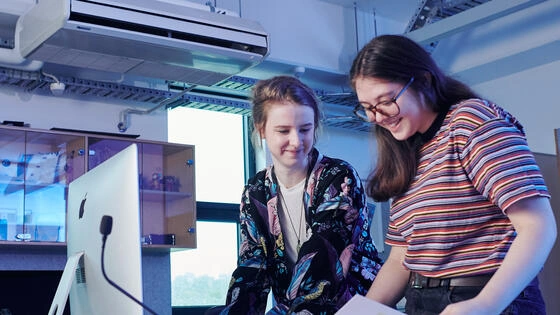
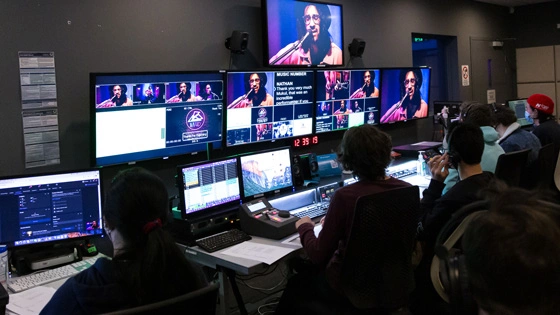
Harness your creativity to make an impact by studying a Bachelor of Design at Deakin. Design is a tangible way to solve complex problems and influence the world around you. No two days will be the same. Learn with design-thinking tools, used widely across industry – like journey mapping, empathy maps and visualisation. Work with industry-leading tools in our world-class facilities. By year two, your work will meet industry standards, giving you an understanding of professional practice in design.
Choose to major in either communication design or interactive and UX design. Then pick a second major or minors in complementary study areas, like brand design, public relations, animation and more. Work on industry projects and interpret client briefs as you build industry connections through internships and networking opportunities. Be supported by Deakin to choose an internship from 600+ employers or even design your own internship.
Current Deakin students
To access your official course details for the year you started your degree, please visit the handbook
- Award granted
- Bachelor of Design
- Year
2027 course information
- VTAC code
- 1400311403 - Waurn Ponds (Geelong), International full-fee paying place
1400511403 - Burwood (Melbourne), International full-fee paying place - Deakin code
- A319
- CRICOS code?Commonwealth Register of Institutions and Courses for Overseas Students
- 109273C Burwood (Melbourne), Waurn Ponds (Geelong)
- Level
- Undergraduate
- Australian Qualifications Framework (AQF) recognition
The award conferred upon completion is recognised in the Australian Qualifications Framework at Level 7
#1 Victorian uni for graduate employment
Choose a Deakin degree for vital industry experience on placements, hands-on learning in world-class facilities and guidance from industry-expert academics. We offer lifetime career support and are the #1 Victorian university for graduate employment.
Course structure
To complete the Bachelor of Design you must pass 24 credit points. This includes:
- DAI001 Academic Integrity and Respect at Deakin (0-credit-point compulsory unit) in your first study period
- 1 credit point of Thematic core unit
- 3 credit points of Employability sequence units
- one of:
- 2 majors (8 credit points each). At least one major must be chosen from the Design majors
- 1 major (8 credit points) from the Design majors, plus 1 minor (4 credit points)
- remaining credit points which may comprise of:
- 1 additional minor
- open electives
- a combination of the above
- a maximum of 10 credit points at level 1
- a minimum of 6 credit points at level 3.
Most units are equal to one credit point. As a full-time student you will study four credit points per trimester and usually undertake two trimesters per year.
Students are required to meet the University's academic progress and conduct requirements.
Plus 1 credit point from:
Plus 1 credit point from:
All Bachelor of Design students are required to complete at least one major sequence from the following list:
Bachelor of Design major sequences
^UX refers to User Experience
Students may choose to complete a second major sequence from the following list:
School of Communication and Creative Arts major sequences
- Advertising
- Animation
- Dance
- Digital and Social Media
- Journalism
- Photography
- Screen Development
- Public Relations
- Screen Production
- Theatre
- Visual Arts
- Writing
Please check the rules of each major sequence to see which units you need to complete to achieve the required credit points.
Refer to the details of each major sequence availability and sequence notes relating to incompatibility.
- 2D practices in the visual arts
- 3D practices in the visual arts
- animation and motion graphics
- brand design
- creative advertising
- creative writing
- dance
- design for social media
- digital media
- film studies
- gender and sexuality studies
- indigenous studies*
- interactive design
- journalism
- literature
- photography
- photojournalism
- professional writing
- public relations
- public relations strategy
- publication design
- screen production
- scriptwriting
- social media
- strategic advertising
- theatre
- technical production
- UX design^
- visual effects and virtual production
^ UX refers to User Experience
Please check the rules of each minor sequence to see which units you need to complete to achieve the required credit points.
Students are advised to refer to the details of each major or minor sequence for availability as some may be offered in campus and/or online mode only.
Intakes by location
The availability of a course varies across locations and intakes. This means that a course offered in Trimester 1 may not be offered in the same location for Trimester 2 or 3. Check each intake for up-to-date information on when and where you can commence your studies.
- Start date: March
- Available at:
- Burwood (Melbourne)
- Waurn Ponds (Geelong)
- Online
- Start date: July
- Available at:
- Burwood (Melbourne)
- Waurn Ponds (Geelong)
- Online
Deakin splits the academic year into three terms, known as trimesters. Most students usually undertake two trimesters each year (March-June, July-November).
CHOOSE DEAKIN, THE #1 VICTORIAN UNIVERSITY FOR COURSE SATISFACTION
Course duration
You may be able to study available units in the optional third trimester to fast-track your degree, however your course duration may be extended if there are delays in meeting course requirements, such as completing a placement.
Mandatory student checks
Any unit which contains work integrated learning, a community placement or interaction with the community may require a police check, Working with Children Check or other check.
Participation requirements
Reasonable adjustments to participation and other course requirements will be made for students with a disability. More information available at Disability support services.
Work experience
Prepare for your future by getting real world experience and the employability skills to succeed, while completing your degree. The Employability Stream is tailored to support you to be future ready. Deakin’s suite of Work Integrated Learning programs can connect you with internships, social impact programs and opportunities to extend your skills in settings across the globe.
Elective units may also provide additional opportunities for Work Integrated Learning experiences.
Entry requirements
Selection is based on a holistic consideration of your academic merit, work experience, likelihood of success, availability of places, participation requirements, regulatory requirements, and individual circumstances. You will need to meet the minimum academic and English language proficiency requirements to be considered for selection, but this does not guarantee admission.
A combination of qualifications and experience may be deemed equivalent to minimum academic requirements.
If you don't meet the academic entry requirements as outlined in the tabs below, or haven't completed Year 12, or don't hold any relevant qualifications, the STAT (Skills for Tertiary Admissions Test) Multiple Choice (MC) may be an option for you to meet course entry requirements.
Academic requirements
If you’re currently studying Year 12, or completed Year 12 in the last two years, you will need to meet all the following criteria to be considered for admission to this degree:
Year 12 prerequisite subjects
- Units 3 and 4: a study score of at least 25 in English EAL (English as an Additional Language) or at least 20 in English other than EAL
ATAR
- Senior Secondary Certificate of Education with an unadjusted ATAR of at least 50 or equivalent
If you have undertaken higher education studies after secondary schooling, you will need to meet all the following criteria to be considered for admission to this degree:
- successful completion of at least two bachelor level or above units (AQF Level 7 or equivalent)
If you have undertaken any Vocational Education and Training (VET) study after secondary school, you will need to meet at least one of following criteria to be considered for admission to this degree:
- completion of a certificate IV or higher in a related discipline
- completion of a diploma or higher in any discipline
- at least 50% completion of a diploma or higher in a related discipline
If you finished Year 12 more than three years ago, or did not finish Year 12, and have not undertaken any further study, you may be considered for admission to this degree based on your work, volunteer and/or life experience.
Submit a personal statement outlining your motivation to study, previous education and employment history, and how this course can assist your career aspirations or progression. Think of it as a job application cover letter – it should be relevant and demonstrate your commitment and interest in this course or study area.
To meet the English language proficiency requirements of this course, you will need to demonstrate at least one of the following:
- Victorian Certificate of Education (VCE) English Units 3 and 4: Study score of 25 in English as an Additional Language (EAL) or 20 in any other English
- IELTS overall score of 6 (with no band score less than 6.0) or equivalent
- other evidence of English language proficiency (learn more about other ways to satisfy the requirements)
Learn more about Deakin courses and how we compare to other universities when it comes to the quality of our teaching and learning. We're also committed to admissions transparency. Read about our first intake of 2026 students (PDF, 879KB) – their average ATARs, whether they had any previous higher education experience and more.
Not sure if you can get into Deakin? Discover the different entry pathways we offer and study options available to you, no matter your ATAR or education history.
Online studies
Deakin offers many courses which can be studied by distance education overseas.
However, international students living in Australia on a student visa, in each compulsory trimester (that is, Trimesters 1 and 2), must enrol in at least one unit that is offered as a Campus located unit and can, in addition enrol in units offered online. International students may undertake a maximum of up to one third (or equivalent) of their study as online study. Please note enrolment in one face to face unit in compulsory study periods is only allowed if the student is completing their final unit of study and will not exceed maximum one third (or equivalent) online requirement.
Recognition of prior learning
If you have completed previous studies which you believe may reduce the number of units you have to complete at Deakin, indicate in the appropriate section on your application that you wish to be considered for credit transfer. You will need to provide a certified copy of your previous course details so your credit can be determined. If you are eligible, your offer letter will then contain information about your credit transfer.
Your credit transfer is formally approved prior to your enrolment at Deakin during the Enrolment and Orientation Program. You must bring original documents relating to your previous study so that this approval can occur.
You can also refer to the recognition of prior learning (RPL) system which outlines the credit that may be granted towards a Deakin University degree.
Fees and scholarships
Fee information
Estimated tuition fee - full-fee paying place
$41,800 for 1 yr full-time AUD
Learn more about fees and your options for paying.
The estimated tuition fee above is based on a typical first-year full-time enrolment of 8 credit points and is provided as a guide only. Your tuition fees are determined by your course and unit enrolment. Your tuition fees will vary depending on your study load, the course duration, and any approved recognition of prior learning.
Scholarship options
Deakin scholarships recognise your hard work and achievements. Our support can ease the financial pressure of studying in Australia so you stay focused on your success. Numbers are limited, so apply early for the best chance.
Apply now
Apply directly to Deakin
Applications can be made directly to the University through StudyLink Connect - Deakin University's International Student Application Service.
We recommend engaging with a Deakin Authorised Agent who can assist you with the process and submit the application.
Apply through VTAC
If you are an international student completing an Australian Year 12 in Australia or overseas, you must submit an application through the Victorian Tertiary Admissions Centre (VTAC). In addition, you may also apply directly to Deakin through StudyLink Connect - Deakin University's international student application service.
Pathways
Articulated courses:
Career outcomes
Deakin is the #1 Victorian university for course satisfaction.* With us you can step-into your future with confidence. Utilise your love for creative thinking and design to solve complex problems in this innovative field. When you study a Bachelor of Design at Deakin, you are working towards a sustainable creative career doing what you love.
Designers work across all industry sectors, including digital and publishing, advertising, online, immersive and interactive virtual experiences, arts organisations, corporate companies, NGOs, and more. Or create your own future freelance career and become an entrepreneurial self-starter.
Graduates are open to many opportunities, including the following design careers:
- AR and VR (mixed reality) designer
- animation/motion designer
- art director/creative director
- brand designer
- communication designer
- digital designer
- game designer
- graphic designer
- illustrator and digital artist
- interactive designer
- motion graphics designer
- social media designer
- systems designer
- UI designer
- UX designer
- web designer
For more information go to DeakinTALENT.
*Graduate Outcomes Survey 2025. Quality Indicators for Learning and Teaching (QILT) based on overall employment for domestic undergraduates
Professional recognition
Deakin’s Bachelor of Design is recognised by the Design Institute of Australia (DIA), so you will be up-to-date with the current industry practices and developments. The DIA also offers student membership and access to some of the biggest design events and experts in the nation.
Deakin's graduate learning outcomes describe the knowledge and capabilities graduates can demonstrate at the completion of their course. These outcomes mean that regardless of the Deakin course you undertake, you can rest assured your degree will teach you the skills and professional attributes that employers value. They'll set you up to learn and work effectively in the future.
| Course Learning Outcomes |
|---|
| Apply theoretical knowledge and practical skills in the forms, functions, processes, languages and materials of communication design to meet client requirements in a rapidly changing industry setting. |
| Articulate ideas using design-specific language, concepts, and media to initiate, resolve and generate professional outcomes in response to design briefs. |
| Identify, evaluate and navigate a complex and ever-changing range of digital tools in order to strategically achieve successful outcomes in dynamic industry environments. |
| Critically analyse and evaluate design methodologies, concepts, modes and media in order to generate ideas and resolve complex problems to achieve professional industry-based outcomes. |
| Strategically evaluate design research methodologies to identify appropriate approaches to complex and ill-defined problems that generate and deliver diverse communication solutions. |
| Critically reflect on professional performance and growth in order to prioritise needs and maintain professional accountability in communication design settings. |
| Lead, deliver and perform respectfully and inclusively within a collaborative and professional team, applying agile and responsive approaches in the delivery of industry standard outcomes. |
| Evaluate and apply design’s capacity to act as an agent of change that is responsive to the social, cultural and ethical needs of diverse communities in global contexts. |
Approved by Faculty Board February 2022
Note – From 2026, Deakin commenced introducing Graduate Attributes (GAs), which define the distinctive characteristics of a Deakin graduate. You may notice some courses still refer to Graduate Learning Outcomes (GLOs) during this transition period.
*Deakin references data from a range of government, higher education and reputable media sources. Learn more about our achievements on our University rankings page, or explore our sources page for supporting references.