


Industry-grade studios and galleries

100-hour placement experience option

Learn within a collaborative arts community
Why choose fine arts at Deakin
Challenge your imagination and take your creative practice further with Deakin’s Graduate Diploma of Fine Arts. Explore the ideas shaping your field while building the critical, practical and collaborative skills employers value.
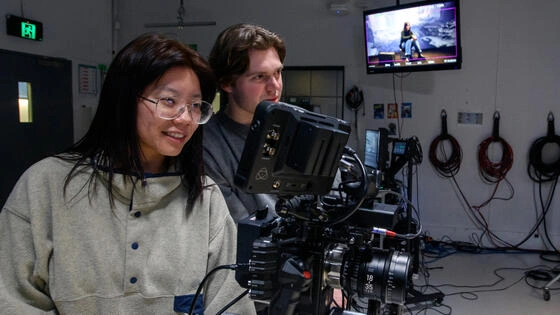
Through projects and creative production, you will develop a portfolio that reflects your interests and professional goals. Learn in industry-grade facilities, including TV broadcast studios, dance and drama studios, a professional photographic light studio, visual arts and design studios and dedicated gallery spaces. Deepen your skillset by choosing from a wide range of electives, including writing with the camera, arts marketing, digital art and photography. Take part in internships, volunteering or on-campus practical experiences through studio work. By graduation, you will be ready to work as an adaptable, resourceful creative. You may also choose to continue building your creative expertise and articulate into Deakin’s Master of Fine Arts.
-
Multidisciplinary creativity
Customise your degree across diverse fine arts disciplines, with electives from photography to arts marketing.
-
Industry experience
Elective internships can connect you with 600+ employers, or you can design your own opportunity.
-
Professional facilities
Hone your skills in industry-standard photography and visual arts studios, gallery spaces, dance studios, black box theatres, design studios and camera motion-control workstations.
-
Flexible program
Study across diverse creative disciplines and choose from a range of elective units to deepen your practice or explore a new area.

Connected to industry
Deakin’s strong industry connections help shape your learning. Build practical experience in real workplace contexts through work-integrated learning, mentoring and networking opportunities. Industry advisory boards also help shape our degrees, which means what you study is current, relevant and aligned to what your future employers need.
Deakin puts employability first
Career outcomes
Develop specialist creative skills for careers across art, design, multimedia production, curation and creative enterprise. Build your portfolio and contribute to collaborative creative projects.
Digital designer
Create digital content using design, imagery, animation, video and sound. You may interpret creative briefs, develop concepts and produce engaging work for digital platforms, agencies or creative studios.
- $105k
Typical annual salary in Australia
- 1,173
Jobs advertised


Curator
Research, interpret and care for artworks and collections. You may develop exhibitions and public programs, coordinate loans and help audiences engage with creative work in museums, galleries and cultural projects.
- $98k
Typical annual salary in Australia
- 17.3%
Projected job growth in 5 years
Professional areas
- Creative arts management
- Design
- Video and sound production
- Multimedia production
- Freelance creative practice
- Creative consulting

Key dates

Direct applications
Trimester 1 2027 applications close 7 February 2027
FAQs
A Deakin postgraduate degree can help you advance your career, deepen your expertise in a specialist field, pivot into a new industry and stand out in a competitive job market. Every course is built with industry input and taught by academics who are active practitioners, so the skills you gain are immediately applicable. Postgraduate study at Deakin is also your chance to connect with leaders in your field and build a network of industry contacts who become valuable professional connections, giving you an advantage that goes well beyond the qualification itself.
Most Deakin postgraduate courses are fee-paying, but there are practical ways to manage the cost of study. You can defer fees with a FEE-HELP loan, repaid through the ATO once you earn above the income threshold. A number of courses have Commonwealth Supported Places where the government covers part of your tuition. Deakin scholarships recognise academic achievement, professional experience and financial need. If you've studied at Deakin before, you may be eligible for a 10% alumni discount. Recognition of prior learning can also reduce costs by crediting past study so you finish sooner.
Yes to all three. Most Deakin postgraduate degrees can be studied online, on campus or a blend of both, and you may be able to switch between full and part time at the start of each trimester to suit your life. If you want to move faster, select courses offer a one-year masters degree designed for working professionals. With three start dates each year for most courses – March, July and November – you don't have to wait long to begin.
The main differences are depth, duration and career outcomes. A graduate certificate is a short, focused qualification, typically six months full time, ideal for upskilling quickly in a specific area. A graduate diploma offers broader knowledge or supports a career change, usually one-year full time. A masters degree delivers advanced expertise and professional recognition, typically one to two years full time. You can also stack qualifications – complete a graduate certificate and use the credit towards a masters.
Each Deakin postgraduate course has a unique structure, check the course stucture section of the course page to see compulsory units, electives and any specialisation streams available. All courses are shaped by industry, so content reflects real challenges in your field. Many courses let you tailor your studies through elective units or specialisations, and some include a capstone project where you apply your learning to a genuine workplace problem.
Entry requirements vary by course, so check this tab on the course page for specific criteria. Most Deakin postgraduate courses require a relevant bachelor degree, though some may accept significant demonstrable work experience as an alternative. You may also be able to build eligibility through a graduate certificate or graduate diploma, which in many cases could count towards a masters degree.
Deakin postgraduate courses are built with industry input, so you're learning skills employers are actively looking for. Depending on your course, you may access work-integrated learning through placements, internships or industry projects with partners including Microsoft, KPMG, National Australia Bank and the Geelong Cats Football Club. DeakinTALENT, Deakin's career service, supports you throughout your studies and for life, helping you grow your network and connect with opportunities in your field.
Yes. Recognition of prior learning (RPL) may turn your previous study or work experience into course credit, reducing both your study time and tuition costs. For some masters degrees, you may be able to receive credit for up to two-thirds of the course, if eligible. Use the RPL calculator to get an indication of what you might receive, and note that prior learning must generally be within the last 10 years, although some courses have a shorter time limit. You can apply for RPL as part of your course application.
Related courses






*Deakin references data from a range of government, higher education and reputable media sources. Learn more about our achievements on our University rankings page, or explore our sources page for supporting references.
What will I study in the Graduate Diploma of Fine Arts?
Move your career in a new direction by collaborating on creative projects, cross-disciplinary learning and practical project work. Customise your degree to match your interests.
Deepen your practice
Advance your creative methods
Develop research-informed and practice-based ways of working that help you test ideas and refine your process.
Shape your direction
With the course built around elective study, you can deepen an established discipline or branch into a new area.
Build industry-ready skills
Projects, collaboration and access to industry-grade facilities help you create portfolio work to progress your career ambitions.
Course structure
To complete the Graduate Diploma of Fine Arts, you must pass 8 credit points. The number of credit points required may vary, depending on your entry point or how much credit you receive as recognition of prior learning (RPL) based on your professional experience and previous qualifications.
Most units are equal to one credit point. As a full-time student you will study four credit points per trimester and usually undertake two trimesters per year.
Are you a current student? For course information that applies to the year you started your degree, visit the handbook.
All students are required to meet the University's academic progress and conduct requirements
Units
Compulsory 0-credit point module
To be completed in the first trimester of study:
Select 8 credit points of units from:

What to expect while studying
You may be able to study available units in the optional third trimester to fast-track your degree, however your course duration may be extended if there are delays in meeting course requirements, such as completing a placement.
Elective units may provide the opportunity for Work Integrated Learning experiences.
At Deakin, we're committed to ensuring an inclusive environment that supports all students to belong, thrive and succeed. We work closely with students, where needed, to identify potential barriers to participation and where possible, provide tailored support so students can engage with learning and assessment activities.
If you are neurodivergent, have a disability, health condition or mental health condition that may impact your study or participation in university life, and want to know how Deakin could support you, contact our Domestic students (opens in a new window) or International students (opens in a new window) or Disability Resource Centre (opens email client) teams for a collaborative and confidential discussion. This discussion is to support you to make plans for your studies and future career and will not have any bearing on your application to the course.
When can I start?
When you study depends on your course, location and available intakes. Check the table to see when you can start and how study is offered throughout the year.
Note: Disciplines of offer
Burwood (Melbourne) - Animation & Motion Capture, Dance, Drama, Film & TV, Photography, Visual Arts and Visual Communication Design
Your course learning outcomes describe the knowledge, skills and capabilities you’ll develop and be able to demonstrate by the time you graduate. Built into your course through your units and assessments, they provide a clear picture of what you’ll be equipped to know, understand and do – preparing you to apply your learning with confidence beyond university.
| Course Learning Outcomes |
|---|
| Apply and extend specialist knowledge and technical and creative skills in creative arts practice in one or more disciplines or areas of creative arts including drama, dance, photography, visual arts, animation, and design. |
| Use specialist creative arts technologies and skills to communicate complex ideas to a range of audiences in academic and non-academic contexts. Harness specialist creative arts technologies, skills, and discourse to communicate complex ideas to a range of audiences in academic and non -academic contexts. |
| Draw on, analyse, and assess digital technologies to produce, document, present and publish in the creative arts. |
| Evaluate, interpret, and synthesise complex ideas within creative arts drawing on discourse and practice. |
| Address theoretical and methodological challenges in the creation of work that is discursive and reflective and engages in creative decision -making processes within the relevant field. |
| Develop systematic and episodic reflective approaches to creative work practices. |
| Advanced interpersonal and communication skills to participate effectively in the critical culture of production, completion and presentation of creative arts projects. |
| Establish ethical approaches that interrogate the value of art and performance in diverse communities and cultures and transfer creative practice outcomes into real world contexts |
Approved at Faculty Board November 2018
- Award granted
- Graduate Diploma of Fine Arts
- Year
2027 course information
- Deakin code
- A659
- Level
- Postgraduate (Graduate Certificate and Graduate Diploma)
- Australian Qualifications Framework (AQF) recognition
The award conferred upon completion is recognised in the Australian Qualifications Framework at Level 8
Fees
Estimated tuition fee
$25,000
for 1 yr full-time - Full-fee paying place
The estimated tuition fee above is based on a typical full-time enrolment of 8 credit points undertaken within the same academic year and is provided as a guide only. Your tuition fees are determined by your course and unit enrolment. Your tuition fees will vary depending on your study load, the course duration, and any approved recognition of prior learning. You may also be eligible for a FEE-HELP loan to defer all or part of your tuition fees.
Scholarships
We want to help you excel at Deakin. Our scholarships recognise your dedication and achievements, providing financial support that can ease the cost of living and studying. With less pressure, you'll have more freedom to focus on what matters most – your education and future success.
Applications for 2027 are open
Ready to take the next step? Apply now to start your journey at Deakin and get ready for what’s next.
Key dates
Direct applications
Trimester 1 2027 applications close 7 February 2027
Apply now

Apply direct
Simply create an account in the Deakin Application Portal, enter your personal and educational details, upload your supporting documents and submit your application.
Recognition of prior learning
We value your previous study and experience. Recognition of prior learning enables you to get credit for what you've already achieved. When you apply, we'll consider your previous study and experience for recognition of prior learning.