
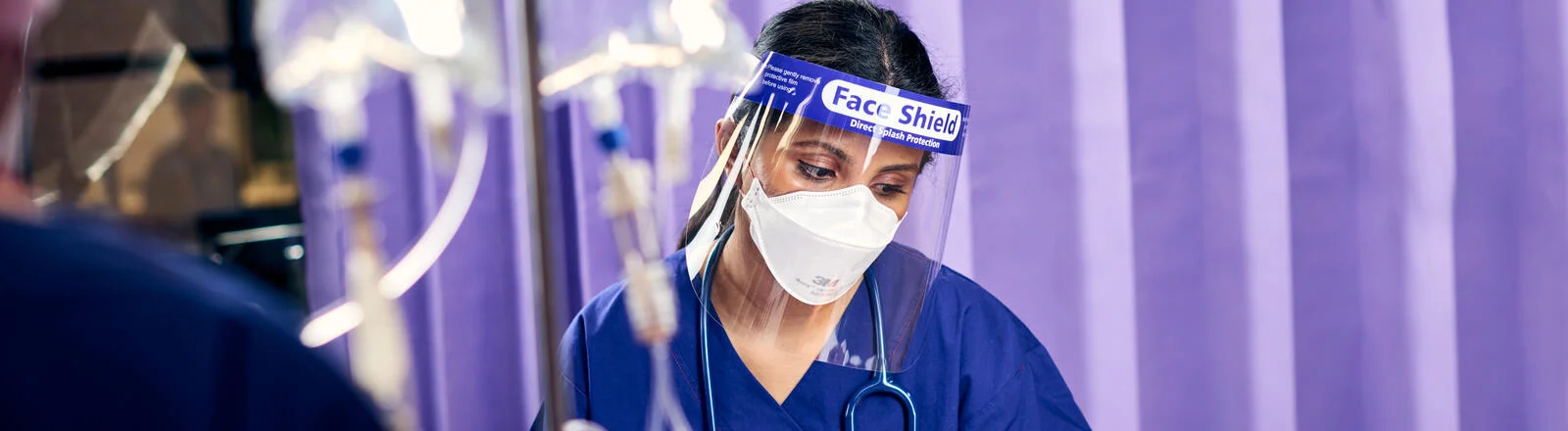

#14 in the world for nursing

Commonwealth supported places available

Flexible online courses for practising nurses
Why choose intensive care nursing at Deakin
With demand for registered nurses continuing to grow, there is increasing need for advanced specialty skills in critical care. Deakin’s Graduate Certificate of Intensive Care Nursing equips you with the knowledge and clinical capability to care for critically ill patients in intensive care and high dependency settings.
Study with Deakin’s School of Nursing and Midwifery, ranked #14 in the world, and learn from experts actively shaping critical care practice. You will build advanced skills in patient assessment, clinical decision-making and the interpretation of complex data, preparing you to practise confidently at an advanced level.
Designed for working nurses, this flexible online course allows you to study while gaining hands-on experience in your specialist practice area through Deakin’s strong network of healthcare partners across metropolitan, rural and regional settings.
-
Study at a globally ranked nursing school
Deakin’s School of Nursing and Midwifery is ranked #14 in the world, reflecting strong teaching and research excellence.
-
Advance your critical care expertise
Build advanced clinical judgement, patient assessment and decision-making skills for complex intensive care environments.
-
Designed for working nurses
Flexible online delivery lets you balance study with clinical practice while applying your learning in real time.
-
Leaders in nursing education
Deakin offers more specialised postgraduate nursing courses than any other Victorian university, allowing you to strengthen your expertise in critical care.


Connected to industry
Deakin’s strong industry connections help shape your learning. Build practical experience in real workplace contexts through work-integrated learning, mentoring and networking opportunities. Industry advisory boards also help shape our degrees, which means what you study is current, relevant and aligned to what your future employers need.

Deakin puts employability first
Career outcomes
Extend your intensive care expertise and develop the leadership and education skills to support teams caring for critically ill patients.
Nurse manager
Lead intensive care nursing teams delivering highly complex care. Coordinate people and resources while supporting clinical quality, patient safety and effective multidisciplinary practice.
- 13.6%
Projected job growth in 5 years
- $145k
Typical annual salary in Australia


Nurse educator
Educate nurses caring for patients who require advanced monitoring and life-support interventions. Develop skills in complex assessment, clinical reasoning and evidence-based intensive care.
- 5,000
Nurse educators employed
- $138k
Typical annual salary in Australia
Other jobs
- Clinical nurse specialist
- Clinical nurse consultant
- Advanced practice nurse
- Nurse researcher
- Quality and safety coordinator
- Healthcare leader

Key dates

Direct applications
Semester 1 2027 applications close 29 January 2027
FAQs
A Deakin postgraduate degree can help you advance your career, deepen your expertise in a specialist field, pivot into a new industry and stand out in a competitive job market. Every course is built with industry input and taught by academics who are active practitioners, so the skills you gain are immediately applicable. Postgraduate study at Deakin is also your chance to connect with leaders in your field and build a network of industry contacts who become valuable professional connections, giving you an advantage that goes well beyond the qualification itself.
Most Deakin postgraduate courses are fee-paying, but there are practical ways to manage the cost of study. You can defer fees with a FEE-HELP loan, repaid through the ATO once you earn above the income threshold. A number of courses have Commonwealth Supported Places where the government covers part of your tuition. Deakin scholarships recognise academic achievement, professional experience and financial need. If you've studied at Deakin before, you may be eligible for a 10% alumni discount. Recognition of prior learning can also reduce costs by crediting past study so you finish sooner.
Yes to all three. Most Deakin postgraduate degrees can be studied online, on campus or a blend of both, and you may be able to switch between full and part time at the start of each trimester to suit your life. If you want to move faster, select courses offer a one-year masters degree designed for working professionals. With three start dates each year for most courses – March, July and November – you don't have to wait long to begin.
The main differences are depth, duration and career outcomes. A graduate certificate is a short, focused qualification, typically six months full time, ideal for upskilling quickly in a specific area. A graduate diploma offers broader knowledge or supports a career change, usually one-year full time. A masters degree delivers advanced expertise and professional recognition, typically one to two years full time. You can also stack qualifications – complete a graduate certificate and use the credit towards a masters.
Each Deakin postgraduate course has a unique structure, check the course stucture section of the course page to see compulsory units, electives and any specialisation streams available. All courses are shaped by industry, so content reflects real challenges in your field. Many courses let you tailor your studies through elective units or specialisations, and some include a capstone project where you apply your learning to a genuine workplace problem.
Entry requirements vary by course, so check this tab on the course page for specific criteria. Most Deakin postgraduate courses require a relevant bachelor degree, though some may accept significant demonstrable work experience as an alternative. You may also be able to build eligibility through a graduate certificate or graduate diploma, which in many cases could count towards a masters degree.
Deakin postgraduate courses are built with industry input, so you're learning skills employers are actively looking for. Depending on your course, you may access work-integrated learning through placements, internships or industry projects with partners including Microsoft, KPMG, National Australia Bank and the Geelong Cats Football Club. DeakinTALENT, Deakin's career service, supports you throughout your studies and for life, helping you grow your network and connect with opportunities in your field.
Yes. Recognition of prior learning (RPL) may turn your previous study or work experience into course credit, reducing both your study time and tuition costs. For some masters degrees, you may be able to receive credit for up to two-thirds of the course, if eligible. Use the RPL calculator to get an indication of what you might receive, and note that prior learning must generally be within the last 10 years, although some courses have a shorter time limit. You can apply for RPL as part of your course application.
*Deakin references data from a range of government, higher education and reputable media sources. Learn more about our achievements on our University rankings page, or explore our sources page for supporting references.
Some courses have limited places, apply early to avoid missing out.
^ 2021 Employment Outlook - for the five years to November 2026, Australian Government National Skills Commission.
What will I study in the Graduate Certificate of Intensive Care Nursing?
The Graduate Certificate of Intensive Care Nursing builds your capability in critical care through focused, advanced study. You will strengthen your clinical knowledge and apply it directly to complex patient care in intensive care settings.
Advanced critical care foundations
Understand complex patient physiology
Build advanced knowledge of normal physiology and the pathophysiology of critical illness to inform safe, evidence-based care.
Develop systematic assessment skills
Learn to perform focused, structured patient assessments and interpret clinical data from multiple sources.
Strengthen clinical decision-making
Apply critical thinking to evaluate patient conditions and respond appropriately in high-pressure care environments.
Course structure
To complete the Graduate Certificate of Intensive Nursing, you must pass 4 credit points.
Most units are equal to one credit point. This course is available part time only, with students typically studying one to two credit points each study period.
Are you a current student? For course information that applies to the year you started your degree, visit the handbook.
All students are required to meet the University's academic progress and conduct requirements
Units
Professional recognition
Nurses employed under the Victorian public hospital award receive a higher duties allowance for postgraduate qualifications relevant to their practice.

What to expect while studying
To undertake this course you must independently secure employment of at least 24 hours per week in an intensive care setting within a collaborating hospital in Australia.
Course duration may be affected by delays in completing course requirements, such as failing of units or accessing or completing clinical requirements.
As a student in the Graduate Certificate of Intensive Care Nursing you can expect to participate in a range of teaching and learning activities each week. You will attend on-line synchronous study days and complete asynchronous guided learning modules. There are also additional self-directed study commitments to complete for both university and clinical assessment tasks.
At Deakin, we're committed to ensuring an inclusive environment that supports all students to belong, thrive and succeed. We work closely with students, where needed, to identify potential barriers to participation and where possible, provide tailored support so students can engage with learning and assessment activities.
If you are neurodivergent, have a disability, health condition or mental health condition that may impact your study or participation in university life, and want to know how Deakin could support you, contact our Domestic students (opens in a new window) or International students (opens in a new window) or Disability Resource Centre (opens email client) teams for a collaborative and confidential discussion. This discussion is to support you to make plans for your studies and future career and will not have any bearing on your application to the course.
When can I start?
When you study depends on your course, location and available intakes. Check the table to see when you can start and how study is offered throughout the year.
Your course learning outcomes describe the knowledge, skills and capabilities you’ll develop and be able to demonstrate by the time you graduate. Built into your course through your units and assessments, they provide a clear picture of what you’ll be equipped to know, understand and do – preparing you to apply your learning with confidence beyond university.
| Course Learning Outcomes |
|---|
| Demonstrate safe psychomotor skills and clinical practice commensurate with intensive care nursing theoretical knowledge, evidence-based practice and person-centred care. |
| Demonstrate communication skills to develop and implement plans of care to ensure the delivery of quality, safe nursing care to patients in the intensive care setting. |
| Evaluate information using digital technologies to effectively disseminate relevant intensive care information to patients and/or the multidisciplinary team. |
| Identify and evaluate complex data from multiple sources to inform clinical decision making in the intensive care setting. |
| Apply specialised nursing knowledge and skills to routine and complex problems in the intensive care setting to optimise patient outcomes. |
| Demonstrate professionalism, accountability, reflection, and personal autonomy as an intensive care nurse. |
| Establish and maintain inclusive, collaborative professional relationships with all members of the multidisciplinary team. |
| Display accountability for, and sound professional judgement in behaviours that uphold ethical principles of practice within diverse social, cultural, and environmental contexts. |
- Award granted
- Graduate Certificate of Intensive Care Nursing
- Year
2027 course information
- Deakin code
- H545
- Level
- Postgraduate (Graduate Certificate and Graduate Diploma)
- Australian Qualifications Framework (AQF) recognition
The award conferred upon completion is recognised in the Australian Qualifications Framework at Level 8
Fees
Estimated tuition fee
$2,455
- Commonwealth Supported Place (CSP)
The estimated tuition (student contribution) fee above is based on a typical enrolment of 4 credit points undertaken within the same academic year and is provided as a guide only. Your student contribution is determined by the units you enrol in and will vary depending on the units you choose, your study load, the course duration, and any approved recognition of prior learning. You may also be eligible for a HECS-HELP loan to defer payment of all or part of your student contribution.
Check your eligibility or learn more about CSP or HECS-HELP.

Scholarships
We want to help you excel at Deakin. Our scholarships recognise your dedication and achievements, providing financial support that can ease the cost of living and studying. With less pressure, you'll have more freedom to focus on what matters most – your education and future success.
Applications for 2027 are open
Ready to take the next step? Apply now to start your journey at Deakin and get ready for what’s next.
Key dates
Direct applications
Semester 1 2027 applications close 29 January 2027
Apply now

Apply direct
Simply create an account in the Deakin Application Portal, enter your personal and educational details, upload your supporting documents and submit your application.
Applicant declaration
Applicants must complete the Applicant declaration as part of their application.
Recognition of prior learning
We value your previous study and experience. Recognition of prior learning enables you to get credit for what you've already achieved. When you apply, we'll consider your previous study and experience for recognition of prior learning.
Pathways
Upon successful completion of the Graduate Certificate of Intensive Care Nursing, students have the option to further their studies by articulating into the below course: