


#1 Victorian university for course satisfaction

#1 public university in Australia for facilities and resources

Specialised year pathway to research degrees
Why choose arts at Deakin
Develop advanced research skills and deepen your disciplinary expertise with the Bachelor of Arts (Honours). In this optional year of specialised study, you will conduct in-depth independent research on a topic you are passionate about, while building research capability and disciplinary knowledge through coursework and a supervised thesis.
Guided by experienced academics, you will engage with contemporary debates in the social sciences, humanities or literary studies while strengthening your critical and analytical thinking. You will graduate with practical research capabilities suited to roles across the public and private sectors, and be well placed to progress to masters or doctoral research.
-
Advanced research focus
Complete a substantial research thesis under expert Deakin supervision to deepen expertise in your chosen field.
-
Develop career-ready skills
Strengthen critical thinking, communication and independent research capabilities applicable to professional and research contexts.
-
Flexible study options
Study on campus at Burwood (Melbourne), Waurn Ponds (Geelong) or online to suit your needs.
-
Learn from experts
Study at Victoria’s #1 university for student support, guided by academic staff who are active researchers and experienced educators.


Connected to industry
Deakin’s strong industry connections help shape your learning. Build practical experience in real workplace contexts through work-integrated learning, mentoring and networking opportunities. Industry advisory boards also help shape our degrees, which means what you study is current, relevant and aligned to what your future employers need.
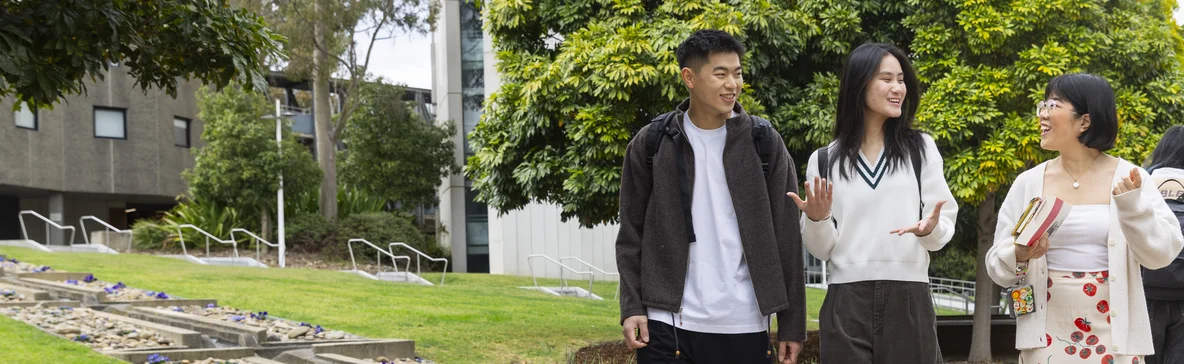
Deakin puts employability first
Career outcomes
Develop advanced research, analytical and communication skills for careers across the public, private and community sectors. You may also use your honours year as a pathway to masters or doctoral research.
Researcher
Conduct research using qualitative and quantitative methods, analyse evidence and prepare reports or papers. You may work across areas such as public policy, community services, government or the private sector.
- $108k
Typical annual salary in Australia
- 12.8%
Projected job growth in 5 years


Editor
Review and refine written material to improve clarity, structure and accuracy. You may collaborate with writers and contribute to publishing, media or other professional communication projects.
- $110k
Typical annual salary in Australia
- 4/5
Job satisfaction

Professional areas
- Government civil service
- International relations
- Media
- Public policy
- Community services
- Private sector consulting



“Deakin is the best choice you can make if you are looking to challenge the status quo and understand the world in a more critical way.”
TaylorBachelor of Arts (Honours), Doctorate of Philosophy
Related courses







*Deakin references data from a range of government, higher education and reputable media sources. Learn more about our achievements on our University rankings page, or explore our sources page for supporting references.
What will I study in the Bachelor of Arts (Honours)?
Study advanced honours-level coursework and complete a supervised research thesis in your chosen discipline to extend your learning and research capabilities.

Developing expertise
Extend your learning
Deepen your understanding of a chosen topic through focused honours-level study and independent inquiry.
Develop research capability
Interpret evidence, ask questions and analyse complex problems within a structured academic environment.
Strengthen career and postgraduate pathways
Prepare for entry into masters or doctoral research programs and specialist roles across public and private sectors.
Course structure
To complete the Bachelor of Arts (Honours), you must pass 8 credit points.
Most units are equal to one credit point. As a full-time student you will study four credit points per trimester and usually undertake two trimesters per year.
Are you a current student? For course information that applies to the year you started your degree, visit the handbook.
All students are required to meet the University's academic progress and conduct requirements
Units
Compulsory 0-credit point module
To be completed in the first trimester of study:
Units
Refer to the details of each discipline for availability.
The School of Communication and Creative Arts (SCCA) offers the Bachelor of Arts (Honours) in the following disciplines:
- Children's Literature
- Gender and Sexuality Studies
- Literary Studies
- Professional and Creative Writing.
Notes:
(i) The School of Communication and Creative Arts (SCCA) offers the Bachelor of Arts (Honours) at Burwood (Melbourne) to all students, to Waurn Ponds (Geelong) students and online students subject to agreement with the Honours Co-ordinator.
(ii) For disciplines in the creative arts (Animation and Motion Capture, Dance, Drama, Film and Television, Media and Communication, Photography, Visual Arts and Visual Communication Design) please refer to A450 Bachelor of Creative Arts (Honours)
(iii) For disciplines in communication (Journalism, Public Relations, Media and Communication) please refer to A451 Bachelor of Communication (Honours)
The School of Humanities and Social Sciences (SHSS) offers the Bachelor of Arts (Honours) in the following disciplines:
- Anthropology
- Criminology
- History
- Sociology
- International Relations
- Politics
- Philosophy
- Language.
Notes:
(i) Anthropology, Criminology, History, International Relations, Languages, Politics, Philosophy and Sociology are all offered at Burwood (Melbourne), Waurn Ponds (Geelong) and online.
(ii) Honours students who commenced prior to 2015 to contact the Faculty Honours Student Adviser in the Student Services Office for enrolment advice.
(iii) Students enrolling in Trimester 2 will commence part-time but may convert to full-time study in the following year. Course completion may be 18 months to 2 years.
(iv) Students who have completed a sequence in Politics or Philosophy within the A336 Bachelor of Politics, Philosophy and Economics (and associated degrees) are also able to apply for honours in those disciplines.

What to expect while studying
You may be able to study available units in the optional third trimester to fast-track your degree, however your course duration may be extended if there are delays in meeting course requirements, such as completing a placement.
Children’s Literature, Gender and Sexuality Studies, Literary Studies and Professional and Creative Writing
Course Director (SCCA)
A/Prof Alyson Miller
Tel: (03) 5247 9315
Email: alyson.miller@deakin.edu.au
Course Director (SHSS)
A/Prof Kiran Pienaar
Email: kiran.pienaar@deakin.edu.au
Tel: (03) 5227 2004
For SHSS discipline students requiring further information, please contact:
Anthropology
Dr David Giles
Tel: (03) 9246 8382
Email: d.giles@deakin.edu.au
Criminology
Dr Sally Kennedy
Tel: (03) 9246 8946
Email: s.kennedy@deakin.edu.au
History
Prof David Lowe
Tel: (03) 5227 2691
Email: david.lowe@deakin.edu.au
International Relations, Middle East Studies, Politics and Policy (PRIMES)
Dr Bianca Baggiarini
Tel: 03 9246 8180
Email: b.baggiarini@deakin.edu.au
Languages
Dr Ramon Lopez Castellano
Tel: 03 9244 5115
Email: ramon.lopezcastellano@deakin.edu.au
Philosophy
Dr Cathy Legg
Tel: 03 9246 8856
Email: c.legg@deakin.edu.au
Sociology
Dr Rose Butler
Email: rose.butler@deakin.edu.au
There are no attendance requirements for online enrolled students, although regular consultation with an appointed thesis supervisor is required.
Deakin offers many courses which can be studied by distance education overseas.
However, international students living in Australia on a student visa, in each compulsory trimester (that is, Trimesters 1 and 2), must enrol in at least one unit that is offered as a Campus located unit and can, in addition enrol in units offered online. International students may undertake a maximum of up to one third (or equivalent) of their study as online study. Please note enrolment in one face to face unit in compulsory study periods is only allowed if the student is completing their final unit of study and will not exceed maximum one third (or equivalent) online requirement.
At Deakin, we're committed to ensuring an inclusive environment that supports all students to belong, thrive and succeed. We work closely with students, where needed, to identify potential barriers to participation and where possible, provide tailored support so students can engage with learning and assessment activities.
If you are neurodivergent, have a disability, health condition or mental health condition that may impact your study or participation in university life, and want to know how Deakin could support you, contact our Domestic students (opens in a new window) or International students (opens in a new window) or Disability Resource Centre (opens email client) teams for a collaborative and confidential discussion. This discussion is to support you to make plans for your studies and future career and will not have any bearing on your application to the course.
When can I start?
When you study depends on your course, location and available intakes. Check the table to see when you can start and how study is offered throughout the year.
Your course learning outcomes describe the knowledge, skills and capabilities you’ll develop and be able to demonstrate by the time you graduate. Built into your course through your units and assessments, they provide a clear picture of what you’ll be equipped to know, understand and do – preparing you to apply your learning with confidence beyond university.
| Course Learning Outcomes |
|---|
| Synthesise complex theoretical knowledge with appropriate discipline-specific research methodologies to conceptualise, plan, and execute an original piece of research or work demonstrating high level, independent critical analysis and evaluative judgment. |
| Articulate complex research questions, designs, and outcomes through a variety of media, adapting communication strategies to effectively convey information to diverse audiences in professional and academic contexts. |
| Apply evaluative judgement to a range of digital technologies in the production of ethically informed research and analysis, employing intellectual independence to the resolution of complex tasks. |
| Critically evaluate and synthesise theoretical knowledge and methodologies and apply these to complex applications, including the generation of new knowledge and works. |
| Analyse and evaluate complex problems and solutions using appropriate theoretical frameworks and implement strategies to address these. |
| Apply autonomy, responsibility and adaptability in learning and meeting deadlines, upholding integrity and accountability for personal actions. |
| Collaborate effectively, responsibly and ethically with a diverse range of people to set and meet relevant and agreed on outcomes. |
| Apply self-reflexivity and critical analysis to personal cultural values, privileges, and biases while engaging with diverse perspectives, particularly Indigenous knowledges, in the development of research and creative works. |
Approved at Faculty Board November 2024
- Award granted
- Bachelor of Arts (Honours)
- Year
2027 course information
- Deakin code
- A400
- CRICOS code?Commonwealth Register of Institutions and Courses for Overseas Students
- 001816G Burwood (Melbourne), Waurn Ponds (Geelong)
- Level
- Undergraduate
- Australian Qualifications Framework (AQF) recognition
The award conferred upon completion is recognised in the Australian Qualifications Framework at Level 8
Fees
Estimated tuition fee
$38,200
for 1 yr full-time AUD
The estimated tuition fee above is based on a typical first-year full-time enrolment of 8 credit points and is provided as a guide only. Your tuition fees are determined by your course and unit enrolment. Your tuition fees will vary depending on your study load, the course duration, and any approved recognition of prior learning.
Scholarships
We want to help you excel at Deakin. Our scholarships recognise your dedication and achievements, providing financial support that can ease the cost of living and studying. With less pressure, you'll have more freedom to focus on what matters most – your education and future success.
Apply now

Apply directly to Deakin
Apply directly through StudyLink Connect. Depending on your location, you may need to apply through a Deakin Authorised Agent, who can support and submit your application.
See our guide to applying to Deakin for application steps and requirements.
Recognition of prior learning
We value your previous study and experience. Recognition of prior learning enables you to get credit for what you've already achieved. When you apply, we'll consider your previous study and experience for recognition of prior learning.