


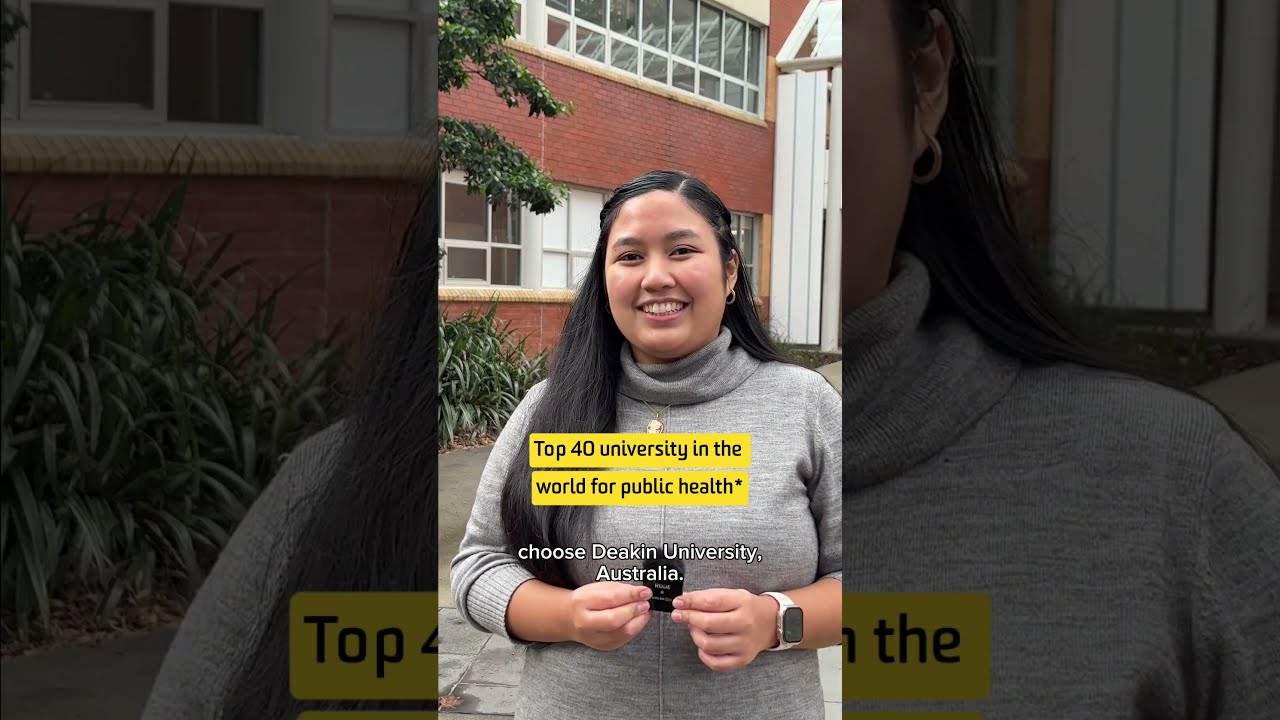
#36 in the world for public health

#1 Victorian university for health student support

Industry-connected learning
Why choose public health at Deakin
Deakin’s Graduate Diploma of Public Health builds your knowledge of public health and develops the practical skills to improve the health and wellbeing of communities locally and globally. In Australia, over half a million new jobs are projected in the health care and social assistance sector over the next decade, creating strong demand for skilled graduates.
Develop a strong foundation in public health practice, health systems and policy while learning to apply evidence to contemporary public health challenges. Build skills in data interpretation, health promotion and population health, preparing you to contribute to public health initiatives across diverse settings. Designed for professionals and graduates from a range of backgrounds, this course offers flexible online and on-campus study, and a pathway into the Master of Public Health. As the #1 university in Victoria for health student support, Deakin provides a supportive learning environment as you continue building your expertise.
-
Apply public health in practice
Build job-ready skills through applied learning that prepares you to contribute to real public health challenges.
-
Study while you work
Flexible online and on-campus options designed to fit around your professional commitments.
-
Learn through industry and research
Benefit from work-integrated learning, applied research and Deakin’s strong connections across the health sector.
-
Outstanding learning environment
#1 public university in Australia for facilities and resources, and #1 Victorian university for student support in postgraduate health.


Connected to industry
Deakin’s strong industry connections help shape your learning. Build practical experience in real workplace contexts through work-integrated learning, mentoring and networking opportunities. Industry advisory boards also help shape our degrees, which means what you study is current, relevant and aligned to what your future employers need.

Deakin puts employability first
Career outcomes
Broaden your public health career opportunities across government, advocacy, population health and global organisations, with scope to move into more specialised and senior roles.
Health and welfare services manager
Lead health and welfare services and programs, using your public health expertise to shape policy, coordinate service delivery, manage resources and improve health outcomes.
- $128k
Typical annual salary in Australia
- 15.2%
Projected job growth in 5 years


Professional areas
- Global health organisations
- Government health departments and services
- Population health and screening
- Public health advocacy



“The ability to exchange ideas, ask questions, and gain advice from those who are shaping policy and practice has been invaluable in shaping my career aspirations and future path in public health.”
BecPostgraduate public health student
Stories that start here


Key dates

Direct applications
Trimester 1 2027 applications close 7 February 2027
FAQs
Deakin's Graduate Diploma of Public Health prepares graduates for roles in health promotion, disease prevention, public health policy, community health, research coordination and program management across government, NGOs and health services. The diploma also provides a pathway into the Master of Public Health. If you choose to continue, you will have already completed half of the credit points from the masters, reducing the number of units you need to complete.
Public health professionals draw on skills in epidemiology, health data analysis, policy development, program planning, community engagement and health communication. Deakin's Graduate Diploma of Public Health develops these core competencies alongside research skills and systems thinking – preparing graduates to address complex health challenges at population level across a range of settings and sectors.
No. Public health is open to graduates from diverse disciplines including nursing, allied health, social sciences, business, policy and beyond. Deakin's Graduate Diploma of Public Health welcomes applicants from all professional backgrounds. The program builds public health knowledge and skills from the ground up, so prior clinical experience is valued but not required. See the course entry requirements for full details.
For a career change into public health, a graduate diploma provides faster entry into the workforce – typically completed in one year full time – while giving you the option to continue to the Master of Public Health later. If you're targeting senior research, policy or leadership roles, the masters carries more weight. For most entry-to-mid-level public health roles, a graduate diploma is a strong and efficient qualification.
Related courses



*Deakin references data from a range of government, higher education and reputable media sources. Learn more about our achievements on our University rankings page, or explore our sources page for supporting references.
What will I study in the Graduate Diploma of Public Health?
The Graduate Diploma of Public Health introduces key concepts, systems and approaches used to improve population health. You will build practical knowledge and skills that can be applied across a range of public health roles, with the option to continue your studies at masters level.
Develop core public health knowledge
Understand public health systems
Learn how health systems operate, including policy, promotion and equity, and how to respond to modern public health challenges.
Develop analytical skills
Build your ability to interpret and apply health data, using evidence to inform decision-making in public health settings.
Build research capability
Develop research literacy or research methods skills, depending on your interests and career goals.
Course structure
To complete the Graduate Diploma of Public Health, you must pass 8 credit points. The number of credit points required may vary, depending on your entry point or how much credit you receive as recognition of prior learning (RPL) based on your professional experience and previous qualifications.
Most units are equal to one credit point. As a full-time student you will study four credit points per trimester and usually undertake two trimesters per year.
Are you a current student? For course information that applies to the year you started your degree, visit the handbook.
All students are required to meet the University's academic progress and conduct requirements
Units
and one of
Note: Students wishing to continue their studies into the Master of Public Health and complete a minor or major project option are recommended to complete core unit HSH753 Research Methods in Health and Social Development.
Professional recognition
All students will receive a two-year membership to the Public Health Association of Australia (PHAA) while studying.

What to expect while studying
You may be able to study available units in the optional third trimester to fast-track your degree, however your course duration may be extended if there are delays in meeting course requirements.
Any unit which contains work integrated learning, a community placement or interaction with the community may require a National Police Record Check, a Working with Children Check or other check. Refer the relevant unit guide.
As a student in the Faculty of Health you can expect to participate in a range of teaching activities each week. This could include lectures, seminars, practicals and online interaction. You will also need to study and complete assessment tasks in your own time. Details for individual units are available in the course structure.
In the Faculty of Health you can expect to participate in a range of teaching activities each week. This could include classes, seminars, practicals and online interaction. You can refer to the individual unit details in the course structure for more information. You will also need to study and complete assessment tasks in your own time.
At Deakin, we're committed to ensuring an inclusive environment that supports all students to belong, thrive and succeed. We work closely with students, where needed, to identify potential barriers to participation and where possible, provide tailored support so students can engage with learning and assessment activities.
If you are neurodivergent, have a disability, health condition or mental health condition that may impact your study or participation in university life, and want to know how Deakin could support you, contact our Domestic students (opens in a new window) or International students (opens in a new window) or Disability Resource Centre (opens email client) teams for a collaborative and confidential discussion. This discussion is to support you to make plans for your studies and future career and will not have any bearing on your application to the course.
When can I start?
When you study depends on your course, location and available intakes. Check the table to see when you can start and how study is offered throughout the year.
Your course learning outcomes describe the knowledge, skills and capabilities you’ll develop and be able to demonstrate by the time you graduate. Built into your course through your units and assessments, they provide a clear picture of what you’ll be equipped to know, understand and do – preparing you to apply your learning with confidence beyond university.
| Course Learning Outcomes |
|---|
| Demonstrate the ability to apply knowledge and skills in the area of public health that includes the understanding of recent developments, research principles, methods and professional practice. |
| Demonstrate clear and effective communication skills to mindfully interpret, articulate and transmit public health information and practice to advise and educate diverse communities. |
| Collect, organise, assess and transmit knowledge, skills and ideas across a range of public health contexts to disseminate and transmit information into practice. |
| Evaluate evidence and appraise solutions to public health practice and care by critically reflecting on and generating complex ideas and concepts with consideration to diverse contexts. |
| Apply expert knowledge and skills using appropriate research methods to critically analyse, evaluate and develop authentic public health strategies and solutions to improve the health status and practice of communities. |
| Demonstrate effective self-management skills to address personal workloads and timeframes with a commitment to ethical practice, engaging in lifelong learning. |
| Demonstrate the ability to contribute and work effectively within a team environment across a range of disciples and backgrounds. |
| Engage in ethical and professional practice and research to generate appropriate and culturally sensitive responses to public health contexts. |
- Award granted
- Graduate Diploma of Public Health
- Year
2027 course information
- Deakin code
- H647
- Australian Qualifications Framework (AQF) recognition
The award conferred upon completion is recognised in the Australian Qualifications Framework at Level 8
Fees
Estimated tuition fee
$30,600
for 1 yr full-time - Full-fee paying place
The estimated tuition fee above is based on a typical full-time enrolment of 8 credit points undertaken within the same academic year and is provided as a guide only. Your tuition fees are determined by your course and unit enrolment. Your tuition fees will vary depending on your study load, the course duration, and any approved recognition of prior learning. You may also be eligible for a FEE-HELP loan to defer all or part of your tuition fees.

Scholarships
We want to help you excel at Deakin. Our scholarships recognise your dedication and achievements, providing financial support that can ease the cost of living and studying. With less pressure, you'll have more freedom to focus on what matters most – your education and future success.
Applications for 2027 are open
Ready to take the next step? Apply now to start your journey at Deakin and get ready for what’s next.
Key dates
Direct applications
Trimester 1 2027 applications close 7 February 2027
Apply now

Apply direct
Simply create an account in the Deakin Application Portal, enter your personal and educational details, upload your supporting documents and submit your application.
Recognition of prior learning
We value your previous study and experience. Recognition of prior learning enables you to get credit for what you've already achieved. When you apply, we'll consider your previous study and experience for recognition of prior learning.