Get in touch with our team to find out more about our research programs, media expertise and collaboration.
Research
Forward-thinking, innovative research
Deakin's School of Engineering is a leader in several engineering-focused research areas, committed to generating fundamental knowledge creation and translation of research to outcomes that benefit the communities we serve.
Study a research degree with us
As a School of Engineering research student, you have access to state-of-the-art facilities, high-quality research training, world-renowned research supervisors and industry partnerships that make a real difference.
Masters by research
Enjoy flexible start dates and study across multiple locations. Our Master of Engineering is a 2-year full-time degree and a pathway to a PhD. Involves a written thesis.
Doctor of Philosophy (PhD)
Work in a collaborative community; study our Doctor of Philosophy (Engineering) over 3 years full time on a supervised research project. Involves a written thesis and an oral defence.
Cotutelle PhD
Our Cotutelle PhD initiative allows candidates to co-enrol at two universities in different countries. Conduct research under a jointly supervised doctoral program with dual awards while being immersed in diverse research.
How to apply for a research degree
Get all the information you need to successfully apply for a Deakin research degree or PhD, including key dates, entry requirements, supporting documents and finding a research supervisor. We’re here to support you through the process.
Find a research supervisor
Keen to get started with postgraduate study but need a supervisor? We can help you find someone suitable. Our disciplines cover a broad range of research areas, including additive manufacturing, civil engineering, design technology, electrical and electronics engineering, engineering management, mechanical engineering, mechatronics engineering, renewable energy engineering and sustainability engineering.
Find a scholarship
Reach your full potential and achieve your career goals with the support of a research degree or PhD scholarship. Our top scholarships recognise and reward students from a range of backgrounds and interest areas.
Biomedical engineering PhD
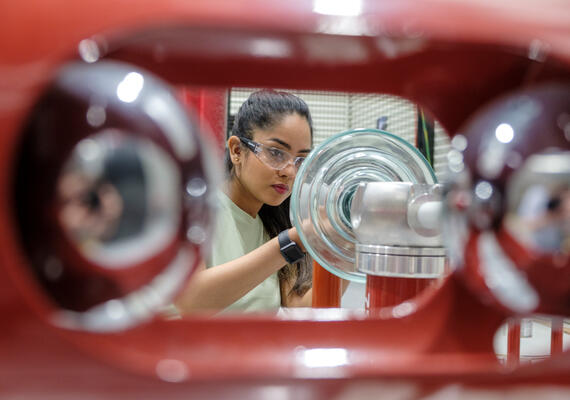
Dr Bipasha Kashyap developed a wearable technology during her PhD that has the potential to make a real difference in people’s lives.
Deakin Digital Design and Engineering Centre
Deakin Digital Design and Engineering Centre was established to respond to the technology-centred industrial revolution by combining design and engineering innovation with cutting-edge digital fabrication and sensor technology expertise. Our collaboration is based on integrating multi-disciplinary ingenuity, people-centred solutions and improving social, economic and environmental outcomes through digital technology innovations.
Learn more about the Deakin Digital Design and Engineering Centre
Our research themes
We have three key research themes, focusing on energy, infrastructure and environment, and smart technologies. Each theme represents several centres, groups and programs.
Energy research
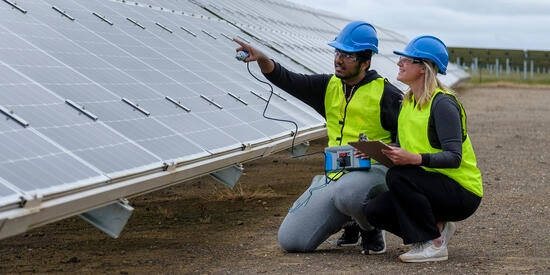
Our energy research revolves around electrical, power, renewable and thermal energy. Our team investigates improving the ways we generate, transmit, use, mitigate and store energy with the aim to solve key challenges that governments, industry and society face.
The Deakin Centre for Smart Power and Energy Research focuses on future power grids, renewable energy and energy storage, and cyber-physical energy systems. The goal is to deliver solutions for our communities in sustainable generation of energy, integration of renewable energy sources and development of new energy management systems.
Deakin Flow, Aerosols and Thermal Energy Research Group brings together researchers with expertise in a broad range of science and engineering fields. Our research focus includes thermal energy, environmental emissions, and biomedical and bio-fluids.
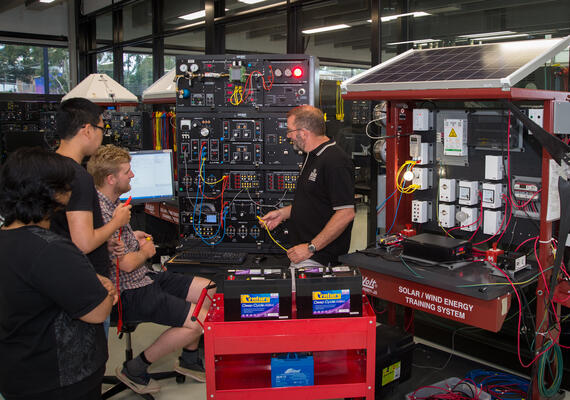
Energy research facilities
The School of Engineering has several world-class research facilities, including our high voltage, renewable energy and power engineering laboratories. We also have state-of-the-art modelling and simulation capability for thermal energy systems and use of our microgrid research platform.
Infrastructure and environment research
Our infrastructure and environment research involves multidisciplinary research groups investigating sustainable solutions in the areas of built and natural environment. We aim to develop technologies to address challenges in construction, water resource, climate change and environment.
Environmental Chemistry and Climate Resilience Engineering Research Group focuses on developing sustainable and resilient engineering solutions to address challenges posed by floods, droughts and fire.
Engineered Timber Structures Research Group conducts research on engineered mass timber and bio-based composite materials in the contexts of manufacturing, supply chain, material characterisation and structural design.
Safe Future Mobility Research Lab specialises in modelling, analysing and evaluating the safety and mobility aspects of all types of road transport users, for current and future transport systems in both urban and rural areas.
The Deakin Renewable Materials in Structures research group focuses on composite materials for construction and structures, working with industry to develop novel uses of engineered materials, such as recycled materials
Geotechnics and Infrastructure Research Group focuses on solving challenging geotechnical problems and how to improve surface and underground infrastructure.
Water Resources and Asset Management Research Group focuses on how water is being captured and used, as well as the overarching management of the infrastructure related to water storage, treatment and transportation.
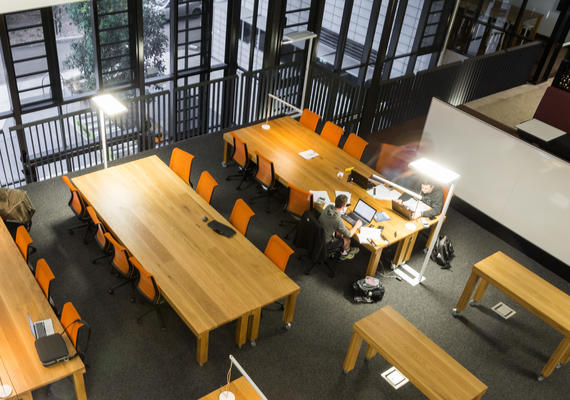
Structural engineering PhD
In partnership with industry, Xin Li’s PhD looks at innovative and environmentally sustainable cross-laminated timber.
Smart technologies research
Our smart technologies research focuses on the creation of new knowledge and innovative technologies for solving fundamental and applied research problems and creating and supporting jobs of the future.
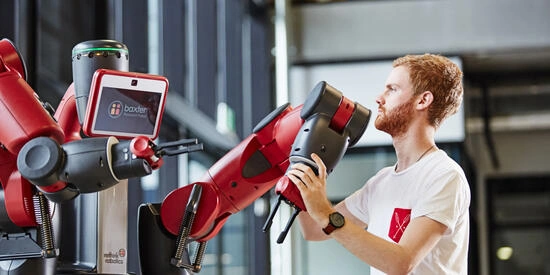
Advanced Robotics Technologies – focuses on electronics, mechanical, software and control for robotic platforms. This includes robots and their uses, and sensors and control systems for robots.
Biomedical Systems Design – focuses on rehabilitation and assistive device design for biomedical applications. This utilises strengths in the bio-mechanic-based problems, robust estimation and human motion capture, signal filtering and motion analytics.
Control Systems – focuses on developing innovative, integrable software and hardware solutions with novel theories and technologies for the next generation of interconnected and complex systems.
Instrumentation and Measurement Systems Design – focuses on designing and deploying measurement technologies for physical parameters. We design and build nano-scale to large-scale measurement systems for environmental, biological and industrial applications.
Sensors, Devices and IoT technologies – focuses on the design and development of smart devices, circuits, instruments and systems incorporating sensing, actuation, wireless transmission, networking and IoT, data acquisition/storage, control, AI analysis, energy harvesting and power management.
Be part of research that’s above world standard
Our mission is to deliver excellence in research and learning that makes a difference to our community. Through partnerships with commercial industry, government, and public and private organisations, we can work together to create sustainable solutions to the technological, social, environmental and economic problems the world faces.
Contact us
Email the School of Engineering