

#1 Victorian university for course satisfaction

#1 Victorian university for psychology facilities and resources

APAC accredited course for registration purposes
Why choose arts (psychology) at Deakin
Become an expert in why people think, feel and behave the way they do. Deakin’s Bachelor of Arts (Psychology) gives you the perfect mix of skills sought by employers in one degree, with exposure to two distinct areas of interest and over 30 study areas to choose from.
Build transferable skills through experiential learning. Work in teams during industry placement, develop critical analysis through work-integrated learning and build valuable life skills through global experiences. Combine this with in-depth study in psychology as a scientific discipline and learn about human behaviour and personality. Undertake 140 hours of practical industry placement in your final year of study to flex your new skill set and grow your professional network. As a graduate you may opt to undertake further studies leading to registration.
-
Deepen your learning
Study psychology alongside 30+ arts study areas. Choose from digital cultures, history, education and more, to broaden your expertise.
-
Accredited course
Deakin’s Bachelor of Arts (Psychology) is accredited by the Australian Psychology Accreditation Council (APAC).
-
Industry focus
Apply theory to real-life issues. The Faculty of Health’s work-integrated learning team can help you secure, and support you through, 140 hours of practical industry placement.
-
Strong postgraduate pathways
Graduate eligible to apply for honours and further psychology study or pursue diverse careers across people-focused industries.


Connected to industry
Deakin’s strong industry connections help shape your learning. Build practical experience in real workplace contexts through work-integrated learning, mentoring and networking opportunities. Industry advisory boards also help shape our degrees, which means what you study is current, relevant and aligned to what your future employers need.

Deakin puts employability first
Career outcomes
Build a mix of skills sought by employers while exploring two distinct areas of interest in one degree. Discover the pathway to becoming a psychologist or explore diverse career opportunities available to arts and psychology graduates.
Psychologist
Support individuals, families and communities to improve their mental health and wellbeing. Psychologists assess behaviour, deliver evidence-based interventions and help people navigate emotional, social and behavioural challenges.
- $113k
Typical annual salary in Australia
- 16.8%
Projected job growth in 5 years
- 4.3/5
Job satisfaction


Policy analyst
Assist in the planning and development of policies for government or a large organisation. Review policies and collect and analyse data to assist with policy creation and modification.
- $110k
Typical annual salary in Australia
- 1,874
Job opportunities
Industries you may work in
- Advertising
- Public health
- Government
- Criminal justice
- Not-for-profits



“Through my degree, I had the opportunity to intern with leading organisations, which gave me a better understanding of how industries and communities work in Australia. The experience helped me grow both professionally and personally.”
KashviBachelor of Arts (Psychology)
Stories that start here




Key dates

Direct applications
Trimester 3 2026 applications close 18 October 2026
Trimester 1 2027 applications close 7 February 2027

VTAC
FAQs
It's a great combination. You get the scientific grounding of psychology – learning about human behaviour and personality – alongside the critical thinking, creative problem solving and communication skills of an arts major. Employers across health, education, business and the community sector value graduates who think analytically and communicate complex ideas. The degree genuinely broadens your options.
Yes. The Bachelor of Arts (Psychology) includes an APAC-accredited psychology sequence recognised by the Psychology Board of Australia. The next step towards becoming a psychologist involves applying for an honours year, for example, the Bachelor of Psychological Science (Honours). Once completed, you can then apply for provisional registration as a psychologist with the Psychology Board of Australia (PsyBA). You will then need to undertake further study through a masters or doctorate course to pursue general registration with PsyBA and work as a registered psychologist.
To study the Bachelor of Arts (Psychology), you'll need to meet Deakin's course entry requirements, including the required English prerequisite. You don't need to have studied psychology at school, and subjects such as biology, maths or the social sciences can be helpful but are not required. Check the course entry requirements for the current prerequisite subjects and admission criteria.
If you don't meet the direct entry requirements for the Bachelor of Arts (Psychology), there are several alternative pathways available. Depending on your previous study and experience, you may be eligible through a pathway course, higher education study, vocational education and training (VET), recognition of prior learning or other admission options. Explore Deakin's entry pathways for the Bachelor of Arts (Psychology) to find the pathway that best suits your circumstances.
Psychology and counselling are related but distinct professions that both support mental health and wellbeing. Psychologists complete a six-year sequence of accredited education and training and must be registered with the Psychology Board of Australia. Depending on their role and training, they may undertake psychological assessments, diagnose mental health conditions and provide psychological treatment. Counsellors use therapeutic approaches to support individuals, couples and groups with concerns such as mental health, relationships, grief and life transitions. Unlike psychology, counselling is not currently regulated through Australia’s national registration scheme, although practitioners can seek professional registration through associations such as ACA and PACFA. Deakin’s Master of Counselling is accredited by both organisations, supporting graduates to apply for professional registration with them.
Related courses






*Deakin references data from a range of government, higher education and reputable media sources. Learn more about our achievements on our University rankings page, or explore our sources page for supporting references.
What will I study in the Bachelor of Arts (Psychology)?
This three-year degree combines an accredited psychology sequence with an arts major, helping you understand human behaviour without losing sight of the wider world. You will move from broad foundations to research-led depth, then into advanced study and practical preparation for work or further study.
Core foundation
Establish core psychology knowledge
Explore the foundations of psychology, while building essential research, writing and study skills for further psychology study.
Commence major study
Choose from over 30 study areas including international relations, education, history, media and communication.
Career pathways
It’s never too early to start thinking about your future career. We will support you in this early-stage career development with helpful strategies.
Build your knowledge
Gain hands-on experience
Complete a work-integrated learning opportunity to build real industry insight.
Progress psychology insights
Be guided as you go in-depth in psychology as a scientific discipline and learn about human behaviour and personality.
Develop professional capabilities
Through your study in the arts you will build communication, problem-solving and critical-thinking skills.
Applying knowledge in practice
Psychology at Work (Internship)
Choose to build industry experience and undertake 140 hours of practical industry placement, strengthening your employment prospects.
Graduate career-ready
Consolidate your psychology and arts learning by completing projects, electives and employability units, with optional international experiences, to prepare for your career.
For a career in psychology
This course leads to a fourth-year level of study (honours or graduate diploma level); the next step toward applying for provisional registration as a psychologist.
Course structure
To complete the Bachelor of Arts (Psychology), you must pass 24 credit points.
Most units are equal to one credit point. As a full-time student you will study four credit points per trimester and usually undertake two trimesters per year.
Are you a current student? For course information that applies to the year you started your degree, visit the handbook.
All students are required to meet the University's academic progress and conduct requirements
Units
Compulsory 0-credit point module
To be completed in the first trimester of study:
Level 1
Level 2
Level 3
Refer to the details of each major sequence for availability. Refer to Bachelor of Arts for list of Arts majors on offer.
Professional recognition
The Bachelor of Arts (Psychology) degree at Deakin meets the requirements of the Psychology Board of Australia (PBA) translating into excellent job and career opportunities for our graduates. Upon graduation of this degree, you'll have gained a three-year undergraduate psychology sequence that is accredited by the Australian Psychology Accreditation Council (APAC) and recognised for registration purposes by the PBA, enabling you to undertake additional study in pursuit of provisional registration.

What to expect while studying
The faculty offers two units AIX160 Introduction to University Study and AIX117 Professional Writing for Work [No longer available for enrolment] which are specifically designed to ease the transition into university study. New students are encouraged to enrol in one or both of these units in their first year.
You may be able to study available units in the optional third trimester to fast-track your degree, however your course duration may be extended if there are delays in meeting course requirements, such as completing a placement.
Any unit which contains work integrated learning, a community placement or interaction with the community may require a police check, Working with Children Check or other check.
Take your learning beyond the classroom by doing a professional work experience placement and/or internship as part of your degree, Work Integrated Learning.
At Deakin, we're committed to ensuring an inclusive environment that supports all students to belong, thrive and succeed. We work closely with students, where needed, to identify potential barriers to participation and where possible, provide tailored support so students can engage with learning and assessment activities.
If you are neurodivergent, have a disability, health condition or mental health condition that may impact your study or participation in university life, and want to know how Deakin could support you, contact our Domestic students (opens in a new window) or International students (opens in a new window) or Disability Resource Centre (opens email client) teams for a collaborative and confidential discussion. This discussion is to support you to make plans for your studies and future career and will not have any bearing on your application to the course.
When can I start?
When you study depends on your course, location and available intakes. Check the table to see when you can start and how study is offered throughout the year.
Aboriginal and Torres Strait Islander students can apply directly through the NIKERI Institute
Your course learning outcomes describe the knowledge, skills and capabilities you’ll develop and be able to demonstrate by the time you graduate. Built into your course through your units and assessments, they provide a clear picture of what you’ll be equipped to know, understand and do – preparing you to apply your learning with confidence beyond university.
| Course Learning Outcomes |
|---|
| Demonstrate a broad and coherent body of knowledge in the Arts disciplines, with depth in the underlying principles and concepts in one or more disciplines or areas of practice. |
| Demonstrate highly developed skills in oral, written and electronic communication and the ability to communicate research outcomes, and produce scholarly papers. |
| Research, analyse, synthesise and disseminate information using a range of appropriate technologies and resources in a rapidly-changing global environment. |
| Use critical and analytical thinking and judgement in selecting and applying appropriate theories and methodologies to evaluate information and knowledge about society, culture and the arts. |
| Apply cognitive, technical and creative skills to generate solutions to unpredictable and sometimes complex problems in the Humanities, Social Sciences and the Creative Arts, including cross-disciplinary approaches. |
| Demonstrate autonomy, responsibility and accountability for personal actions and a continued commitment to learning in personal, professional, and scholarly contexts. |
| Work and learn collaboratively with colleagues, other professionals and members of the wider community. |
| Demonstrate an awareness of ethical issues, cultural diversity, and social responsibility when engaging in scholarship and professional roles in the local, national or international community. |
Approved by Faculty Board June 2014
- Award granted
- Bachelor of Arts (Psychology)
- Year
2027 course information
- VTAC code
1400316261 - Waurn Ponds (Geelong), Commonwealth Supported Place (HECS)
1400516261 - Burwood (Melbourne), Commonwealth Supported Place (HECS)
1400616261 - Online, Commonwealth Supported Place (HECS)- Deakin code
- A301
- Level
- Undergraduate
- Australian Qualifications Framework (AQF) recognition
The award conferred upon completion is recognised in the Australian Qualifications Framework at Level 7
Fees
Estimated tuition fee
$12,926
for 1 yr full-time - Commonwealth Supported Place (CSP)
The estimated tuition (student contribution) fee above is based on a typical first-year full-time enrolment of 8 credit points and is provided as a guide only. Your student contribution is determined by the units you enrol in and will vary depending on the units you choose, your study load, the course duration, and any approved recognition of prior learning. You may also be eligible for a HECS-HELP loan to defer payment of all or part of your student contribution.
Check your eligibility or learn more about CSP or HECS-HELP.
Scholarships
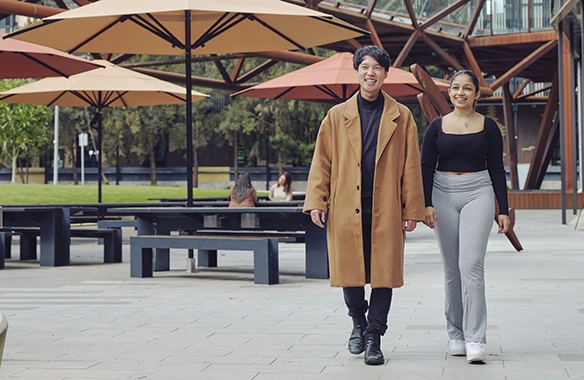
We want to help you excel at Deakin. Our scholarships recognise your dedication and achievements, providing financial support that can ease the cost of living and studying. With less pressure, you'll have more freedom to focus on what matters most – your education and future success.
Applications for 2027 are open
Ready to take the next step? Apply now to start your journey at Deakin and get ready for what’s next.
Key dates
Direct applications
Trimester 3 2026 applications close 18 October 2026
Trimester 1 2027 applications close 7 February 2027
VTAC
Apply now
Apply direct
Simply create an account in the Deakin Application Portal, enter your personal and educational details, upload your supporting documents and submit your application.

Apply through VTAC
Applications are open. Apply through VTAC if you're:
- currently in Year 12 and applying for Trimester 1 or Semester 1
- applying for multiple undergraduate courses
Need help? Follow our step-by-step undergraduate guide to prepare and submit your application.
Indigenous students
Deakin courses are flexible and culturally inclusive. There are multiple ways you can apply for this course, including through the NIKERI Institute and the Indigenous Access Scheme.
Recognition of prior learning
We value your previous study and experience. Recognition of prior learning enables you to get credit for what you've already achieved. When you apply, we'll consider your previous study and experience for recognition of prior learning.
Please note that a maximum of five credit points can be granted for Psychology core units. You can also refer to the recognition of prior learning (RPL) system which outlines the credit that may be granted towards a Deakin University degree and how to apply for credit.
Not sure if you'll meet entry requirements?
Deakin offers a range of pathways into the Bachelor of Arts (Psychology) to suit your background and goals. Explore the pathways finder to see how previous study, diplomas or alternative qualifications can lead you into the course.