


Course designed with criminology justice experts

Capstone portfolio showcase built into the degree

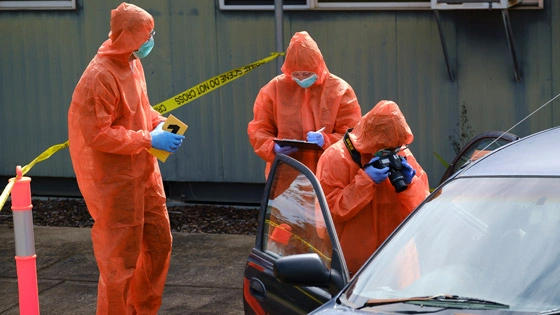
Forensic site visits and justice agency internships
Why choose criminology at Deakin
Discover why crime occurs, how it is perceived and how we can address it – graduating with the skills to make a real difference in the criminal justice system. You will gain a deep understanding of the causes and impacts of a range of individual and organised criminal activities, from environmental crime to illicit digital surveillance. Learn how to use this knowledge to develop effective responses to harmful behaviours.
Deakin’s Bachelor of Criminology degree is one of the most established in Australia. Our curriculum has been developed and designed in collaboration with professional justice bodies, ensuring your study experience closely reflects industry needs. Discover how justice and criminality are defined and by whom, how our courts and correctional processes operate and the intended outcomes of criminal justice processes. You will also gain practical industry experience and bridge theory with practice.
-
A leader in Australia
The Bachelor of Criminology at Deakin is one of Australia's most established and forward-thinking criminology courses.
-
Industry-ready skills
Our criminology courses are designed with professional government and justice bodies.
-
Experiential learning
Gain industry skills through internships, forensic site visits and partnerships with justice and community agencies at the #1 Melbourne uni for course satisfaction.
-
Graduate career-ready
Be industry ready with capstone units that mirror criminology workplaces, from policy development to stakeholder engagement and frontline practice.


Connected to industry
Deakin’s strong industry connections help shape your learning. Build practical experience in real workplace contexts through work-integrated learning, mentoring and networking opportunities. Industry advisory boards also help shape our degrees, which means what you study is current, relevant and aligned to what your future employers need.

Deakin puts employability first
Career outcomes
Build analytical, research and communication skills for careers across criminal justice, policy, intelligence, policing and corrections. Apply criminological knowledge to investigate harm and support evidence-informed responses.
Policy analyst
Work with the government or other large organisations to assist in the planning and development of policies. Review current policies and analyse data to assist with policy creation and modification.
- $110k
Typical annual salary in Australia
- 1,893
Jobs advertised


Intelligence analyst
Gather, assess and verify information to identify security risks and emerging threats. Prepare intelligence reports and brief decision-makers across government, law enforcement and related organisations.
- $108k
Typical salary in Australia
- 16%
Projected job growth in 5 years
Other industries
- Public administration and safety
- Scientific and technical services
- Health care and social assistance



“Deakin has been really good at showing what kind of career options you have. You look at cybercrime, indictable offences, you put yourself in the shoes of a lawyer or a prosecutor, so you can find what you enjoy most.”
EthanBachelor of Criminology
Stories that start here




FAQs
Deakin's Bachelor of Criminology covers criminal justice, theories of crime, policing, corrections, youth justice, terrorism and social policy. You'll develop research and analytical skills with practical application across justice sector agencies, government and community organisations. The curriculum is informed by Deakin's internationally recognised criminology research, providing an evidence-based understanding of crime, victimisation and systemic responses.
Criminology examines crime and justice from social, legal and systemic perspectives – covering policing, policy, corrections and victimology. Psychological science focuses on human behaviour, cognition, mental health and research methodology. Criminology asks 'what drives crime and how does society respond?'. Psychology asks 'why do people think, feel and behave the way they do?'. Deakin's double degree combines both for students interested in criminal behaviour, forensic psychology and justice reform.
Yes – criminology provides an excellent foundation for a career in policing. A criminology degree builds knowledge of criminal law, policing practices, ethics and justice policy that directly supports law enforcement work. Many police services value tertiary education for promotional pathways and specialist roles in intelligence, policy and community safety. The Bachelor of Criminology is also a strong foundation for postgraduate study in law or public policy.
A criminology degree opens doors across criminal justice, law enforcement and policy. Graduates can pursue roles including corrections officer, crime prevention adviser, crime researcher or analyst, intelligence analyst, parole officer and policy adviser. The Bachelor of Criminology can also provide pathways into postgraduate law, psychology and social policy study. It's a degree for people who want to understand why crime happens – and what can be done about it.
Related courses






*Deakin references data from a range of government, higher education and reputable media sources. Learn more about our achievements on our University rankings page, or explore our sources page for supporting references.
What will I study in the Bachelor of Criminology?
Explore core criminology foundations to advanced analysis and research-informed practice.

Develop foundational knowledge
Criminology fundamentals
Learn key ideas about crime, harm and justice, and start thinking critically about why behaviour is labelled ‘criminal’ and by whom.
How systems respond to crime
Map the basics of criminal justice processes and institutions. Start to connect theory to how decisions are made in real-life settings.
Strong study habits early
Complete academic integrity requirements and build confidence with research, writing and communication skills.
Build depth and direction
Explain crime with evidence
Compare major criminological theories and test ideas against real-life issues, data and contemporary debates.
Start shaping your study
Use criminology electives and open electives to explore focus areas that match your interests.
Apply disciplinary lenses
Strengthen problem-solving and professional communication by tackling complex scenarios that reflect justice-related work.
Apply experience and graduate
Contemporary justice challenges
Engage with advanced perspectives on crime and criminal justice, including how approaches vary across contexts and jurisdictions.
Research and analysis skills
Develop your ability to design, interpret and communicate criminology research essential skills for policy, practice or further study.
Work-integrated learning
Take the opportunity to get industry experience. Graduate with practical experience, industry networks and career-ready skills.
Course structure
To complete the Bachelor of Criminology, you must pass 24 credit points.
Most units are equal to one credit point. As a full-time student you will study four credit points per trimester and usually undertake two trimesters per year.
Are you a current student? For course information that applies to the year you started your degree, visit the handbook.
All students are required to meet the University's academic progress and conduct requirements
Units
Compulsory 0-credit point module
To be completed in the first trimester of study:
Units
Plus at least six credit points from the list below:
Up to 12-credit points can be non-Criminology units.
No more than 8-credit points taken outside the Faculty of Arts and Education.
Students must ensure they select appropriate Level 2 and Level 3 units to fulfil course requirements.
Students are encouraged to consider utilising their open electives to complete a major sequence from A310. Please refer to A310 Bachelor of Arts for a list of Faculty of Arts and Education major sequences.

What to expect while studying
The faculty offers a unit that is specifically designed to ease the transition into university study:
New students are encouraged to enrol in this unit in their first year.
Any unit which contains work integrated learning, a community placement or interaction with the community may require a police check, Working with Children Check or other check.
Elective units may provide the opportunity for Work Integrated Learning experiences.
Deakin offers many courses which can be studied by distance education overseas.
However, international students living in Australia on a student visa, in each compulsory trimester (that is, Trimesters 1 and 2), must enrol in at least one unit that is offered as a Campus located unit and can, in addition enrol in units offered online. International students may undertake a maximum of up to one third (or equivalent) of their study as online study. Please note enrolment in one face to face unit in compulsory study periods is only allowed if the student is completing their final unit of study and will not exceed maximum one third (or equivalent) online requirement.
At Deakin, we're committed to ensuring an inclusive environment that supports all students to belong, thrive and succeed. We work closely with students, where needed, to identify potential barriers to participation and where possible, provide tailored support so students can engage with learning and assessment activities.
If you are neurodivergent, have a disability, health condition or mental health condition that may impact your study or participation in university life, and want to know how Deakin could support you, contact our Domestic students (opens in a new window) or International students (opens in a new window) or Disability Resource Centre (opens email client) teams for a collaborative and confidential discussion. This discussion is to support you to make plans for your studies and future career and will not have any bearing on your application to the course.
When can I start?
When you study depends on your course, location and available intakes. Check the table to see when you can start and how study is offered throughout the year.
Your course learning outcomes describe the knowledge, skills and capabilities you’ll develop and be able to demonstrate by the time you graduate. Built into your course through your units and assessments, they provide a clear picture of what you’ll be equipped to know, understand and do – preparing you to apply your learning with confidence beyond university.
| Course Learning Outcomes |
|---|
| Review and analyse major social science theories and key criminological concepts, theories and technical knowledge relating to crime and criminal justice issues, including the causes and consequences of crime, ways of responding to crime, media representations of crime, core debates in policing, security and surveillance, as well as broader issues of policy and politics, inclusion and exclusion, governing and governance, security, social justice, citizenship and human rights. |
| Effectively communicate the findings and analyses of criminological concepts, theories and technical knowledge, in a selection of written, digital and oral formats, to a range of audiences. |
| Employ a range of generic and specialist criminal justice-specific digital communication technologies to apply criminological knowledge and conduct social and criminological research and deliver reports and presentations to a diverse range of audiences within and outside the field. |
| Analyse and critically evaluate theoretical approaches to crime problems and current policies and practices of governments and criminal justice practitioners and professions in the context of broad social change, new crimes, new responses and an increasing responsibility for preventing and controlling individual and complex crimes at local, state, national and international levels. |
| Employ initiative and creativity in conjunction with accepted evidence-based criminological methods to generate innovative and pragmatic approaches and solutions to complex problems in the areas of individual crime, complex and organised crime, the criminal justice process, questions of justice and injustice, local, national and international policing, surveillance, privacy and technology, and domestic and international crime and security issues. |
| Demonstrate autonomy, responsibility, accountability and a continued commitment to learning and skill development, as a reflective practitioner, while working in the criminological field. |
| Work and learn collaboratively with others in the criminology field and from different disciplines and backgrounds while still maintaining responsibility for their own learning. |
| Analyse and address criminological issues in the domestic and global context as a reflective scholar and practitioner, taking into consideration cultural and socio-economic diversity, social and environmental responsibility and the application of the highest ethical standards. |
Approved at Faculty Board 2014
- Award granted
- Bachelor of Criminology
- Year
2027 course information
- VTAC code
- 1400314633 - Waurn Ponds (Geelong), International full-fee paying place
1400514633 - Burwood (Melbourne), International full-fee paying place - Deakin code
- A329
- CRICOS code?Commonwealth Register of Institutions and Courses for Overseas Students
- 057849B Burwood (Melbourne), Waurn Ponds (Geelong)
- Level
- Undergraduate
- Australian Qualifications Framework (AQF) recognition
The award conferred upon completion is recognised in the Australian Qualifications Framework at Level 7
Apply now

Apply directly to Deakin
Apply directly through StudyLink Connect. Depending on your location, you may need to apply through a Deakin Authorised Agent, who can support and submit your application.
See our guide to applying to Deakin for application steps and requirements.

Apply through VTAC
If you are an international student completing an Australian Year 12 in Australia or overseas, you must submit an application through the Victorian Tertiary Admissions Centre (VTAC). In addition, you may also apply directly to Deakin through StudyLink Connect - Deakin University's international student application service.
Recognition of prior learning
We value your previous study and experience. Recognition of prior learning enables you to get credit for what you've already achieved. When you apply, we'll consider your previous study and experience for recognition of prior learning.
Pathways
Don’t quite meet the entry requirements for this course? The Associate Degree of Arts (A250) can be used as a guaranteed entry pathway into the Bachelor of Criminology and counts as credit towards your first year of study*. You’ll gain a solid foundation of relevant knowledge and be ready to transition seamlessly into your goal degree.
*Specific units of study must be completed within A250 for full credit to be granted. We recommend speaking with one of our student advisers before selecting your units.