


#1 Melbourne university for student support

#1 Melbourne university for science facilities

#1 Melbourne university for course satisfaction
Why choose biotechnology (professional) at Deakin
Become an in-demand expert and create innovative solutions to global challenges with a Master of Biotechnology (Professional) at Deakin. From pioneering medical advancements to cutting-edge solutions for food, agricultural and environmental issues; gain advanced technical skills to build a global career effecting positive change.
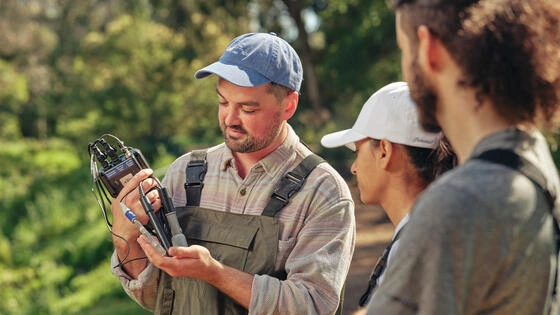
Undertake up to 500 hours of placements with organisations specialising in food innovation, agricultural biotechnology, disease monitoring and analytical testing, such as Symbio Laboratories, Agromillora, CSIRO and Australian Clinical Labs.
Learn under globally recognised researchers and discover how to apply your specialist knowledge across genetic, chemical, industrial and agricultural settings. Your biotechnology expertise will be complemented by skills in statistical data analysis, coding and research alongside a well-developed understanding of the commercial biotechnology environment.
-
Skills employers want
Graduate with advanced biotechnology skills and professional experience, preparing you for roles across research, health and industry sectors.
-
Hands-on learning
Gain practical experience with the option to complete up to 500 hours of professional placements or industry projects that build essential skills and networks.
-
Advanced laboratory training
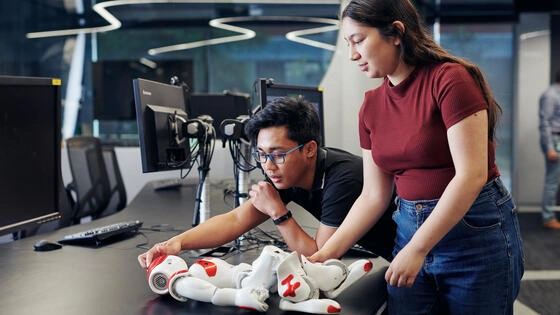
Develop laboratory and analytical skills that supports confident scientific investigation and data interpretation.
-
Industry-relevant curriculum
Study biotechnology aligned with industry practices, ensuring your knowledge reflects current applications and emerging trends.


Connected to industry
Deakin’s strong industry connections help shape your learning. Build practical experience in real workplace contexts through work-integrated learning, mentoring and networking opportunities. Industry advisory boards also help shape our degrees, which means what you study is current, relevant and aligned to what your future employers need.

Deakin puts employability first
Career outcomes
Develop advanced biotechnology expertise and professional experience to tackle challenges across health, agriculture, food and environmental industries. Graduate with technical, analytical and commercial skills for research and industry careers.
Medical scientist
Investigate disease, analyse biological samples and support the diagnosis, treatment and prevention of illness. Apply advanced laboratory and analytical skills to improve healthcare and medical research.
- $100K
Typical salary in Australia
- 5.6%
Projected job growth in 5 years


Chemist
Conduct laboratory experiments, analyse chemical substances and develop new products, materials or processes. Apply scientific expertise to solve real-world challenges across research, manufacturing, healthcare and environmental industries.
- $95K
Typical salary in Australia
- 3.8/5
Job satisifaction

Other jobs
- Food scientist
- Botanist
- Molecular biologist
- Animal scientist
- Material scientist
- Agriculture technologist



“Deakin's system allowed me to easily ask for help and clarify any questions I had during my classes. The facilities and laboratories I encountered were modern and state of the art. The library is my favourite place on campus and I always feel really productive there!”
MeganMaster of Biotechnology and Bioinformatics
FAQs
A Master of Biotechnology can support global roles in biotechnology, pharmaceuticals, diagnostics, food innovation, agriculture, environmental science and research. Deakin’s program develops advanced laboratory and applied bioscience capability, while international students can use international student support to plan study in Australia and future career pathways.
Biology is the broader study of living systems, while biotechnology applies biological science to develop products, processes and technologies. Deakin’s Master of Biotechnology focuses on applied bioscience, laboratory practice and research capability, helping international students connect study in Australia with global biotechnology, pharmaceutical, food and environmental sector needs.
Deakin's Master of Biotechnology usually takes 1.5 years full time, with pathways linked to the professional biotechnology program, depending on your entry pathway and study load. International students should also check visa, enrolment and international student support information when planning to study in Australia.
The Master of Biotechnology includes technical skills where they are relevant to biotechnology, laboratory practice and applied bioscience. Deakin’s international student support can help international students build confidence with study tools while studying in Australia.
Related courses


*Deakin references data from a range of government, higher education and reputable media sources. Learn more about our achievements on our University rankings page, or explore our sources page for supporting references.
What will I study in the Master of Biotechnology (Professional)?
Typically completed in two years full-time or part-time equivalent, this degree builds advanced biotechnology knowledge alongside professional skills for industry and research settings.

Advanced biotechnology foundations
Explore modern applications
Study how biotechnology is applied across health, agriculture and environmental contexts.
Build advanced laboratory capabilities
Develop practical skills in experimental design, data analysis and interpreting scientific results.
Understand industry and research contexts
Learn how biotechnology operates across commercial, regulatory and research environments.
Professional practice and application
Tailor your study focus
Choose from three areas of interest to deepen your expertise and align your learning with career goals.
Gain industry experience
Undertake a professional placement, research pathway or an advanced discipline coursework pathway.
Optional capstone experience
Integrate your learning through a final project that demonstrates your ability to solve complex biotechnology problems.
Course structure
To complete the Master of Biotechnology (Professional) students must pass 16 credit points. The number of credit points required may vary, depending on how much credit you receive as recognition of prior learning (RPL) based on your professional experience and previous qualifications.
Most units are equal to one credit point. As a full-time student you will study four credit points per trimester and usually undertake two trimesters per year.
Are you a current student? For course information that applies to the year you started your degree, visit the handbook.
All students are required to meet the University's academic progress and conduct requirements
Units
You are required to complete seven core units (these are essential units for this degree)
In your first trimester you must also complete three 0-credit point units which are compulsory for this degree.
You must complete one of these professional studies pathways:
Research pathway
OR
Industry practice pathway
plus two (2) level 7 open elective units (2 credit points)
OR
Advanced discipline coursework pathway
plus three (3) level 7 open elective units (3 credit points)

What to expect while studying
You may be able to study available units in the optional third trimester to fast-track your degree, however your course duration may be extended if there are delays in meeting course requirements, such as completing a placement.
Any unit which contains work integrated learning, a community placement or interaction with the community may require a police check, Working with Children Check or other check.
You can expect to participate in a range of teaching activities each week. This could include classes, seminars, site visits and online interaction. You can refer to the individual unit details in the course structure for more information. You will also need to study and complete assessment tasks in your own time.
Elective units may be selected that include compulsory placements, work-based training, community-based learning or collaborative research training arrangements.
Students will have an opportunity to complete work experience as part of the industry practice pathway.
At Deakin, we're committed to ensuring an inclusive environment that supports all students to belong, thrive and succeed. We work closely with students, where needed, to identify potential barriers to participation and where possible, provide tailored support so students can engage with learning and assessment activities.
If you are neurodivergent, have a disability, health condition or mental health condition that may impact your study or participation in university life, and want to know how Deakin could support you, contact our Domestic students (opens in a new window) or International students (opens in a new window) or Disability Resource Centre (opens email client) teams for a collaborative and confidential discussion. This discussion is to support you to make plans for your studies and future career and will not have any bearing on your application to the course.
When can I start?
When you study depends on your course, location and available intakes. Check the table to see when you can start and how study is offered throughout the year.
Your course learning outcomes describe the knowledge, skills and capabilities you’ll develop and be able to demonstrate by the time you graduate. Built into your course through your units and assessments, they provide a clear picture of what you’ll be equipped to know, understand and do – preparing you to apply your learning with confidence beyond university.
| Course Learning Outcomes |
|---|
| Develop deep knowledge of biotechnology, and the ability to apply it in different arenas including the genetic, chemical, industrial and agricultural settings. Using scientific process and knowledge of research planning to conduct research for discovery as well as development of commercially valuable products. Ability to use bioinformatics skills to analyse large research data sets and make valid inferences using rigorous statistical methods. |
| Demonstrate well developed communication skills both written and oral in a range of settings including among peers, to academic staff, industry contacts and outreach to the general public. Articulate scientific information in a structured form to describe scientific problems, formulate hypotheses, analyse evidence to support or oppose the interpretations of findings and conclusions, considering the evidence from scientific studies. |
| Evaluate information using evidence from a range of reliable sources to establish scientific knowledge, recognise ambiguity and disseminate accurate information. Apply existing analytical tools (bioinformatics) and data resources to solve problems and use computer programming to develop new methods and resources to advance biotechnology. |
| Use abstract, analytical and logical reasoning to critically evaluate scientific evidence arguments and approaches. Apply critical reasoning in a variety of situations to scope, interpret and structure investigations to develop an in-depth knowledge for professional biotechnological practice. Use statistical thinking to determine the strength of scientific evidence. |
| Identify scientific problems and use systematic approaches and experimental strategies to formulate and propose solutions by considering relevant discipline and contextual factors. Use judgement to convince scientific and non-scientific audiences, in the use of strategies to generate solutions to real world problems. |
| Evaluate own knowledge and skills using frameworks of reflection and take responsibility for learning and performance. Work responsibly and safely in scientific and professional environments to enrich the ideas of others by sharing learning experiences. |
| Work effectively as a team member, assuming various roles and utilising effective teamwork skills to achieve goals. Ability and courage to step into a leadership role when the situation demands. |
| Apply ethical practice in professional situations to demonstrate responsibility as practitioners when working with people from diverse cultures and communities. Identify and prioritise local, national and global issues and concerns and contribute towards solving real world problems from the perspective of biotechnology. |
- Award granted
- Master of Biotechnology (Professional)
- Year
2027 course information
- Deakin code
- S713
- CRICOS code?Commonwealth Register of Institutions and Courses for Overseas Students
- 113876H Waurn Ponds (Geelong)
- Level
- Higher Degree Coursework (Masters and Doctorates)
- Australian Qualifications Framework (AQF) recognition
The award conferred upon completion is recognised in the Australian Qualifications Framework at Level 9
Apply now

Apply directly to Deakin
Apply directly through StudyLink Connect. Depending on your location, you may need to apply through a Deakin Authorised Agent, who can support and submit your application.
See our guide to applying to Deakin for application steps and requirements.
Recognition of prior learning
We value your previous study and experience. Recognition of prior learning enables you to get credit for what you've already achieved. When you apply, we'll consider your previous study and experience for recognition of prior learning.
Pathways
Graduates who have completed the Research Project pathway will be uniquely positioned to commence a PhD.