


#13 in the world for nursing

Nursing and Midwifery Board of Australia-approved degree

Placements start in your first trimester
Why choose nursing and midwifery at Deakin
Study at the world's #13 university for nursing in a course developed in consultation with our healthcare partners. Learn how to provide high quality, patient-centred nursing and woman-centred midwifery care and gain experience across many settings, such as maternity, neonatal, paediatrics, acute and medical care, aged care, rehabilitation, community and mental health.
Start your placements in the first trimester of your degree, completing 800 hours of nursing placement, and approximately 840 hours of midwifery placement in metropolitan, regional and rural environments. With nursing and midwifery roles in Australia projected to grow more than 13% by 2029, you'll graduate eligible to register as both a nurse and midwife, with the flexibility to shape your career.
-
Unbeatable employability
Study at a university ranked #13 in the world for nursing and graduate with dual qualifications respected across Australia.
-
Extensive hands-on experience
Complete around 1,500 hours of supervised clinical placements across hospitals, maternity services and community healthcare settings.
-
High-quality simulation facilities
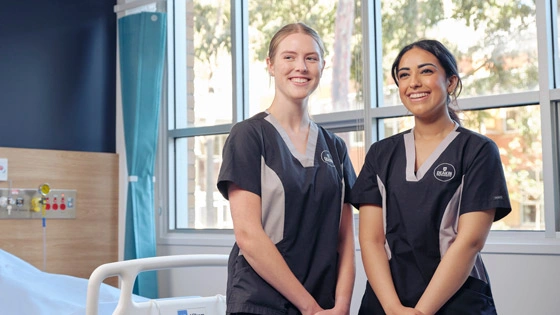
Learn in Deakin’s clinical simulation centres, which are designed to reflect real healthcare and maternity care environments.
-
Industry-shaped and accredited
Graduate eligible to apply for registration with the Nursing and Midwifery Board of Australia (NMBA) and begin practising as a registered nurse and/or midwife.


Connected to industry
Deakin’s strong industry connections help shape your learning. Build practical experience in real workplace contexts through work-integrated learning, mentoring and networking opportunities. Industry advisory boards also help shape our degrees, which means what you study is current, relevant and aligned to what your future employers need.

Deakin puts employability first
Career outcomes
Prepare for careers supporting patients, women, babies and families across nursing, midwifery and community care settings.
Nurse
Provide person-centred care, coordinate treatment and support health outcomes across hospitals, community services and specialist settings.
- 13.7%
Projected job growth in 5 years
- $105k
Typical annual salary in Australia


Midwife
Support women and families through pregnancy, labour, birth and early postnatal care, providing evidence-based clinical care.
- 13.9%
Projected job growth in 5 years
- $105k
Typical annual salary in Australia
Other jobs
- Community nurse
- Maternal and child health nurse
- Practice nurse
- Aged care nurse
- Clinical nurse specialist
- Nurse educator

Key dates

VTAC
FAQs
Yes – every Deakin student can access work-integrated learning (WIL) in their degree. Each year, more than 30,000+ students complete a placement or internship with partners including Microsoft, KPMG, EY and the National Australia Bank. You can access WIL through placements, industry projects, field-based experiences, simulations and global programs, helping you apply your skills and graduate with the experience and confidence employers value.
DeakinTALENT is Deakin's award-winning career service, and you can access it for life – not just while you're studying. From personalised career coaching sessions and AI-enhanced resume support to a jobs and internships board with employment opportunities, it’s designed to give you the career management skills and connections you need to stand out. Every Deakin degree is built with input from employers, so your course is designed around real workplace needs, now and into the future.
Entry requirements and the minimum ATAR vary by degree and are detailed on the degree page, but if your ATAR is below the cut-off, you still have options. Use the pathway finder tool to find the opportunities available to you, including associate degrees and Deakin Guaranteed ATAR, which offers eligible students a guaranteed entry score that's on average 10 points below the lowest selection rank. If you don't have an ATAR, Deakin Uni Ready is a free, supported program designed to build your skills and confidence and open doors to degrees in arts, health, science and business. Access programs and equity schemes are also available.
At Deakin, employability isn't an add-on – it's built in. Our degrees are designed with industry input, so your skills are aligned to what employers actually need. Every Deakin student can access work-integrated learning through opportunities such as placements, internships and industry projects, helping you build your professional network and practical experience before you even graduate. It's an approach that works: nine out of 10 Deakin graduates get a job within four to six months of finishing their degree.
Yes. Most eligible undergraduate students are offered a Commonwealth Supported Place meaning the government subsidises part of your tuition fees. If eligible, you can pay your student contribution using a HECS-HELP loan that you only start repaying once your income is above the repayment threshold. Deakin has scholarships that cater to our diverse student community, ranging from $5,000 per year for high ATAR achievers to $10,000 per year for students facing financial or personal hardship. The University also offers support services including financial counselling, budgeting help and access to short-term, interest-free loans to help you stay on track.
Deakin is the #1 Victorian university for student support and that starts the moment you accept your offer. Orientation is designed to help you feel welcome and get to know your community of classmates and teachers from day one. Across all campuses, there's a vibrant student community with clubs, events and opportunities to build real friendships. Deakin offers a range of services to help students stay healthy and safe, including sport and fitness facilities, free counselling, on-campus medical services and around-the-clock security.
Yes, and it's straightforward. You can transfer to Deakin in a few steps and apply for credit through recognition of prior learning (RPL), so you won't necessarily repeat subjects you've already completed. If you're coming from a TAFE partner, you may get guaranteed entry into second year with guaranteed RPL. Deakin's three-trimester system also means you may be able to start mid-year rather than waiting until March.
Most Deakin courses run across three trimesters per year instead of the traditional two semesters. Trimester 1 begins around March, Trimester 2 around July and Trimester 3 around November, each with roughly 12 weeks of teaching followed by an exam period. This means you can usually start your degree at three different points in the year and have more flexibility to manage your study load. Check the intakes by location section on the course page for details.
Related courses




*Deakin references data from a range of government, higher education and reputable media sources. Learn more about our achievements on our University rankings page, or explore our sources page for supporting references.
What will I study in the Bachelor of Nursing/Bachelor of Midwifery?
This four-year degree prepares you to apply for registration as both a registered nurse and a midwife with the Nursing and Midwifery Board of Australia. Throughout your degree, you will complete required clinical practice placements across healthcare and maternity settings.

Foundations of health and maternity care
Fundamentals of nursing and midwifery
Build core assessment, communication and safe care skills for hospital and maternity contexts.
Human biosciences
Develop knowledge of anatomy, physiology and pathophysiology relevant to nursing and midwifery practice.
Clinical placements begin
In Trimester 1, you will begin your supervised placements across healthcare and healthcare environments.
Developing clinical capability
Clinical reasoning and assessment
Apply structured assessment frameworks in acute, community and maternity care settings.
Midwifery across the continuum
Learn how to provide evidence-informed care during labour and birth and the postnatal period.
Further placements
Undertake structured supervised practice in hospital and community environments.
Integrated care across contexts
Complex nursing care
Apply advanced reasoning to diverse and high-acuity patient presentations.
Complex midwifery care
Employ a collaborative evidence-informed approach to the midwifery care of women and babies with complex health needs.
Applied interprofessional practice
Strengthen your collaboration and communication skills across multidisciplinary teams and apply your skills with further placement opportunities.
Consolidate your skills
Advanced nursing and midwifery practice
Integrate your knowledge from both nursing and midwifery and learn to apply your skills in complex clinical scenarios.
Leadership and professional accountability
Demonstrate responsibility and effective teamwork within healthcare teams.
Transition to dual practice
Complete your final supervised placements that prepare you for entry into both professions.
Course structure
To complete the Bachelor of Nursing/Bachelor of Midwifery, you must pass 32 credit points.
Most units are equal to one credit point. As a full-time student you will study four credit points per trimester and usually undertake two trimesters per year.
Are you a current student? For course information that applies to the year you started your degree, visit the handbook.
All students are required to meet the University's academic progress and conduct requirements
Units
Year 1 - Trimester 1
Trimester 2
Year 2 - Trimester 1
Trimester 2
Year 3 - Trimester 1
Trimester 2
Year 4 - Trimester 1
Trimester 2
Year 1 - Trimester 1
Trimester 2
Year 2 - Trimester 1
Trimester 2
Year 3 - Trimester 1
Trimester 2
Year 4 - Trimester 1
*** Note: HNN154 Aboriginal and Torres Strait Islander People's History, Culture and Health is NOT available to enrol in Trimester 1. Please speak to a Student Adviser to assist with your enrolment into this unit for either Trimester 2 or Trimester 3 in years 1 or 2.
Trimester 2
Professional recognition
On successful completion of your course, you will be eligible to apply for registration as a Registered Nurse and Midwife with the Nursing and Midwifery Board of Australia (NMBA).
The NMBA has mandatory registration standards that applicants need to meet to be registered. Core registration standards are available on the NMBA website.
This course is accredited with the Australian Nursing and Midwifery Accreditation Council (ANMAC) and is an NMBA approved course.

What to expect while studying
You may be able to study available units in the optional third trimester to fast-track your degree, however your course duration may be extended if there are delays in meeting course requirements, such as completing a placement.
Professional experience placements are conducted throughout your course beginning in Trimester 1 of your first year. This early exposure to the clinical environment gives you extensive opportunities to develop clinical skills under the supervision of registered nurses and enables you to experience being part of a multidisciplinary health care team. You will gain clinical skills in a variety of settings such as acute/sub-acute care, medical and surgical care, paediatrics, aged care, rehabilitation, community nursing and mental health nursing.
Midwifery practice experiences include all areas of midwifery practice, including pregnancy care, labour and birth, postnatal care and neonatal special care under the supervision of midwives. These may be undertaken in metropolitan, rural and regional hospitals and in the community in caseload midwifery programs that may also include home birth.
There is an expectation that you will be available to undertake clinical practicum outside of trimester dates. All expenses associated with professional experience placements are your own responsibility.
Department of Health Safety Screening Requirements - Police Record Check, Working With Children Check and Immunisation Status
Police Record Check
In accordance with the Department of Health policy, all students are required to undertake a Police Record Check prior to professional experience placements in each calendar year of their course. Students who fail to obtain a Police Record Check prior to the commencement of professional experience placement will not be able to undertake professional experience placement and this will impede progress in the course.
Working with Children Check
In accordance with the Worker Screening Act 2020, all students are required to undertake a Working with Children Check at the commencement of their course. Students who fail to obtain a Working with Children Check prior to the commencement of professional experience placement will not be able to undertake professional experience placement and this will impede progress in the course.
Immunisation
Students are required to declare their immunisation status to satisfy the requirements of health organisations where they will be undertaking their clinical learning experience. A health organisation may refuse to accept a student for placement if the student’s immunisation status is not satisfactory to the health organisation.
As a student in the Faculty of Health you can expect to participate in a range of teaching activities each week. This may include lectures, seminars, practicals and online interaction. You can refer to the individual unit details in the course structure for more information. You will also need to study and complete assessment tasks in your own time.
The course involves compulsory professional experience placement totalling 41 weeks. The midwifery component consists of 21 weeks in midwifery settings across Victoria. The nursing component consists of 20 weeks in hospitals and community health centres in metropolitan, rural and regional areas. These placements may require travel to rural areas. Professional experience placement can occur at any time, including during the standard holiday breaks listed here.
To be eligible to undertake placements, you are required to supply mandatory documents (prerequisites) including police checks, working with children check and immunisation status.
In order to participate in on-campus learning activities, and to safely engage in placements in clinical environments, there are a number of skills and functions that students need to be able to demonstrate, with or without reasonable adjustments. These skills and functions are known as Inherent Requirements. Find out more about the School of Nursing and Midwifery’s Undergraduate Courses Inherent Requirements.
To discuss these requirements and the adjustments we can provide to support your success, please contact the Disability Resource Centre.
At Deakin, we're committed to ensuring an inclusive environment that supports all students to belong, thrive and succeed. We work closely with students, where needed, to identify potential barriers to participation and where possible, provide tailored support so students can engage with learning and assessment activities.
If you are neurodivergent, have a disability, health condition or mental health condition that may impact your study or participation in university life, and want to know how Deakin could support you, contact our Domestic students (opens in a new window) or International students (opens in a new window) or Disability Resource Centre (opens email client) teams for a collaborative and confidential discussion. This discussion is to support you to make plans for your studies and future career and will not have any bearing on your application to the course.
When can I start?
When you study depends on your course, location and available intakes. Check the table to see when you can start and how study is offered throughout the year.
Your course learning outcomes describe the knowledge, skills and capabilities you’ll develop and be able to demonstrate by the time you graduate. Built into your course through your units and assessments, they provide a clear picture of what you’ll be equipped to know, understand and do – preparing you to apply your learning with confidence beyond university.
| Course Learning Outcomes Bachelor of Nursing |
|---|
| Think critically, analyse and apply evidence and evaluate outcomes to inform safe and quality nursing practice |
| Foster effective therapeutic and professional relationships to ensure safe and quality care across the lifespan. |
| Exhibit professionalism through self-management and engagement with feedback to maintain capability for practice of self and others. |
| Apply nursing knowledge and capability in accordance with professional, legal and ethical requirements to deliver comprehensive, safe and quality care based on best available evidence. |
| Provide person-centred, culturally safe, and respectful nursing care that upholds the rights, dignity, and wellbeing of all people, enriched by Aboriginal and Torres Strait Islander Peoples’ cultures and knowledges, and responsive to the diversity of all communities. |
| Critically and ethically apply digital technologies to locate, interpret and disseminate information and deliver safe and quality care. |
| Course Learning Outcomes |
| Practice midwifery that is underpinned by the philosophy of woman-centred care. |
| Critically engage in a process of assessment, planning, implementation and evaluation to provide evidence informed, safe and quality care to optimise outcomes in partnership with the woman. |
| Be a reflective learner who actively develops and maintains the knowledge, skills and attitudes essential for contemporary midwifery practice. |
| Develop sustainable, culturally safe partnerships, enriched by Aboriginal and Torres Strait Islander peoples’ cultures and knowledges, founded on mutual trust, respect and collaboration to support safe, quality midwifery care. |
| Foster effective professional relationships to ensure safe and quality care. |
- Award granted
Bachelor of Nursing/Bachelor of Midwifery
- Year
2027 course information
- VTAC code
- 1400414361 - Waterfront (Geelong), Commonwealth Supported Place (CSP)
1400514361 - Burwood (Melbourne), Commonwealth Supported Place (CSP)
1400714361 - Warrnambool, Commonwealth Supported Place (CSP) - Deakin code
- D355
- Level
- Undergraduate
- Australian Qualifications Framework (AQF) recognition
The award conferred upon completion is recognised in the Australian Qualifications Framework at Level 7
Fees
Estimated tuition fee
$5,513
for 1 yr full-time - Commonwealth Supported Place (CSP)
The estimated tuition (student contribution) fee above is based on a typical first-year full-time enrolment of 8 credit points and is provided as a guide only. Your student contribution is determined by the units you enrol in and will vary depending on the units you choose, your study load, the course duration, and any approved recognition of prior learning. You may also be eligible for a HECS-HELP loan to defer payment of all or part of your student contribution.
Check your eligibility or learn more about CSP or HECS-HELP.

Scholarships
A Deakin scholarship can open the door to new opportunities. Whether you have something unique to offer or simply need a bit of extra support to reach your goals, we’re here to help. Scholarships can assist with course fees, living costs and study materials – so you can focus on achieving your best.
If you're eligible, the Commonwealth Prac Payment (CPP) can help with the costs of completing a mandatory placement as part of your course.
Key dates
VTAC
Apply now

Apply through VTAC
- currently in Year 12 and applying for Trimester 1 or Semester 1
- applying for multiple undergraduate courses
Need help? Follow our step-by-step undergraduate guide to prepare and submit your application.
Recognition of prior learning
We value your previous study and experience. Recognition of prior learning enables you to get credit for what you've already achieved. When you apply, we'll consider your previous study and experience for recognition of prior learning.
Deakin University policies and procedures will pertain to students who apply for Recognition of Prior Learning (RPL).
University policy regarding RPL states that students will be provided with the maximum credit for relevant approved post-secondary study or informal learning which exceeds the normal entry requirements for the relevant course.
This may include previous completed or incomplete degrees, diplomas, and TAFE awards. In all cases, credit will need to be determined on a case-by-case basis, with the maximum credit that can be granted towards the course determined by University policy and procedure (Deakin University, Recognition of Prior Learning policy and procedure, September 2026) and in alignment with course accreditation.
Not sure if you'll meet entry requirements?
Deakin offers a range of pathways into the Bachelor of Nursing/Bachelor of Midwifery to suit your background and goals. Explore the pathways finder to see how previous study, diplomas or alternative qualifications can lead you into the course.
Pathways
If you did not meet the selection requirements for this course, you may be eligible for an alternative entry pathway. Our Indigenous Entry Stream is also available for this course providing a specialised pathway for Indigenous students to become healthcare practitioners. Explore your options to get ready for the Bachelor of Nursing/Bachelor of Midwifery using our pathways finder.
This course provides a pathway to higher degree by research courses and other postgraduate coursework programs.