


Top 200 worldwide for architecture and built environment

Victoria’s only combined degree

Deakin sets the standard for employability
Why choose Deakin
Stand out with Deakin’s Bachelor of Design (Architecture)/Bachelor of Construction Management (Honours). This double degree combines architecture and construction management, giving you a complete understanding of the built environment. Explore architectural ideas and design approaches while learning to manage construction projects of any scale. Gain knowledge across architecture, design, construction and project management, preparing you for diverse, globally relevant careers in the built environment.
With a focus on practical learning, you will gain hands-on experience through opportunities such as industry placements, project-based work, international study tours and site visits. Develop your design and technical skills in drawing, digital fabrication, measurement and estimating, while applying project management in real-world contexts. You will graduate ready to apply your skills across architecture and construction management.
-
Victoria’s only double degree
One integrated architecture and construction management double degree, so you graduate with skills in both design and project delivery.
-
Construction management accreditation
Accredited by leading international and Australian industry bodies, opening career pathways in over 50 countries.
-
Multidisciplinary learning
Collaborate with architecture and construction management students to gain practical, cross-disciplinary skills valued by employers.
-
Purpose-built design studios
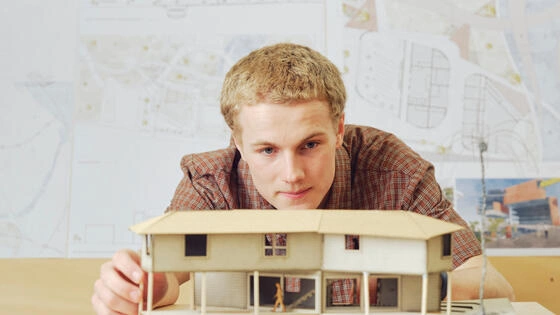
Bring your projects to life in a large, open studio and workshop equipped with 3D printers, laser cutters and CNC routers, where you can experiment with materials and processes.


Connected to industry
Deakin’s strong industry connections help shape your learning. Build practical experience in real workplace contexts through work-integrated learning, mentoring and networking opportunities. Industry advisory boards also help shape our degrees, which means what you study is current, relevant and aligned to what your future employers need.

Deakin puts employability first
Career outcomes
Combine architectural design with construction management to understand how buildings are designed, costed and delivered. Graduate with creative, technical and project management skills for diverse careers across architecture, construction and the built environment.
Construction manager
Plan, coordinate and oversee construction projects from start to finish. Manage budgets, schedules, contractors and resources while helping ensure projects are delivered safely, efficiently and to required standards.
- $185k
Typical salary in Australia
- 4.3/5
Job satisfaction in Australia


Architect
Design buildings and spaces that balance creativity, functionality and sustainability. Develop concepts and detailed plans, collaborate with clients and construction professionals, and guide projects from initial design through to completion.
- $100k
Typical salary in Australia
- 3.6/5
Job satisfaction in Australia
Other jobs
- 3D architectural modeller
- Building project manager
- Estimator
- Quantity surveyor
- Contract administrator

Key dates

Direct applications
Trimester 1 2027 applications close 7 February 2027

VTAC
FAQs
Yes – every Deakin student can access work-integrated learning (WIL) in their degree. Each year, more than 30,000+ students complete a placement or internship with partners including Microsoft, KPMG, EY and the National Australia Bank. You can access WIL through placements, industry projects, field-based experiences, simulations and global programs, helping you apply your skills and graduate with the experience and confidence employers value.
DeakinTALENT is Deakin's award-winning career service, and you can access it for life – not just while you're studying. From personalised career coaching sessions and AI-enhanced resume support to a jobs and internships board with employment opportunities, it’s designed to give you the career management skills and connections you need to stand out. Every Deakin degree is built with input from employers, so your course is designed around real workplace needs, now and into the future.
Entry requirements and the minimum ATAR vary by degree and are detailed on the degree page, but if your ATAR is below the cut-off, you still have options. Use the pathway finder tool to find the opportunities available to you, including associate degrees and Deakin Guaranteed ATAR, which offers eligible students a guaranteed entry score that's on average 10 points below the lowest selection rank. If you don't have an ATAR, Deakin Uni Ready is a free, supported program designed to build your skills and confidence and open doors to degrees in arts, health, science and business. Access programs and equity schemes are also available.
At Deakin, employability isn't an add-on – it's built in. Our degrees are designed with industry input, so your skills are aligned to what employers actually need. Every Deakin student can access work-integrated learning through opportunities such as placements, internships and industry projects, helping you build your professional network and practical experience before you even graduate. It's an approach that works: nine out of 10 Deakin graduates get a job within four to six months of finishing their degree.
Yes. Most eligible undergraduate students are offered a Commonwealth Supported Place meaning the government subsidises part of your tuition fees. If eligible, you can pay your student contribution using a HECS-HELP loan that you only start repaying once your income is above the repayment threshold. Deakin has scholarships that cater to our diverse student community, ranging from $5,000 per year for high ATAR achievers to $10,000 per year for students facing financial or personal hardship. The University also offers support services including financial counselling, budgeting help and access to short-term, interest-free loans to help you stay on track.
Deakin is the #1 Victorian university for student support and that starts the moment you accept your offer. Orientation is designed to help you feel welcome and get to know your community of classmates and teachers from day one. Across all campuses, there's a vibrant student community with clubs, events and opportunities to build real friendships. Deakin offers a range of services to help students stay healthy and safe, including sport and fitness facilities, free counselling, on-campus medical services and around-the-clock security.
Yes, and it's straightforward. You can transfer to Deakin in a few steps and apply for credit through recognition of prior learning (RPL), so you won't necessarily repeat subjects you've already completed. If you're coming from a TAFE partner, you may get guaranteed entry into second year with guaranteed RPL. Deakin's three-trimester system also means you may be able to start mid-year rather than waiting until March.
Most Deakin courses run across three trimesters per year instead of the traditional two semesters. Trimester 1 begins around March, Trimester 2 around July and Trimester 3 around November, each with roughly 12 weeks of teaching followed by an exam period. This means you can usually start your degree at three different points in the year and have more flexibility to manage your study load. Check the intakes by location section on the course page for details.
Related courses


*Deakin references data from a range of government, higher education and reputable media sources. Learn more about our achievements on our University rankings page, or explore our sources page for supporting references.
What will I study in the Bachelor of Design (Architecture)/Bachelor of Construction Management (Honours)?
This five-year double degree takes you from foundational skills in design and construction to advanced studio practice and project leadership. You will build your expertise progressively across architecture and construction management, learning how buildings are designed, documented, costed and delivered across projects.
Design and construction foundations
Studio and design thinking
Explore form, space and context in studio-based projects, learning to develop and communicate your architectural ideas through drawing, modelling and digital tools.
Construction fundamentals
Discover how buildings are made, studying materials, structures and site processes while understanding how technical decisions shape building performance.
Architecture in context
Investigate the history and cultural influences of the built environment, exploring how architecture reflects society, the environment and human experience.
Building systems, costing and context
Structures and environments
Build knowledge of structural systems and environmental factors, connecting technical performance with architectural design.
Measurement and costing
Learn to read construction drawings, measure building works and understand financial factors that inform project decisions.
Architecture in society
Explore historical and contemporary influences on the built environment, helping you place design within cultural and social contexts.
Integration and project coordination
Advanced design studios
Work on larger, more ambitious studio projects that respond to environmental and public challenges, further refining your design skills.
Contracts and project management
Develop practical skills to manage contracts, coordinate teams and oversee projects from planning to delivery.
Cost planning and analysis
Learn to estimate and plan project costs, linking design decisions with budgets and financial outcomes.
Leadership and professional practice
Project planning and control
Learn to plan, schedule and manage construction projects using industry methods and tools to balance time, cost and quality.
Environmental services and systems
Examine building systems and performance, understanding how integrated services support sustainable and efficient outcomes.
Professional practice and contract management
Build skills in contract administration, project management and quantity surveying, preparing you to lead architects, builders and project managers.
Honours and integrated research
Capstone design studio
Complete a major architecture project where you apply your technical, creative and critical skills to produce and present a complete design.
Integrated research project
Work on a research project that solves a building or construction challenge, using knowledge from both design and management.
Project evaluation and development
Learn to assess whether building projects are practical and financially realistic, connecting your design ideas with construction and business decisions.
Course structure
To complete the Bachelor of Design (Architecture)/Bachelor of Construction Management (Honours), you must pass 40 credit points.
Most units are equal to one credit point. As a full-time student you will study four credit points per trimester and usually undertake two trimesters per year.
Are you a current student? For course information that applies to the year you started your degree, visit the handbook.
All students are required to meet the University's academic progress and conduct requirements
Units
You are required to complete 35 core units (these are essential units for this degree).
In your first trimester you must also complete three 0-credit point units which are compulsory for this degree.
Year 1 - Trimester 1
Year 1 - Trimester 2
Year 2 - Trimester 1
Year 2 - Trimester 2
Plus one open elective unit (level two or above)
Year 3 - Trimester 1
Year 3 - Trimester 2
Year 4 - Trimester 1
Year 4 - Trimester 2
Year 5 - Trimester 1
Year 5 - Trimester 2
Bachelor of Design (Architecture)/Bachelor of Construction Management (Honours): (accelerated program)
The Bachelor of Construction Management (Honours) component of this course may be taken as an accelerated program. By taking selected units in Trimester 3 the course can be completed in four years instead of five.
You are required to complete 35 core units (these are essential units for this degree).
In your first trimester you must also complete three 0-credit point units which are compulsory for this degree.
Year 1 - Trimester 1
Year 1 - Trimester 2
Year 1 - Trimester 3
Year 2 - Trimester 1
Year 2 - Trimester 2
Year 2 - Trimester 3
Plus one open elective unit (level two or above)
Year 3 - Trimester 1
Year 3 - Trimester 2
Year 3 - Trimester 3
Year 4 - Trimester 1
Year 4 - Trimester 2
Choose one open elective unit (level two or above) from across the University, including from a completely different study area (subject to meeting the unit prerequisites).
Professional recognition
When this combined course is followed by the 12 credit point (1.5 year) Master of Architecture (S700), you will have successfully completed an Architects Accreditation of Australia (AACA) accredited academic qualification and be on your way to becoming a registered architect via any state registration board, such as the Architects Registration Board of Victoria (ARBV).
The construction management stream of this combined course is professionally accredited by industry. Graduates of the course qualify for membership to the following:
- Australian Institute of Quantity Surveyors (AIQS)
- Chartered Institute of Building (CIOB)
- Royal Institution of Chartered Surveyors (RICS)

What to expect while studying
The learning experiences and assessment activities within this course require students to engage with a number of production methods, such as drawing, large format printing, model making, and digital fabrication (laser cutting + 3D printing). Students will be required to purchase minor equipment such as drawing media, paperstock, sketchbooks, and model making tools, however many of these will be usable within different units. As such, there might be a higher upfront cost as students enter in the course. Each unit will outline the specific requirements at the commencement of the unit. Where possible, students are encouraged to reuse, recycle or think creatively about model materials. The indicative cost of this equipment and material (over time) can vary depending on quality or execution, but can be suggested in the range of $750-$1500 over the course duration.
Students are also recommended to have access to a personal computer (laptop or desktop) in order to engage digital communications methods (drawing, CAD and presentations). Advice on this is presented to students in first year, so it is not imperative to have this before commencing the course as Deakin has dedicated Computer Labs to get started with. Where possible, all required software (Autodesk, Adobe) is provided to students under free academic licencing and does not require additional cost.
You may be able to study available units in the optional third trimester to fast-track your degree, however your course duration may be extended if there are delays in meeting course requirements, such as completing a placement.
You can expect to participate in a range of teaching activities each week. This could include lectures, seminars, workshops, site visits and online interaction. You can refer to the individual unit details in the course structure for more information. You will also need to study and complete assessment tasks in your own time.
You can apply to undertake a discipline specific industry placement as an elective option as part of your course. Explore the SEBE WIL program.
At Deakin, we're committed to ensuring an inclusive environment that supports all students to belong, thrive and succeed. We work closely with students, where needed, to identify potential barriers to participation and where possible, provide tailored support so students can engage with learning and assessment activities.
If you are neurodivergent, have a disability, health condition or mental health condition that may impact your study or participation in university life, and want to know how Deakin could support you, contact our Domestic students (opens in a new window) or International students (opens in a new window) or Disability Resource Centre (opens email client) teams for a collaborative and confidential discussion. This discussion is to support you to make plans for your studies and future career and will not have any bearing on your application to the course.
When can I start?
When you study depends on your course, location and available intakes. Check the table to see when you can start and how study is offered throughout the year.
Your course learning outcomes describe the knowledge, skills and capabilities you’ll develop and be able to demonstrate by the time you graduate. Built into your course through your units and assessments, they provide a clear picture of what you’ll be equipped to know, understand and do – preparing you to apply your learning with confidence beyond university.
| Course Learning Outcomes Bachelor of Design (Architecture) (S342) | Course Learning Outcomes Bachelor of Construction Management (Honours) (S346) |
|---|---|
| Synthesise knowledge of architecture history, theory, technology and practice to design, develop and manage architecture projects, demonstrating initiative and judgement for professional practice. Apply technical and theoretical knowledge of architectural design to propose diverse, authentic, alternative, and well-rounded responses that are conceptually and physically sustainable to problems in the contemporary built environment. Integrate the knowledge of language of architecture, its meanings, capacities and implications to demonstrate ability and responsibility as reflective practitioners, in making decisions to define the human landscape. | Develop a broad and coherent knowledge of construction materials, structures, construction practices, estimating, cost planning, regulatory, legal, construction economics and construction management frameworks to manage construction projects. Integrate knowledge of technology, management, economics, regulatory and legal systems in implementing a construction project from small residential to large complex and high-rise buildings. Integrate well-developed knowledge of contextual factors that impact on construction management including regulatory requirements, industry environment, professional practice and sustainability to finalise construction management decisions. Acquire and apply research skills to initiate and formulate a research plan an undertake research that contributes to scholarly knowledge, based on current research directions. |
| Communicate clearly, professionally and responsibly in a variety of contexts using oral, visual, digital, graphic and interpersonal communication modes to inform, motivate and persuade specialist and non-specialist audiences about architectural ideas and designs. Imagine, conceive and represent ideas using the language of architecture, its codes and conventions to reflect on possibilities, the implications of hypothetical designs and its applications. | Communicate clearly, professionally and responsibly with specialist and non-specialist audiences in a variety of contexts using oral, written, graphical and interpersonal skills to inform, negotiate, lead and motivate a project team. |
| Apply knowledge of relevant technological tools, methodologies and techniques to locate, collect, analyse, interpret and synthesise complex information. Use architecture theory and practice to analyse, evaluate, produce and disseminate design responses using techniques and technology ethically and responsibly in a digital world. | Utilise a range of digital technologies including building information modelling to locate, select, analyse, use, evaluate, and disseminate a variety of information. |
| Use critical thinking to analyse and provide a rational, reflective and socially responsible response to architectural problems at different scales and complexities in a variety of contexts. Examine causes and consequences of different morphologies to appreciate their capacities and opportunities in order to reproduce, manipulate, and identify conventional and alternative solutions to architectural problems. | Use critical and analytical thinking and judgment to identify and evaluate appropriate principles and procedures in technology, law, management and economics for construction projects. |
| Investigate and identify ill-defined real world environmental, cultural, physical and social architectural problems, explain its significance, causes and consequences, and use a methodical approach to formulate a solution. Make appropriate choices to solve problems in complex and contradictory situations based on knowledge of social, economic, environmental and cultural aspects of architectural design to evolve human landscape. | Apply analytical thinking and judgment to make decisions to identify a variety of problems and recommend solutions related to technology, law, management and economics for construction projects. Generate solutions to construction management problems using a framework of accountability and professional practice in the construction industry environment. |
| Work independently and collaboratively to produce architectural designs and responses in an ethical, responsible and professional manner. Use initiative and judgement to reflect on knowledge and skills, to demonstrate autonomy and capacity to identify opportunities for improving practice. | Use appropriate strategies including reflective evaluation to develop independence and demonstrate responsibility for professional learning. |
| Work as a team to analyse and evaluate complex problems, and share critical, analytical and creative approaches to select best responses to architectural problems. | Work in multidisciplinary teams and develop leadership skills to manage construction projects and use appropriate team processes to collaborate, communicate, and negotiate solutions. |
| Integrate subjective and objective stakeholder perspectives in the process of formulating architectural and design responses taking into account economic, cultural, social and ethical values inherent in human landscape. Engage with global trends in contemporary architectural design and urbanism in order to recognise cultural diversity, the need for equity in outcomes and implement high ethical and professional standards. | Engage ethically and productively with diverse stakeholders, communities and cultures in the global construction industry. |
- Award granted
Bachelor of Design (Architecture)/Bachelor of Construction Management (Honours)
- Year
2027 course information
- VTAC code
1400415361 - Waterfront (Geelong), Commonwealth Supported Place (HECS)
- Deakin code
- D364
- Level
- Undergraduate
- Australian Qualifications Framework (AQF) recognition
The award conferred upon completion is recognised in the Australian Qualifications Framework at Level 7/8
Fees
Estimated tuition fee
$9,881
for 1 yr full-time - Commonwealth Supported Place (CSP)
The estimated tuition (student contribution) fee above is based on a typical first-year full-time enrolment of 8 credit points and is provided as a guide only. Your student contribution is determined by the units you enrol in and will vary depending on the units you choose, your study load, the course duration, and any approved recognition of prior learning. You may also be eligible for a HECS-HELP loan to defer payment of all or part of your student contribution.
Check your eligibility or learn more about CSP or HECS-HELP.
Scholarships
We want to help you excel at Deakin. Our scholarships recognise your dedication and achievements, providing financial support that can ease the cost of living and studying. With less pressure, you'll have more freedom to focus on what matters most – your education and future success.
Applications for 2027 are open
Ready to take the next step? Apply now to start your journey at Deakin and get ready for what’s next.
Key dates
Direct applications
Trimester 1 2027 applications close 7 February 2027
VTAC
Apply now
Apply direct
Simply create an account in the Deakin Application Portal, enter your personal and educational details, upload your supporting documents and submit your application.

Apply through VTAC
Applications are open. Apply through VTAC if you're:
- currently in Year 12 and applying for Trimester 1 or Semester 1
- applying for multiple undergraduate courses
Need help? Follow our step-by-step undergraduate guide to prepare and submit your application.
Recognition of prior learning
We value your previous study and experience. Recognition of prior learning enables you to get credit for what you've already achieved. When you apply, we'll consider your previous study and experience for recognition of prior learning.
Not sure if you'll meet entry requirements?
Deakin offers a range of pathways into the Bachelor of Design (Architecture)/Bachelor of Construction Management (Honours) to suit your background and goals. Explore the pathways finder to see how previous study, diplomas or alternative qualifications can lead you into the course.