


Top 3 business school in Melbourne

80+ hours work-integrated learning

#1 Melbourne university for business course satisfaction
Why choose Deakin
Understand the human mind in the business context and apply psychological science to the real workplace challenges faced in human resource management. Develop dual expertise to make confident, evidence-based decisions in recruitment, workplace negotiations and creating high-performance work environments and gain a competitive edge for a human resources career.
Build targeted knowledge in psychology and human resources and develop practical skills that employers value. Your strong understanding of human behaviour will help you assess employee performance, support positive organisational culture and select the right person for each role. The course is aligned with key accreditation bodies, including the Australian HR Institute (AHRI) and the Australian Psychology Accreditation Council (APAC), and closely reflects industry needs, with practical learning experiences such as industry placements and opportunities for overseas study.
-
Industry-accredited expertise
Graduate with credentials recognised by the Australian Human Resources Institute (AHRI) and the Australian Psychology Accreditation Council (APAC).
-
Practical learning for every student
Gain real workplace experience through work-integrated learning placements with organisations while building professional networks.
-
Human insight for the modern workplaces
Apply psychological tools to understand behaviour, strengthen workplace culture and improve organisational performance.
-
Strong graduate outcomes
Study at the #1 Melbourne university in for business course satisfaction and graduate with skills valued by employers.


Connected to industry
Deakin’s strong industry connections help shape your learning. Build practical experience in real workplace contexts through work-integrated learning, mentoring and networking opportunities. Industry advisory boards also help shape our degrees, which means what you study is current, relevant and aligned to what your future employers need.
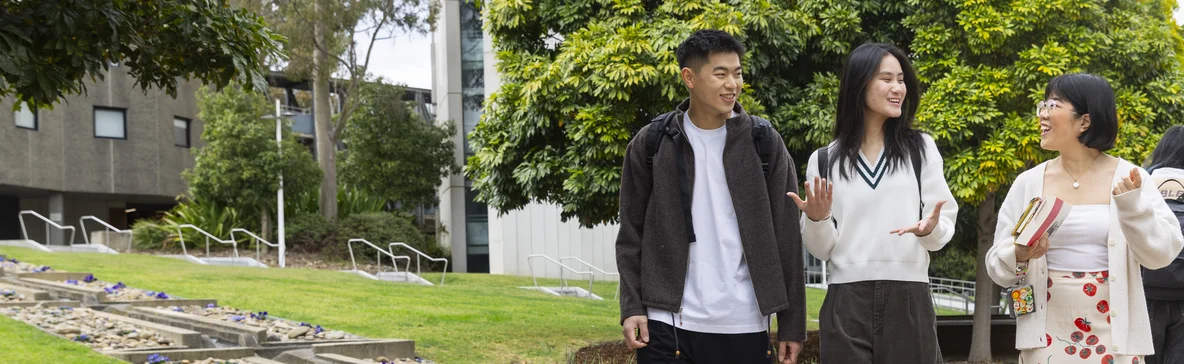
Deakin puts employability first
Career outcomes
Combine psychology and human resource management to pursue people-focused roles in employee relations, HR consulting, organisational development, industrial relations and workplace learning.
Human resources consultant
Advise organisations on HR policies, recruitment, performance and workplace relations. Use people insights to support managers, resolve workforce issues and strengthen organisational effectiveness.
- $100k
Typical Australian annual salary
- 7.4%
Projected job growth in 5 years
- 4.2/5
Job satisfaction


Organisational development officer
Support organisational change and workforce development by analysing needs, coordinating learning and culture initiatives, and helping improve employee capability, engagement and performance.
- $85k
Typical Australian annual salary
- 7.4%
Projected job growth in 5 years
- 4.3/5
Job satisfaction
Other jobs
- Employee relations officer
- Industrial relations officer
- Training and development manager

FAQs
Deakin's campuses in Melbourne, Geelong and Warrnambool are set in vibrant, multicultural communities where it is easy to connect and feel at home. As the #1 university in Australia for international student happiness and student satisfaction, you will be supported at every step of your journey. You can join clubs and societies through the Deakin University Student Association (DUSA), attend social events, go on trips and live on campus to meet people from around the world. Each campus has fitness centres, cafes and 24-hour security, as well as prayer rooms and multifaith chaplains.
Deakin offers a range of merit-based scholarships that can reduce your tuition fees by 20%, 25%, 50% or 100% for the duration of your degree. Eligibility varies by scholarship and the degree you choose, but you will automatically be considered for most scholarships when you apply to Deakin. Use the Find a scholarship tool and filter by 'citizenship' to see what is available to you, or explore Australia Awards scholarships if you are from an eligible country.
As an international student at Deakin, you can work part time according to the conditions of your visa. On a Student Visa (Subclass 500), you can work up to 48 hours per fortnight during trimesters. When you are on a trimester break you can work as much as you want. Compulsory work experience that forms part of your degree does not count toward this limit. Find part-time roles and internships through DeakinTALENT and learn more about working in Australia.
Most students studying full time at Deakin need a Student Visa (Subclass 500). You can apply for this visa after you accept your offer and receive your electronic Confirmation of Enrolment (CoE). To apply, you will need a valid passport, your CoE, proof of Overseas Student Health Cover and any other documents required by the Department of Home Affairs. Apply as early as possible, but do not book travel until your visa has been granted. Find out more about student visas.
Australia is widely regarded as one of the safest and most welcoming countries in the world for students, with strong legal protections, reliable public services and a multicultural community. In fact, Melbourne is ranked the #4 student city in the world! At Deakin, you will be part of a supportive community, with 24/7 help, dedicated campus security and practical tools to help you feel safe, confident and connected. Deakin’s SafeZone app also connects you directly to campus security and support services if you ever need help. Find out more about studying in Australia.
Deakin offers a wide range of support to help you settle in and succeed throughout your studies – we are ranked the #1 university in Melbourne for student support. You can access 1:1 study support, English language support, career planning help, disability services and free counselling, as well as financial assistance if you need it. On campus, the SafeZone app and 24/7 security services mean help is always within reach. You can explore the full range of support services for international students or start an online chat with a student ambassador before you arrive.
To enrol in an undergraduate degree at Deakin, many degrees require a minimum IELTS score of 6.0 (or equivalent). Some degrees require higher scores so check the entry requirements tab on the degree page for details. You may also meet the requirement through recent secondary or university study completed in English, or by demonstrating five or more years of living and working in an English-speaking country. Eligibility is assessed on a case-by-case basis. If you do not yet meet the requirement, the Deakin University English Language Institute (DUELI) offers pathway programs to help develop your English reading, writing, listening and speaking skills. Completion of DUELI’s English for Academic Purposes can give you the minimum English language requirements for most Deakin degrees.
Deakin is the #1 university in Melbourne for international student graduate employment. Our degrees are developed with industry insight, so you will gain career-ready skills from the beginning. Each Deakin student can access work-integrated learning through opportunities including placements, internships and projects with well-known industry partners. Our dedicated international student career support program helps you learn about the Australian workforce, make connections and build your network through placements. You will get support with your resume, help looking for an internship or a job after graduation and even advice about your career options overseas.
There is more than one way to study at Deakin. If you do not meet the academic requirements, Deakin College offers a guaranteed pathway to Deakin with small, supportive classes on campus. If you meet the academic requirements but not the English requirements, you can enrol in a Deakin University English Language Institute (DUELI) English pathway program and progress to your chosen Deakin degree upon successful completion. Deakin also has formal pathway agreements with partner institutions in countries like China, India, Vietnam, Sri Lanka and the United States, so you can start your studies locally before transferring to Australia to complete your degree.
*Deakin references data from a range of government, higher education and reputable media sources. Learn more about our achievements on our University rankings page, or explore our sources page for supporting references.
What will I study in the Bachelor of Human Resource Management (Psychology)?
Form a close-knit cohort as your class progresses from foundations in human resource management and psychology, to specialised knowledge, including change management and strategic HR, personality and neurobiological psychology. Explore how organisations manage talent, motivation and performance, grounded in psychological principles.

Business and psychology foundations
Explore human behaviour and development
Build a grounding in psychological science, including how people think, learn and interact in social environments. These foundations help you understand behaviour in workplaces and organisations.
Learn core business and management concepts
Develop an understanding of organisations, leadership and management practices that shape effective workplaces and professional relationships.
Understand the HR function in organisations
Discover the role human resource professionals play in supporting employees, building teams and contributing to organisational success.
Workplace dynamics and people management
Develop HR practice and capability
Explore the processes organisations use to recruit, train and develop employees while building practical people management skills.
Analyse workplace behaviour and culture
Apply psychological concepts to understand motivation, group dynamics and organisational behaviour in real-world settings.
Build research and analytical skills
Learn how to interpret behavioural data and research evidence to inform people management and organisational decision making.
Strategic HR and professional practice
Learn the importance of strategy
Explore how organisations manage change, employment relationships and workforce strategy in complex business environments.
Understand emerging HR technologies
Examine how digital systems and data tools are transforming how organisations manage people and performance.
Gain professional workplace experience
Complete a work-integrated learning opportunity that allows you to apply your knowledge in a real organisational or industry context.
Course structure
To complete the Bachelor of Human Resource Management (Psychology), you must pass 24 credit points.
Most units are equal to one credit point. As a full-time student you will study four credit points per trimester and usually undertake two trimesters per year.
Are you a current student? For course information that applies to the year you started your degree, visit the handbook.
All students are required to meet the University's academic progress and conduct requirements
Units
And one credit point from:
*Unit was previously coded MMH250
To be completed in the first trimester of study:-
Professional recognition
The Bachelor of Human Resource Management (Psychology) is accredited by the Australian Human Resources Institute (AHRI) and Australian Psychology Accreditation Council (APAC).
Completion of the course also provides students with an APAC accredited three-year degree in psychology. This allows students to then undertake additional study in pursuit of professional registration as a practising psychologist through the Psychology Board of Australia (PBA).
Deakin Business School holds the prestigious and globally recognised AACSB and EQUIS accreditations, which attest to quality, academic and professional excellence, ongoing improvement, innovation and graduate employability.

What to expect while studying
Students admitted to this course will be given advice on unit selection, however students must take responsibility for planning their own studies within the course structure and course rules.
part-time study is available via Campus and online mode. part-time study refers to academic workload, not mode of study.
You may be able to study available units in the optional third trimester to fast-track your degree, however your course duration may be extended if there are delays in meeting course requirements, such as completing a placement.
Units which contain work integrated learning, a community placement or interaction with the community may require a police check, working with children check or other check. These requirements will be detailed in unit guides upon enrolment.
You can expect to participate in a range of teaching activities each week. This could include lectures, seminars, online interactions, or professional experiences for Work Integrated Learning (WIL) units. You can refer to the individual unit details in the course structure for more information. You will also need to study and complete assessment tasks in your own time.
Units in this course may have participation requirements that include compulsory placements, work-based training, community-based learning or collaborative research training arrangements.
Placement can occur at any time, including during standard holiday breaks. Learn about key dates at Deakin.This course provides students the opportunity to complete one or more work integrated learning units.
Explore Business and Law WIL opportunities.
International Students:
This course includes Work Integrated Learning (WIL) formally registered as part of the course on the CRICOS register. The total work integrated learning hours will differ depending on the WIL unit you choose. For more information about WIL hours, please check the unit information in the handbook or the unit guide.
For information about how WIL units may impact student visa holder work rights, please visit Home Affairs. See 8105 Work limitation.
At Deakin, we're committed to ensuring an inclusive environment that supports all students to belong, thrive and succeed. We work closely with students, where needed, to identify potential barriers to participation and where possible, provide tailored support so students can engage with learning and assessment activities.
If you are neurodivergent, have a disability, health condition or mental health condition that may impact your study or participation in university life, and want to know how Deakin could support you, contact our Domestic students (opens in a new window) or International students (opens in a new window) or Disability Resource Centre (opens email client) teams for a collaborative and confidential discussion. This discussion is to support you to make plans for your studies and future career and will not have any bearing on your application to the course.
When can I start?
When you study depends on your course, location and available intakes. Check the table to see when you can start and how study is offered throughout the year.
Students and Applicants to Geelong Waterfront Campus
Travel between campuses will be required to complete Bachelor of Human Resource Management (Psychology). On-campus Business and Law units are taught at Waterfront campus and on-campus Faculty of Health units are taught at Waurn Ponds Campus.
Your course learning outcomes describe the knowledge, skills and capabilities you’ll develop and be able to demonstrate by the time you graduate. Built into your course through your units and assessments, they provide a clear picture of what you’ll be equipped to know, understand and do – preparing you to apply your learning with confidence beyond university.
| Course Learning Outcomes |
|---|
| Integrate theoretical knowledge of the disciplines of psychology and human resources/organisational behaviour in relation to human behaviour; apply a broad and coherent knowledge of psychology and human resources/organisational behaviour |
| Communicate knowledge and arguments effectively using the most appropriate means utilising clear, discipline appropriate, coherent and well-developed communication skills, including oral, written, and visual communications |
| Utilise online technologies to interact with others, access research and evaluate empirical evidence; and create and disseminate human resources/organisational behaviour and psychology-relevant content |
| Identify and critically evaluate information from diverse sources including academic and other; develop arguments, reports, or commentaries based on empirical research and apply these skills in diverse contexts |
| Identify existing and theoretical problems related to human resources/organisational behaviour and psychology; design, plan, and construct solutions to these problems using knowledge of existing human resources/organisational behaviour practice and empirical research; apply knowledge and skills toward the development of these solutions |
| Engage in independent learning and personal responsibility while managing resources and timelines; and use a self-reflective lens toward personal and professional development within the practices of human resources and psychology |
| Collaborate and communicate psychology and human resources principles and practices effectively in interdisciplinary teams; collaborate and engage to work and learn in a range of environments including communities of practice, research, and professional practice |
| Embody the value of global citizenship by engaging ethically, responsibly, sustainably, and effectively with local and global communities within diverse cultural, social, and regulatory frameworks |
- Award granted
- Bachelor of Human Resource Management (Psychology)
- Year
2027 course information
- VTAC code
- 1400410683 - Waterfront (Geelong), International full-fee paying place
1400510683 - Burwood (Melbourne), International full-fee paying place - Deakin code
- M335
- CRICOS code?Commonwealth Register of Institutions and Courses for Overseas Students
- 0101801 Burwood (Melbourne), Waterfront (Geelong)
- Level
- Undergraduate
- Australian Qualifications Framework (AQF) recognition
The award conferred upon completion is recognised in the Australian Qualifications Framework at Level 7
Apply now

Apply directly to Deakin
Apply directly through StudyLink Connect. Depending on your location, you may need to apply through a Deakin Authorised Agent, who can support and submit your application.
See our guide to applying to Deakin for application steps and requirements.

Apply through VTAC
If you are an international student completing an Australian Year 12 in Australia or overseas, you must submit an application through the Victorian Tertiary Admissions Centre (VTAC). In addition, you may also apply directly to Deakin through StudyLink Connect - Deakin University's international student application service.
Recognition of prior learning
We value your previous study and experience. Recognition of prior learning enables you to get credit for what you've already achieved. When you apply, we'll consider your previous study and experience for recognition of prior learning.
Please note that a maximum of five credit points can be granted for Psychology core units. You can also refer to the recognition of prior learning (RPL) system which outlines the credit that may be granted towards a Deakin University degree and how to apply for credit.
Pathways
Expand your career options and create pathways into further study.