
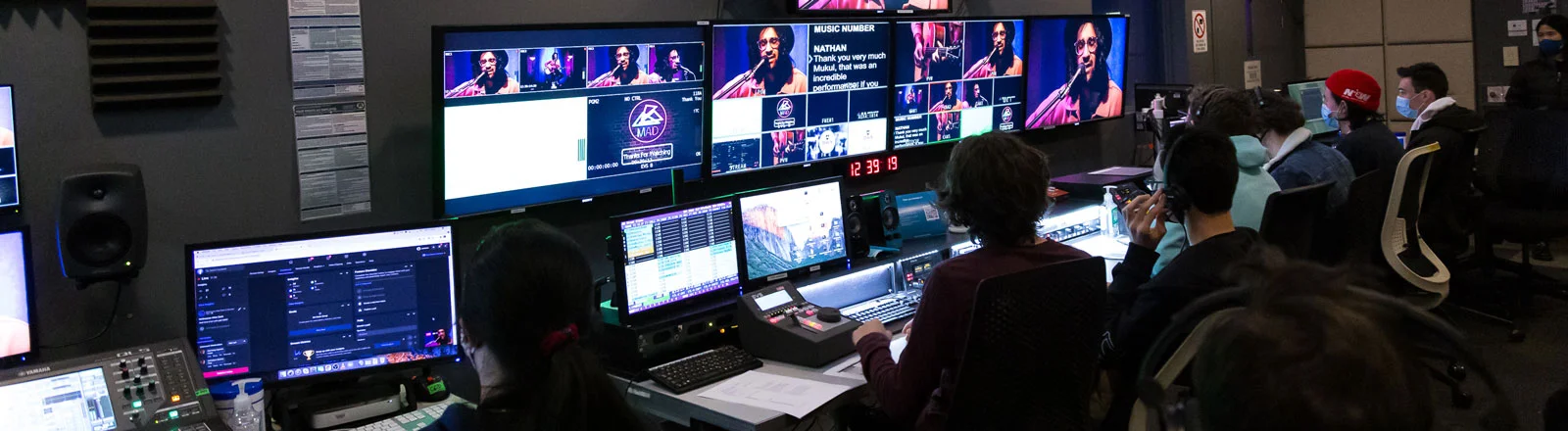

Industry internship in live sports broadcast

Support to showcase your work at film festivals

Virtual production and real-time 3D technology
Why choose film, television and animation at Deakin
Find your creative voice in a supportive and collaborative environment. Discover the art of storytelling on the big and small screen when you study Deakin's Bachelor of Film, Television and Animation. Explore your creative potential in a vibrant learning environment where you are mentored by inspiring academics while work on live-action, virtual production and animated films across narrative, documentary and episodic genres and styles. Immerse yourself in your craft, learn emerging technologies, develop cross-disciplinary critical and technical skills to work across multiple roles.
Unlock your creativity at the #1 Victorian university for facilities in our state-of-the-art learning spaces, including virtual production, television, film and animation studios. Get experience by designing your own internship or choosing from 600+ employers like Melbourne International Animation Film Festival, Melbourne Women in Film Festival, Jam TV and Script to Screen.
-
Industry-leading virtual production
We are one of a few institutions worldwide partnered with Unreal Engine, the gold-standard tool for visual effects, game design, architecture and more.
-
Experiential learning
Crew on sports broadcasts with the Deakin LiveStream OB van, intern on a TV series set or at the Indian Film Festival of Melbourne.
-
Create in Deakin Studios
Learn on industry-grade film, TV, and animation tools, plus access to TV broadcast studio, pro lighting and cameras.
-
Festival-ready portfolio
Be supported to submit work to local and international festivals like St Kilda, Melbourne and Blackbird, New York, and graduate with a creative portfolio.


Connected to industry
Deakin’s strong industry connections help shape your learning. Build practical experience in real workplace contexts through work-integrated learning, mentoring and networking opportunities. Industry advisory boards also help shape our degrees, which means what you study is current, relevant and aligned to what your future employers need.

Deakin puts employability first
Career outcomes
Build your creative and technical skills for careers across film, television, animation and screen media, from production and post-production to broadcast, digital content and freelance creative work.
Videographer
Plan, capture and edit video content for film, television, advertising and digital platforms, combining camera operation, storytelling and post-production skills to create engaging screen content.
- $88k
Typical salary in Australia
- 6.6%
Projected job growth in 5 years


Sound technician
Work in studio or live environments and be responsible for the installation, operation and maintenance of sound equipment.
- $80k
Typical salary in Australia
- 4/5
Job satisfaction

Other jobs
- Animators
- Corporate content producers
- Motion designers
- Editors and colourists
- Screen production crew
- Television broadcast technicians

Key dates

Direct applications
Trimester 3 2026 applications close 18 October 2026
Trimester 1 2027 applications close 7 February 2027

VTAC
FAQs
Yes – every Deakin student can access work-integrated learning (WIL) in their degree. Each year, more than 30,000+ students complete a placement or internship with partners including Microsoft, KPMG, EY and the National Australia Bank. You can access WIL through placements, industry projects, field-based experiences, simulations and global programs, helping you apply your skills and graduate with the experience and confidence employers value.
DeakinTALENT is Deakin's award-winning career service, and you can access it for life – not just while you're studying. From personalised career coaching sessions and AI-enhanced resume support to a jobs and internships board with employment opportunities, it’s designed to give you the career management skills and connections you need to stand out. Every Deakin degree is built with input from employers, so your course is designed around real workplace needs, now and into the future.
Entry requirements and the minimum ATAR vary by degree and are detailed on the degree page, but if your ATAR is below the cut-off, you still have options. Use the pathway finder tool to find the opportunities available to you, including associate degrees and Deakin Guaranteed ATAR, which offers eligible students a guaranteed entry score that's on average 10 points below the lowest selection rank. If you don't have an ATAR, Deakin Uni Ready is a free, supported program designed to build your skills and confidence and open doors to degrees in arts, health, science and business. Access programs and equity schemes are also available.
At Deakin, employability isn't an add-on – it's built in. Our degrees are designed with industry input, so your skills are aligned to what employers actually need. Every Deakin student can access work-integrated learning through opportunities such as placements, internships and industry projects, helping you build your professional network and practical experience before you even graduate. It's an approach that works: nine out of 10 Deakin graduates get a job within four to six months of finishing their degree.
Yes. Most eligible undergraduate students are offered a Commonwealth Supported Place meaning the government subsidises part of your tuition fees. If eligible, you can pay your student contribution using a HECS-HELP loan that you only start repaying once your income is above the repayment threshold. Deakin has scholarships that cater to our diverse student community, ranging from $5,000 per year for high ATAR achievers to $10,000 per year for students facing financial or personal hardship. The University also offers support services including financial counselling, budgeting help and access to short-term, interest-free loans to help you stay on track.
Deakin is the #1 Victorian university for student support and that starts the moment you accept your offer. Orientation is designed to help you feel welcome and get to know your community of classmates and teachers from day one. Across all campuses, there's a vibrant student community with clubs, events and opportunities to build real friendships. Deakin offers a range of services to help students stay healthy and safe, including sport and fitness facilities, free counselling, on-campus medical services and around-the-clock security.
Yes, and it's straightforward. You can transfer to Deakin in a few steps and apply for credit through recognition of prior learning (RPL), so you won't necessarily repeat subjects you've already completed. If you're coming from a TAFE partner, you may get guaranteed entry into second year with guaranteed RPL. Deakin's three-trimester system also means you may be able to start mid-year rather than waiting until March.
Most Deakin courses run across three trimesters per year instead of the traditional two semesters. Trimester 1 begins around March, Trimester 2 around July and Trimester 3 around November, each with roughly 12 weeks of teaching followed by an exam period. This means you can usually start your degree at three different points in the year and have more flexibility to manage your study load. Check the intakes by location section on the course page for details.
Related courses






*Deakin references data from a range of government, higher education and reputable media sources. Learn more about our achievements on our University rankings page, or explore our sources page for supporting references.
What will I study in the Bachelor of Film, Television and Animation?
Build your screen practice step by step, moving from creative foundations to advanced production work and professional preparation. Along the way, complete at least one film, television and animation major, broaden your horizons with a second study area or electives and build career readiness through a dedicated employability sequence.
Find your screen language
Build your screen foundations
Explore how on-screen stories are communicated through image, sound and style. Begin practical work across film, television and animation.
Structure your course choices
Start your major study and pair it with a second study area or electives, so your degree takes on your own creative style from early on.
Start to think like a professional
Early employability learning helps you identify your strengths and map possible creative futures.
Deepen your creative practice
Develop production skills
Take on more ambitious briefs and refine how you plan, create and review screen work across pre-production, production and post-production.
Expand your creative range
Deepen your major studies and invite feedback as you work in teams and grow your peer network.
Grow your industry confidence
Refine your practice to reflect the employability sequence – learn professional skills, enterprise thinking and experience-based learning.
Graduate prepared for industry
Complete advanced screen practice
Sharpen your judgement, technical control and creative independence as you bring together story, form, audience and production craft.
Consolidate your learning
Complete your second sequence or electives, graduating with a depth of knowledge and broadened perspectives.
Get ready for industry
Through employability learning and work-integrated opportunities, you can strengthen your portfolio, professional story and networks before graduation.
Course structure
To complete the Bachelor of Film, Television and Animation, you must pass 24 credit points.
Most units are equal to one credit point. As a full-time student you will study four credit points per trimester and usually undertake two trimesters per year.
Are you a current student? For course information that applies to the year you started your degree, visit the handbook.
All students are required to meet the University's academic progress and conduct requirements
Units
Plus 1 credit point from:
Plus 1 credit point from:
All Bachelor of Film, Television and Animation students are required to complete at least one major sequence from the following list:
Bachelor of Film, Television and Animation major sequences
Students may choose to complete a second major sequence from the following list:
School of Communication and Creative Arts major sequences
- Advertising
- Communication Design
- Dance
- Digital and Social Media
- Interactive and UX^ Design
- Journalism
- Photography
- Public Relations
- Theatre
- Visual Arts
- Writing
^ UX refers to User Experience
Please check the rules of each major sequence to see which units you need to complete to achieve the required credit points.
Refer to the details of each major sequence availability and sequence notes relating to incompatibility.
- 2D practices in the visual arts
- 3D practices in the visual arts
- animation and motion graphics
- brand design
- creative advertising
- creative writing
- dance
- design for social media
- digital media
- film studies
- gender and sexuality studies
- indigenous studies*
- interactive design
- journalism
- literature
- photography
- photojournalism
- professional writing
- public relations
- public relations strategy
- publication design
- screen production
- scriptwriting
- social media
- strategic advertising
- theatre
- technical production
- UX design^
- visual effects and virtual production
^ UX refers to User Experience
Please check the rules of each minor sequence to see which units you need to complete to achieve the required credit points.
Students are advised to refer to the details of each major or minor sequence for availability as some may be offered in campus and/or online mode only.

What to expect while studying
You may be able to study available units in the optional third trimester to fast-track your degree, however your course duration may be extended if there are delays in meeting course requirements, such as completing a placement.
Assessment within the award of Bachelor of Film, Television and Animation varies from written assignments and/or examination to practical and technical exercises and performance. In some units assessment may also include class participation, online exercises, seminar exercises and tests.
Any unit which contains work integrated learning, a community placement or interaction with the community may require a police check, Working with Children Check or other check.
Prepare for your future by getting real world experience and the employability skills to succeed, while completing your degree. The Employability Stream is tailored to support you to be future ready. Deakin’s suite of Work Integrated Learning programs can connect you with internships, social impact programs and opportunities to extend your skills in settings across the globe.
Elective units may also provide additional opportunities for Work Integrated Learning experiences.
At Deakin, we're committed to ensuring an inclusive environment that supports all students to belong, thrive and succeed. We work closely with students, where needed, to identify potential barriers to participation and where possible, provide tailored support so students can engage with learning and assessment activities.
If you are neurodivergent, have a disability, health condition or mental health condition that may impact your study or participation in university life, and want to know how Deakin could support you, contact our Domestic students (opens in a new window) or International students (opens in a new window) or Disability Resource Centre (opens email client) teams for a collaborative and confidential discussion. This discussion is to support you to make plans for your studies and future career and will not have any bearing on your application to the course.
When can I start?
When you study depends on your course, location and available intakes. Check the table to see when you can start and how study is offered throughout the year.
Your course learning outcomes describe the knowledge, skills and capabilities you’ll develop and be able to demonstrate by the time you graduate. Built into your course through your units and assessments, they provide a clear picture of what you’ll be equipped to know, understand and do – preparing you to apply your learning with confidence beyond university.
| Course Learning Outcomes |
|---|
| Employ established screen production genres, forms and styles to compose and design moving images and sound to communicate ideas. Plan and manage screen productions to create media assets using conceptual and narrative approaches aligned with industry standard techniques. |
| Effectively communicate the intent, design approaches and ideas in creative screen productions through written, oral and digital form to a range of audiences. Communicate the process of executing the design of the idea onto the screen. |
| Evaluate and employ appropriate digital technologies for screen genre and forms, and use high level digital film, television and animation production tools to create film, television and animation products to be distributed through a range of digital platforms. |
| Evaluate and synthesise research to develop proposals for screen projects. Critically evaluate existing practices and concepts as a foundation for developing and implementing strategies to execute production work through the stages of production. |
| Apply discipline knowledge and skills along with creative judgement to solve problems that arise in the execution of film, television and animation productions. |
| Demonstrate autonomy, initiative and responsibility, an ability to self-evaluate and manage time and resources to identify, evaluate and research project needs and solutions as a reflective practitioner. |
| Work cooperatively and collaboratively across different production roles and screen forms as part of a diverse team in order to produce screen productions. |
| Work with respect, critical reflection and self-awareness to engage ethically with Aboriginal and Torres Strait Island peoples as well as diverse communities and cultures, within professional, industrial and/or scholarly screen contexts. |
Approved by Faculty Board February 2022
- Award granted
- Bachelor of Film, Television and Animation
- Year
2027 course information
- VTAC code
1400516221 - Burwood (Melbourne), Commonwealth Supported Place (HECS)
- Deakin code
- A351
- Level
- Undergraduate
- Australian Qualifications Framework (AQF) recognition
The award conferred upon completion is recognised in the Australian Qualifications Framework at Level 7
Fees
Estimated tuition fee
$15,126
for 1 yr full-time - Commonwealth Supported Place (CSP)
The estimated tuition (student contribution) fee above is based on a typical first-year full-time enrolment of 8 credit points and is provided as a guide only. Your student contribution is determined by the units you enrol in and will vary depending on the units you choose, your study load, the course duration, and any approved recognition of prior learning. You may also be eligible for a HECS-HELP loan to defer payment of all or part of your student contribution.
Check your eligibility or learn more about CSP or HECS-HELP.
Scholarships
We want to help you excel at Deakin. Our scholarships recognise your dedication and achievements, providing financial support that can ease the cost of living and studying. With less pressure, you'll have more freedom to focus on what matters most – your education and future success.
Applications for 2027 are open
Ready to take the next step? Apply now to start your journey at Deakin and get ready for what’s next.
Key dates
Direct applications
Trimester 3 2026 applications close 18 October 2026
Trimester 1 2027 applications close 7 February 2027
VTAC
Apply now
Apply direct
Simply create an account in the Deakin Application Portal, enter your personal and educational details, upload your supporting documents and submit your application.

Apply through VTAC
Applications are open. Apply through VTAC if you're:
- currently in Year 12 and applying for Trimester 1 or Semester 1
- applying for multiple undergraduate courses
Need help? Follow our step-by-step undergraduate guide to prepare and submit your application.
Indigenous Access Scheme
If you’re an Indigenous student, you can apply for this course through the Indigenous Access Scheme. We recognise a broader range of achievements alongside ATAR and academic results, considering your skills, experience and community work as preparation for university study.
Recognition of prior learning
We value your previous study and experience. Recognition of prior learning enables you to get credit for what you've already achieved. When you apply, we'll consider your previous study and experience for recognition of prior learning.
Not sure if you'll meet entry requirements?
Deakin offers a range of pathways into the Bachelor of Film, Television and Animation to suit your background and goals. Explore the pathways finder to see how previous study, diplomas or alternative qualifications can lead you into the course.