
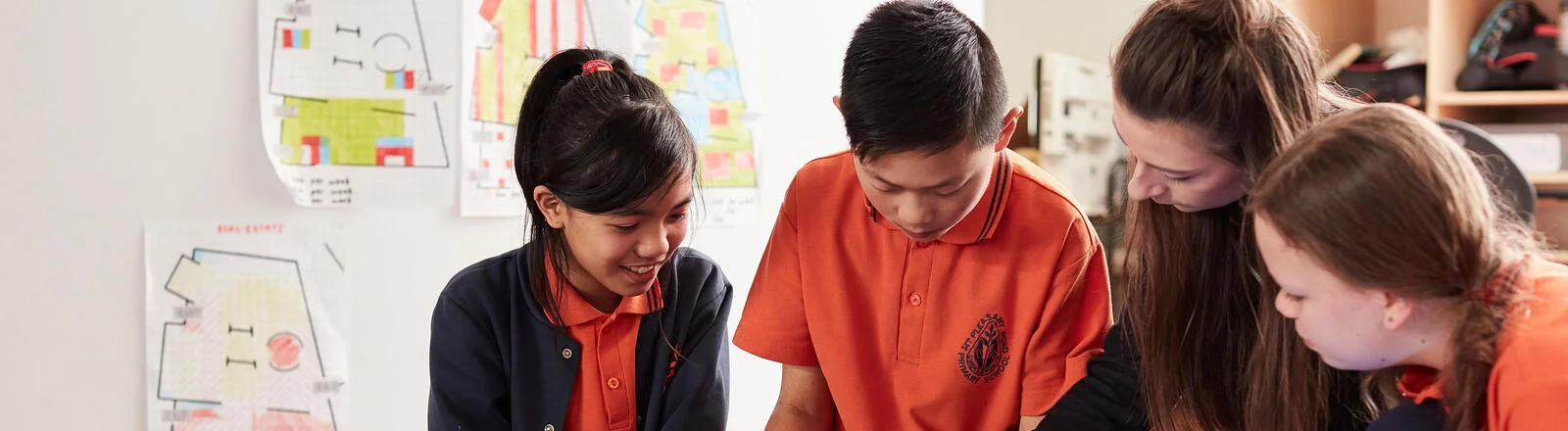

Teaching placements arranged for you by Deakin

VIT-accredited teaching degree

80+ days teaching placements
Why choose education (primary) at Deakin
Build a solid foundation in primary curriculum (foundation to Year 6) with Deakin’s accredited Bachelor of Education (Primary). Graduate in demand and classroom-ready after completing 80+ days of professional placements.
Deakin is ranked #3 in Australia and #13 worldwide for education and educational research. We are also the only university to embed the Berry Street Education Model, a trauma-informed practice, into all our initial teaching degrees. You will build the skills to create safe, healthy and engaging learning environments, and grow positive classroom relationships that support every learner – giving you and your employer confidence.
Learn how to teach across a range of subjects and specialisations from mathematics, science, the arts and literacy. You can also access generous scholarships to help you become a teacher. Achieve a four-year equivalent qualification in only three years of full-time study by completing selected units in Trimester 3.
-
Internationally ranked
We are ranked #3 in Australia and #13 worldwide for education and educational research, reflecting our course quality, leading facilities, academics and graduate outcomes.
-
Australian leader
The only university to offer a three-year Bachelor of Education (Primary) and to embed the Berry Street Education Model’s trauma-informed strategies across all initial teaching degrees.
-
Guaranteed placements
Complete 80+ days of professional placement with one-on-one mentorship in our network of 1,400 schools, plus a Teaching Performance Assessment benchmarked to national standards.
-
Achieve work-life balance
Deakin’s blend of online and on-campus learning means you can balance work, study and personal development.


Connected to industry
Deakin’s strong industry connections help shape your learning. Build practical experience in real workplace contexts through work-integrated learning, mentoring and networking opportunities. Industry advisory boards also help shape our degrees, which means what you study is current, relevant and aligned to what your future employers need.

Deakin puts employability first
Career outcomes
Graduate with practical skills and classroom experience, ready to teach in primary school settings in the public, Catholic or independent education sectors.
Primary school teacher
Educate children between the ages of 5 and 12 using a prescribed curriculum to develop students’ literacy and numeracy skills, and foster social, physical and emotional growth.
- $103k
Typical annual salary in Australia
- 9,200
More teaching roles


Education officer
Develop and deliver learning programs, resources and workshops for schools, communities or public audiences, often in museums, galleries, government or not-for-profit settings.
- $95k
Typical salary in Australia
- 1.32m
Employed in Australia's education sector
Other workplace settings
- Community services
- Government agencies
- Not-for-profit organisations



“The teaching and academic staff at Deakin are exceptional... most of them are still teaching in schools, as well as lecturing and teaching at Deakin. This allows them to be a key asset in what the theory looks, sounds and feels like in a classroom.”
NatashaBachelor of Education (Primary) graduate
Stories that start here



Key dates

Direct applications
Trimester 1 2027 applications close 31 January 2027

VTAC
FAQs
Deakin's Bachelor of Education (Primary) includes a minimum of 80 days of supervised professional placement in primary school settings. Placements are spread across the degree so you can apply what you learn in the classroom from early in your studies. You'll work alongside experienced mentor teachers, developing your own teaching practice in real schools.
The quickest way is to take advantage of Deakin's accelerated learning option, completing the Bachelor of Education (Primary) in three years of full-time study instead of four by enrolling in selected units across all three trimesters – including Trimester 3 in your first and second year. The standard course takes four years, so the accelerated mode saves you a full year without compromising the 80 days of supervised professional placement required to graduate.
Yes, you must complete the Casper test to receive an offer for the Bachelor of Education (Primary). Casper is an online assessment that helps evaluate the personal and professional attributes important for teaching. You can learn more about key dates, eligibility and registration on our Casper test info page.
If you don't meet direct entry requirements, there are several pathways into teaching at Deakin. The Associate Degree of Education can provide a guaranteed pathway. Mature-age applicants may also be assessed on work and life experience. Contact us to explore which pathway suits your situation best.
The Berry Street Education Model (BSEM) is an evidence-based, trauma-informed teaching framework embedded into all Deakin initial teacher education degrees. It equips graduates with strategies to support students who have experienced trauma, building safe and inclusive classrooms. Deakin is the only Australian university to embed BSEM across all its teaching degrees – making our graduates uniquely prepared for the realities of modern classrooms.
Related courses







*Deakin references data from a range of government, higher education and reputable media sources. Learn more about our achievements on our University rankings page, or explore our sources page for supporting references.
What will I study in the Bachelor of Education (Primary)?
Build confidence from the first trimester with at least 80 days of supervised school experience and a specialist focus in the primary curriculum. This four-year degree has an optional accelerated pathway that can be completed in three years.
Build your foundations
Learn how children learn
Explore child development, wellbeing and learning science so you can plan lessons that support diverse learners and build confidence early.
Build literacy and maths confidence
Develop strong foundations in literacy and numeracy and learn how to teach them, alongside core curriculum areas like science and humanities.
Meet teaching requirements early
Complete required academic integrity learning, trauma-informed practice, and literacy and numeracy checks that underpin safe, responsible teaching.
Step into classroom practice
Design effective learning
Plan, teach and assess lessons across Foundation to Year 6, turning curriculum goals into engaging learning sequences and clear assessment tasks.
Manage real classrooms
Practise routines, behaviour support and relationship-building strategies that keep learning on track, even when the day does not go to plan.
Teach the full primary curriculum
Apply practical approaches in maths, science, the arts and health and physical education, linking subject content to how children learn best.
Deepen your impact
Support inclusion and equity
Learn how to differentiate instruction, respond to additional needs and create welcoming classrooms that respect culture, language and identity.
Strengthen assessment decisions
Use evidence to plan, assess and give feedback, sharpening your judgement in literacy and numeracy across the primary years.
Add a specialisation focus
Choose a pathway that builds depth in an area of the primary curriculum, so you graduate with a clear teaching niche and flexibility.
Transition to the profession
Apply your knowledge in practice
Apply advanced pedagogical content knowledge and teach across key learning areas, refining your style through supervised placements.
Demonstrate classroom readiness
Complete the Deakin Teaching Performance Assessment, showing you meet the Graduate Teacher Standards in action.
Start strong and stay well
Prepare for your first teaching role with transition-to-profession learning and practical strategies for teacher wellbeing and career longevity.
Course structure
To complete the Bachelor of Education (Primary), you must pass 32 credit points.
Most units are equal to one credit point. As a full-time student you will study four credit points per trimester and usually undertake two trimesters per year.
Are you a current student? For course information that applies to the year you started your degree, visit the handbook.
All students are required to meet the University's academic progress and conduct requirements
Units
Compulsory 0-credit point units
To be completed in the first trimester of study:
To be completed in the first year of study:
Year 1
Year 2
Year 3
Plus:
- 1 credit point specialisation unit from the table below;
Year 4
English (SP-E359010)
Mathematics (SP-E359009)
Science (SP-E359003)
Humanities (SP-E359004)
OR
and
Physical Education (SP- E359011)
The Arts (SP-E359012)
Professional recognition

This course is accredited by the Victorian Institute of Teaching (VIT) as a nationally accredited course and students are eligible to apply for registration with VIT upon graduation. If you intend to apply for registration in Victoria or interstate you may be required to provide further information.
Applicants are advised to check the registration requirements in their state or territory, carefully.

What to expect while studying
For each unit of study, you are expected to participate in at least three hours of formal contact each week of trimester. A minimum of 6-hours of study time in addition to the formal contact is also expected for each unit each week.
You will complete a minimum of 80-days supervised school experience over the duration of the course, providing hands-on experience in a primary school setting.
Teacher Education Graduation requirements
Students undertaking an initial teacher education course must pass an approved literacy and numeracy test in order to be eligible to graduate and apply for teacher registration. Learn more about the literacy and numeracy test.
Working with Children Check
Students will be required to hold a valid Working with Children (WWC) Check prior to undertaking professional placements as part of this course. Learn more about Working with Children Checks.
Interstate applicants must check the requirements and meet all conditions for undertaking professional experience in schools for their state or territory before undertaking professional experience placements as part of this course.
Inherent requirements
It is expected that all students will be able to abide by, and ensure their behaviour is in accordance with the Deakin University initial teacher education inherent requirements.
Immunisations
Immunisation and/or vaccination requirements will be communicated by the Professional Experience Office in line with the Department of Education and Training's directions at the time of placement.
For further information contact the School of Education, Professional Experience Office.
Typically 150-hours of learning and assessment activities per Deakin credit point (as per AQF Explanation).
Placement can occur at any time, including during standard holiday breaks. Learn about key dates at Deakin.
This course includes 80-days of supervised professional experience, and students must successfully complete the Deakin Teaching Performance Assessment (DTPA)*. This must be complete in the final year of study. Successful completion of this course indicates that a student has met the expected standard of performance for each of the Graduate Teacher Standards. Students who do not pass the DTPA must seek advice from the course director.
Students will satisfactorily complete 80-days of professional experience placement in primary education settings, as outlined below:
ETP103 Foundations of Teaching: Becoming a Professional: 5-day on site professional experience (observation placement) in a primary school, one day in each of the following areas:
- Foundation
- Year 1 or 2 or Year 1/2
- Year 3 or 4 or Year 3/4
- Year 5 or 6 of Year 5/6
- Specialist area/s
ETP104 Foundations of Teaching: Planning for Teaching and Learning: 10-day on site professional experience (placement to be completed in a 2 week block)
For the most up-to-date advice regarding your professional experience (placement) please see here.
Placements for this unit are scheduled across multiple placement blocks. Students will be assigned to one of these blocks and cannot choose their preferred placement window. It is the student's responsibility to ensure they are available for placement at any time within the designated placement periods, as scheduling may occur at any point within these time frames.
Flexibility and full availability during all placement windows is essential for successful allocation and completion of the professional experience.
Please note: Placement periods may take place during or outside standard trimester teaching dates.
ETP200 Classroom Management: 10-day on site professional experience (placement to be completed in a 2 week block)
For the most up-to-date advice regarding your professional experience (placement) please see here.
Placements for this unit are scheduled across multiple placement blocks. Students will be assigned to one of these blocks and cannot choose their preferred placement window. It is the student's responsibility to ensure they are available for placement at any time within the designated placement periods, as scheduling may occur at any point within these time frames.
Flexibility and full availability during all placement windows is essential for successful allocation and completion of the professional experience.
Please note: Placement periods may take place during or outside standard trimester teaching dates.
ETP202 Classroom Pedagogies: 15-day on site professional experience (placement to be completed in a 3 week block)
Placements for this unit are scheduled across multiple placement blocks. Students will be assigned to one of these blocks and cannot choose their preferred placement window. It is the student's responsibility to ensure they are available for placement at any time within the designated placement periods, as scheduling may occur at any point within these time frames.
Flexibility and full availability during all placement windows is essential for successful allocation and completion of the professional experience.
Please note: Placement periods may take place during or outside standard trimester teaching dates.
ETP304 Curriculum, Pedagogy, Assessment and Feedback Practices: 10-day on site professional experience (placement to be completed in a 2 week block)
For the most up-to-date advice regarding your professional experience (placement) please see here.
Placements for this unit are scheduled across multiple placement blocks. Students will be assigned to one of these blocks and cannot choose their preferred placement window. It is the student's responsibility to ensure they are available for placement at any time within the designated placement periods, as scheduling may occur at any point within these time frames.
Flexibility and full availability during all placement windows is essential for successful allocation and completion of the professional experience.
Please note: Placement periods may take place during or outside standard trimester teaching dates.
ETP305 Curriculum, Pedagogy, Assessment and Feedback Application: 10-day on site professional experience (placement completed in a 2 week block)
For the most up-to-date advice regarding your professional experience (placement) please see here.
Placements for this unit are scheduled across multiple placement blocks. Students will be assigned to one of these blocks and cannot choose their preferred placement window. It is the student's responsibility to ensure they are available for placement at any time within the designated placement periods, as scheduling may occur at any point within these time frames.
Flexibility and full availability during all placement windows is essential for successful allocation and completion of the professional experience.
Please note: Placement periods may take place during or outside standard trimester teaching dates.
EPR787 Transition to the Profession 2:
In person attendance at the practical experience in Orientation Week (Waurn Ponds campus) is strongly encouraged for all online students (where practicable, online option will also be available).
Professional Experience:
Students must successfully complete all days of their required professional experience placement as outlined below:
E330, E334, E359, E377: 20-days
E762, E763, E764, E765, E737, E778, E779, D303, D304: 25-days
For the most up-to-date advice regarding your professional experience (placement), policies and calendars please refer to the Professional Experience Office website
Placements for this unit are scheduled across multiple placement blocks. Students will be assigned to one of these blocks and cannot choose their preferred placement window. It is the student's responsibility to ensure they are available for placement at any time within the designated placement periods, as scheduling may occur at any point within these time frames.
Flexibility and full availability during all placement windows is essential for successful allocation and completion of the professional experience.
Please note: Placement periods may take place during or outside standard trimester teaching dates.
At Deakin, we're committed to ensuring an inclusive environment that supports all students to belong, thrive and succeed. We work closely with students, where needed, to identify potential barriers to participation and where possible, provide tailored support so students can engage with learning and assessment activities.
If you are neurodivergent, have a disability, health condition or mental health condition that may impact your study or participation in university life, and want to know how Deakin could support you, contact our Domestic students (opens in a new window) or International students (opens in a new window) or Disability Resource Centre (opens email client) teams for a collaborative and confidential discussion. This discussion is to support you to make plans for your studies and future career and will not have any bearing on your application to the course.
When can I start?
When you study depends on your course, location and available intakes. Check the table to see when you can start and how study is offered throughout the year.
Aboriginal and Torres Strait Islander students can apply directly through the NIKERI Institute
* An optional accelerated course structure is available in this course, allowing students to complete the course in 3-years duration by enrolling into 8 consecutive trimesters. Students undertaking the accelerated course structure are required to enrol in Trimester 3 of the first and second year of the course. All students are advised to seek course advice prior to attempting the accelerated course structure from Student Central.
International students on a student visa who complete the course earlier than the registered 4-year course duration will have their early completions reported to the Department of Home Affairs, resulting in their CoEs updating to ‘Finished’ status. International students who complete the course early are required to either enrol into another CRICOS registered course that is of the same AQF level as their visa was granted for or depart Australia within 28-days from the date of their early completion reporting. International students are advised to seek visa advice by contacting a Registered Migration Agent on the MARA website.
Your course learning outcomes describe the knowledge, skills and capabilities you’ll develop and be able to demonstrate by the time you graduate. Built into your course through your units and assessments, they provide a clear picture of what you’ll be equipped to know, understand and do – preparing you to apply your learning with confidence beyond university.
| Course Learning Outcomes |
|---|
| Acquire broad and coherent theoretical knowledge and understanding of education and the application of this knowledge and skills in teaching and learning, particularly for primary school contexts |
| Engage in appropriately diverse effective interpersonal, oral, written, digital and non-verbal communication with students, their parents or caregivers, colleagues and other stakeholders to demonstrate empathy, develop rapport and build professional teacher/ student/ parent/ caregiver relationships with trust for quality learning and teaching. |
| Select, collect, use and create a range of digital teaching and learning resources and technologies to support student engagement and learning. |
| Critically evaluate and synthesise contemporary research and theoretical perspectives relating to teaching, student learning, and using diverse assessment data to make judgements about the use of appropriate teaching, learning and assessment strategies. |
| Critically reflect on professional practice to generate creative, innovative and authentic solutions to a range of real-world problems encountered in the learning and teaching contexts and professional learning communities. |
| Actively work and learn independently with responsibility taken for professional actions and judgements |
| Work and learn collaboratively with colleagues, other professionals, families and members of the wider community who share responsibility for student learning and their wellbeing. |
| Apply culturally responsive, critically reflective and embodied self-knowledge of decolonial praxis in the design, delivery and evaluation of teaching and learning that honours and respects the educational expectations of Aboriginal and Torres Strait Islander students and diverse learners, families and communities. |
Approved by Faculty Board
- Award granted
- Bachelor of Education (Primary)
- Year
2027 course information
- VTAC code
- 1400314271 - Waurn Ponds (Geelong), Commonwealth Supported Place (CSP)
1400514271 - Burwood (Melbourne), Commonwealth Supported Place (CSP)
1400714271 - Warrnambool, Commonwealth Supported Place (CSP) - Deakin code
- E359
- Level
- Undergraduate
- Australian Qualifications Framework (AQF) recognition
The award conferred upon completion is recognised in the Australian Qualifications Framework at Level 7
Applications for 2027 are open
Ready to take the next step? Apply now to start your journey at Deakin and get ready for what’s next.
Key dates
Direct applications
Trimester 1 2027 applications close 31 January 2027
VTAC
Apply now
Apply direct
Simply create an account in the Deakin Application Portal, enter your personal and educational details, upload your supporting documents and submit your application.

Apply through VTAC
Applications are open. Apply through VTAC if you're:
- currently in Year 12 and applying for Trimester 1 or Semester 1
- applying for multiple undergraduate courses
Need help? Follow our step-by-step undergraduate guide to prepare and submit your application.
Indigenous students
Deakin courses are flexible and culturally inclusive. There are multiple ways you can apply for this course, including through the NIKERI Institute and the Indigenous Access Scheme.
Recognition of prior learning
We value your previous study and experience. Recognition of prior learning enables you to get credit for what you've already achieved. When you apply, we'll consider your previous study and experience for recognition of prior learning.
From 2026, all accredited Initial Teacher Education programs in Australia must deliver mandated Core Content requirements aligned with the AITSL Graduate Teacher Standards, which must be demonstrated within an accredited program for teacher registration eligibility. As the Bachelor of Education (Primary) has been redesigned to meet these national requirements, Recognition of Prior Learning is not available for the Primary teaching units in this course. You can also refer to the recognition of prior learning (RPL) system which outlines the credit that may be granted towards a Deakin University degree.
Not sure if you'll meet entry requirements?
Deakin offers a range of pathways into the Bachelor of Education (Primary) to suit your background and goals. Explore the pathways finder to see how previous study, diplomas or alternative qualifications can lead you into the course.
Pathways
Don’t quite meet the entry requirements for this course? The Associate Degree of Education (E200) can be used as a guaranteed entry pathway into the Bachelor of Education (Primary) and counts as credit towards your first year of study*. You’ll gain a solid foundation of relevant knowledge and be ready to transition seamlessly into your goal degree.
The Bachelor of Education (Primary) provides an approved pathway from the Associate Degree of Education (E200)*. On successful completion of the Associate Degree of Education students are eligible to articulate (or pathway) into the Bachelor of Education (Primary) into the second year of the course.
Applicants who have completed the Advanced Diploma of Rudolph Steiner Education may articulate into the Bachelor of Education (Primary). Applicants are advised to contact the Faculty (details above) for course advice and credit arrangements.
All Applicants into E359 Bachelor of Education (Primary) must complete an additional selection tool for non-academic attributes. Deakin University is using the Casper test. Casper is an online, video-scenario based situational judgement test, designed to measure non-academic suitability for teaching.
* Specific units of study must be completed within E200 for full credit to be granted. You can also refer to the Recognition of prior learning system. We recommend speaking with one of our student advisers before selecting your units. Students are also required to successfully complete the Casper test – an online, video scenario-based test that lets you demonstrate your suitability for a teaching career – as part of the entry requirements for the Bachelor of Education (Primary).